Blog Archives
AAA Publishers Balk While Indie Devs Rock At E3
 Last Wednesday I made my annual pilgrimage to the Electronic Entertainment Expo to check out the new video games coming out this year. Okay, it wasn’t much of a pilgrimage; it was just a short subway ride from my work to the Los Angeles Convention Center, which has been the home to E3 almost every year since the trade show debuted in 1995. However, unlike many trips, it’s the destination and not the journey that matters, for E3 is like the video game industry Mecca, where publishers show off their upcoming releases to retailers and the gaming press.
Except that there seemed like a lot more elbow room in Mecca this year. Activision, Electronic Arts, and Wargaming were all no-shows this year, as was Disney, which is (once again) dropping out of video game publishing entirely. Whereas in previous years South Hall was jam-packed with ginormous booths numbing crowds with sensory overload, this year there were a lot of lounge area and recharging stations in the back of the hall. The reason: retail sales are losing their significance in an era of digital downloads, and there are now many more outlets for promoting games that through the gaming press.
For the publishers that did show up for the party, the games that they were promoting indicated that they were living in glory days of the past: Deus Ex: Mankind Divided, Halo 2, Killer Instinct Season 3, Gears of War 4, Elder Scrolls 5, Civilization 6, Resident Evil 7, and Final Fantasy 15. Now, don’t get me wrong, I loves me some more Civilization and Deus Ex, but I would have liked to have seen something new at the show. The closest the AAA publishers had to anything innovative was in slapping virtual reality onto titles: Batman Arkham VR, Doom VR, Fallout VR Resident Evil VII Biohazard, Star Wars Battlefront: X-Wing VR Mission, and perhaps the best of the bunch, Star Trek: Bridge Crew VR. Now, these are all good indicators that consumer virtual reality will eventually go mainstream, but there was still no killer app that convinced me that I gotta have VR today.
Truth be told, I found the most interesting games not in the multi-million dollar AAA publisher booths, but in the modest IndieCade exhibit. Here are a few of the games that captured my imagination.
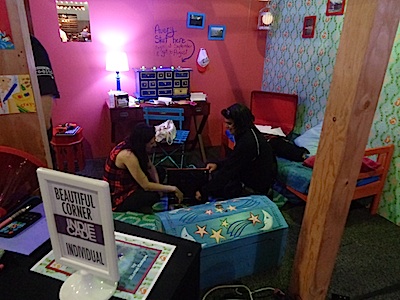
Beautiful Corner is indeed both beautiful and in a corner:the entire game played out in a small, fantastical bedroom. t has a set, and lights and sounds that react to the player’s progress. Two interactive puzzles are used to convey the narrative,a coming-of-age story that plays out through letters, trinkets and postcards from the player’s imaginary friend. It’s moving and sweet, while commenting on the realities of growing up (or not).
The player assumes the identity of a specific character, and is given costuming and props. The player enters the set and explores both puzzles to see how the puzzles relates to the character they are playing. As the player plays through the two puzzles, the set reacts to their progress by lighting and music changes. The experience ends with the player being asked to make a narrative choice on the outcome of the story. After choosing, the player experiences one of two possible endings
Lead designer and artist Martzi Campos created the game as her Master’s thesis in the University of Southern California’s Interactive Media and Design track. Her goal was to create an emotional tone in an interactive space of something besides fear or panic. By creating a single player experience, Campos’ hope was to bring about a higher degree of roleplaying opportunities for the player, bridging the emotional tones of interactive theater with the gameplay of escape rooms and creating a hybrid that sets players up as the main character in their own interactive play.
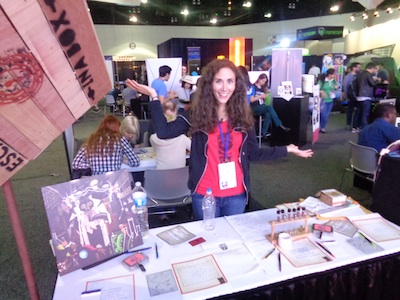
Speaking of escape rooms, I was once hired to write an escape room scenario, and ever since then, I’ve toyed with the idea of creating an escape room in a box that could be sold in retailed stores, like those murder mystery party games. Well, as they say in this business, ideas are a dime a dozen but implementation is everything, and two women beat me to making the idea into a reality.
Ariel Rubin and Juliana Patel are the co-creators of Escape Room In A Box: The Werewolf Experiment, a tabletop gaming experience that crams together all the fun and social interaction of a party game, the event nature of a consumable game and the cooperative spirit and dramatic timed challenges of an escape room. You have 19 puzzles, 3 locks, and 1 hour to save your life! Doc Gnaw has sent you a mysterious box. When you open it, you release a poisonous vapor and need to solve her devious puzzles to unlock the antidote, or you will be forced to join her werewolf army. Unlike boxed “murder mystery” games, Escape Room In A Box consists us to try to capture the physical nature of escape rooms and not have our game consists not of not just pen and paper puzzles but also diverse materials and hidden objects to capture the physical experience of real-life escape rooms.
This game grew out of the duo’s deep passion for escape rooms and at home game nights and their desire to bring them together in a completely new way. Their initial plan is to sell their game at a real-life escape room locations, so that players have an opportunity to bring their experience home with them to play with their friends. I just hope some smart retailers who appreciate the growing escape room craze will offer to carry this product on their shelves, because I would be just one of the first to buy one.
You can learn more here: http://www.escaperoominabox.com/.
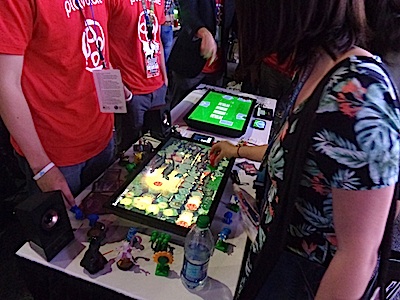
A tabletop game can be a lot of fun, but how about a thousand? PlayTable is a tabletop console system designed to let you play any number of board and card games without fiddling with rulebook and hour-long set-ups. The system consists of a full-HD 1920x1080p monitor that’s impact-resistant and waterproof, software compatible with any Windows-based laptop (future compatibility with Mac and iOS), and a set of standard pieces, cards and stickers. The system also comes with a recommendation engine allowing you out new games and find the perfect one for game night. It even includes a construction kit allowing you to make your own games using your existing game and toy pieces such as Infinity, Skylanders, and Amiibo figurines. However, at $599, the price of admission is steep.
You can find out more at http://playtable.xyz/.
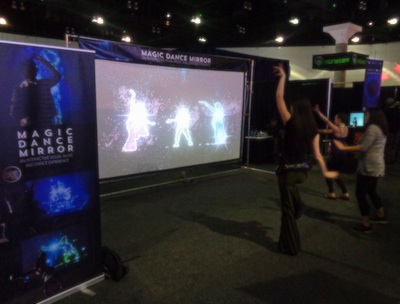
Magic Dance Mirror is an interactive visual music and dance experience created by game developer Kinetic Magic, a seven-person team assembled by Game Director Kyle Ruddick. It uses a Kinect motion sensor to track player’s movement and create a stylized mirror image of those using it onto a giant screen filled with neon starbursts that reacted to their dancing.
The concept was inspired by Burning Man and the immersive art there.The goal is to primarily explore and let players’ own movements and sounds entertain them and spectators. The Magic Dance Mirror is designed to be fun for all ages and promote exercise and healthy self-expression. Not a typical game in tat there is no way to “win” or “lose”, Magic Dance Mirror was built for clubs or large parties, but thankfully not to the home living room, where my spastic attempts at dancing would result in all my furniture being trashed.
You can learn more here: http://www.magicdancemirror.com/.

From time to time I get on my soap box and talk about the need for more female game developers, and so I was really pleased to come across an exhibit for the book #Feminism: A Nano Game Anthology. Written by feminists from eleven different countries, #Feminism offers bite-sized takes on contemporary feminist issues. Each of the 34 analog nano-games (games that can be played in less than an hour, explained exhibitor Whitney “Strix” Beltrán) in this collection requires between three and five participants, and simple (if any) props.
The games range from silly to serious, including scenarios about selfies and rom-coms as well as reproductive rights and domestic violence. And of course, enjoyment has no ideological boundaries–there are games here for participants new to feminism as well as those experienced in making gender arguments on the internet. The book is available for sale via Indie Press Revolution.
You can learn more at https://feministnanogames.wordpress.com/.
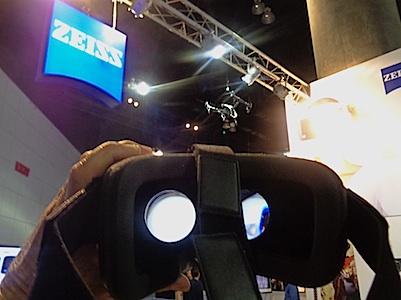
Virtual reality was as popular among the indie games as they were with the AAA games, but the experience that most captured my imagination was not a game at all. The Zeiss booth featured a pair of their VR One Plus virtual reality headsets controlling and receiving camera images from drone suspended from above. The headset could only control the camera (you would need a second person to control the drone’s flight), but with the very lightweight headset (essentially a pair of lenses on which you mount a smartphone running the virtual reality software) and heads-up display, I felt like Iron Man flying above the South Hall exhibits.
You can find out more at http://vrone.us/flyfpv.
Maybe the reason I didn’t describe too many video games is that it’s a sign the E3 organizers need to rethink what their show is all about. Fun is fun no matter how you get it, and in a year when doing the same ole, same ole just isn’t cutting it, I’m tipping my hat to the innovators who are thinking outside the console box.
Augmenting Reality at the USC GamePipe Lab

Twice a year I attend demo days at the University of Southern California’s GamePipe Showcase to see what game engineering students in the world-renowned USC Games program have accomplished. This semi-annual event features the work of multidisciplinary, collaborative teams of programmers, artists and game designers, who demonstrate to event attendees the games they conceived, designed and built for various platforms, including work from USC’s mobile, networked artificial intelligence, immersive and advanced games courses. The event introduces students to host of industry scouts who may purchase and produce the games for mass audiences, as well as hire program graduates to develop the games of the future.
Last week I attended the Spring Showcase event hosted by USC Viterbi School of Engineering Professor Mike Zyda at the USC GamePipe Laboratory EGG-Building, where the culmination of more than a year’s worth of student teams’s collaboration, creativity and engineering is presented. This time I was particularly interested in augmented and virtual reality projects because these are hot topics in game design right now, USC has been in the forefront of virtual reality development (former GamePipe Lab instructor Laird Malamed is now Chief Operating Officer of Oculus VR, developers of the Oculus Rift VR headset) and I happen to be doing some consulting with a client in those areas.
Here are some of the projects that captured my attention last week.
Dragon Runner
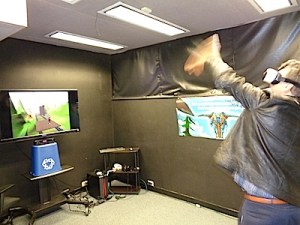
Your camp has been overtaken. Fire and ash overwhelm the camp. The only thing between you and freedom is a few miles of train track…and a huge, menacing dragon! Dragon Runner VR is a virtual reality game developed using the Samsung VR Gear and Microsoft Kinect, allowing players to step into a 3-D virtual world where they must dodge under bridges, dart around rocks, and skillfully move around their cart as you escape the fireballs. I managed to get in my day’s exercise by dodging obstacles, crouching to avoid low-hanging barriers, and using my arms to fling fireballs at scaly enemies.
The five-person student team that developed the game have formed a company to make a meaningful impact in the emerging virtual reality and immersive environment platforms. You can learn more about the team and their projects on the Void Dimensions website.
TikiPong
 This multiplayer game for mixed reality platforms simulates a traditional beer pong match against an opponent. Developed by a team of seven for USC’s Advanced Mobile Devices and Game Consoles class using Project Tango, which brings spatial perception to Android devices through advanced image processing techniques and special vision sensors, TikiPong features trippy visual effects to simulate drunkenness and add gameplay elements that are not found in traditional beer pong.
I found this game to be a lot of fun to play. Players move their fingers along the left edge of the screen to set the trajectory and force of a ball so that it flies through a floating hoop and into a beer bottle for points. Seeing your opponent in the game’s background adds to the social and immersive experience of the game. To find out more about the game and the team that developed it, watch this YouTube video.
ZombieEscape VR
 This zombie apocalypse virtual reality game was developed for iOS and Android using Google Cardboard. The story premise is that a global viral pandemic wipes out over 80% of the world population, causing the dead to rise and feed on the living. Players travel automatically through their environment and must shoot zombies coming towards them using three choices of guns : pistol, rifle, fire gun. Players can change weapon by looking down and clicking the menu. Different guns cause levels of damage to zombies. Players can also shoot the power-up packages to recover their health.
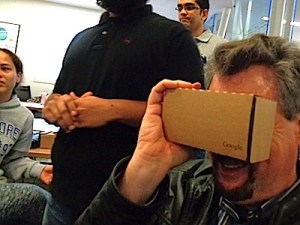
I found using the Google Cardboard, which is a VR headset quite literally made from cardboard into which a mobile phone running the game is mounted, to be a much more enjoyable and immersive experience than heavier headsets like the Oculus Rift. Yet while I liked the zombie apocalypse theme, I would have preferred more freedom of movement than this rail shooter game provided.
ZombieEscape VR was developed by a six-person team lead by Saksham Kashyap over a three-month period. You can learn more about the game and the team that developed it by visiting its website.
As always, the creativity and technical prowess of the USC Games students was impressive, and it was exciting to see how these kids are bending our reality to create a new gaming future.






 David Mullich