Blog Archives
Designing A Good Game Is About More Than Making It Difficult: Complexity, Depth and Balance
 No matter what assignment I give my novice game design students, whether it be about experience design, core mechanics, or game narrative, they invariable turn in a game with the difficulty cranked up so high that not only does it obscure the concept I wanted them to demonstrate, I can’t even play it for more than one second. When I ask them why they did that, it was clear that they thought that making a game difficult was the most important consideration when designing a game.
Difficulty is the amount of skill a player needs to have to achieve the game’s goals. Achieving goals should generally require some amount of difficulty, otherwise there is no challenge to make goal achievement satisfying. However, that difficulty may require mental or dexterity skills, depending on the game’s genre, and casual games require only a low amount of difficulty while hard difficulty is reserved for games made specifically for hardcore gamers.
Closely related to difficulty is complexity. Complexity is the number of game rules or other objects with which the players to achieve the game’s goals. For example, a cluttered or non-intuitive interface displaying critical information a player needs to process to progress may make a game overly complex. Similarly, a goal that requires the player to take a hundred different actions in the right order successfully, even if each of those actions require very little skill to do, is also complex. However, the goal of hitting a hole-in-one in golf is simple, even if the action itself is difficult for many players.
Depth is a measure of how enjoyable a game is even as one’s skill improves. This metric is directly related to the number of interesting decision the player can make while attempting to achieve the game’s goals. For example, Tic-Tac-Toe has very few rules and very few decisions, so it a game with both low complexity and low depth. Chess has a few more rules and elements, but has many interesting decisions, so it has moderate complexity and very high depth. Monopoly even more rules and elements than chess, but relatively few interesting decisions. Dungeons & Dragons is an extremely complex game with many books of rules, but arguably has less depth than Chess.
Perhaps the number one rule of game design is that games should be easy to learn but difficult to master. This means that a game should ideally be of high depth but low complexity. This depth-to-complexity ratio is called elegance and is what many game designers strive to achieve as their measure of what makes a good game.
Yet other game designers such as myself consider engagement is the most important factor of a good game design. Engagement is how mentally and emotionally immersed the player is in a game. Engagement depends on many factors — the clarity of a game’s goals, the feedback the player receives about whether he or she has performed actions successfully, the appeal of the player’s reward for achieving the goals — but perhaps the most critical factor is balance.
Balance in multiplayer games means that all players have an equal opportunity to win given their starting positions and abilities, but across all types of games it also refers to whether the difficulty of a game’s challenges is appropriate to a player’s skill level. If a challenge is too difficult, then the player will feel frustrated, but if it is too easy, the player will feel bored. Either of these two extremes can cause a player to quit the game.
The thing that many novice game designers fail to understand is that when players first play a game, they are very unskilled at that game, and so the difficulty needs to be appropriately low. The complexity also needs to be low when they first play the game so that they aren’t overwhelmed by too many rules and other information.
As players gain more experience playing your game and improve their skills, then the game designer can increase both the difficulty and the complexity. And once the player’s have mastered the game’s most difficult challenges, there hopefully is sufficient depth in the game so that they will return to play it again using different techniques and strategies.
Crayons, Circles And Diamonds Inspire Games At The Fall 2016 Bill Hart Merit Badge Midway
 This Saturday I again volunteered at a local merit badge midway to run a workshop for the game design merit badge that I helped to create for the Boy Scouts of America. To earn this merit badge, the scouts not only have to create a game of their own design, but also engage in the process of playtesting and redesign for at least three iterations. Now, the average merit badge takes about ten hours of a scout’s time to complete, and Game Design is no exception. So, in my three-hour workshop, I help scouts to either get started on the merit badge or to finish it up. And therein lies a problem: how to deal with a dozen scouts at different stages during the limited time I have with them.
This time, I decided to try something different. Although I did my normal process of doing a “classroom lecture” about the elements of a game, different types of play value, game design terms, and intellectual property protection, I broke up the lecture into four segments for the scouts who were just starting their merit badge, this time I had these scouts do playtesting between the segments for the scouts who had already completed their games. This had the double benefit of breaking up the lecture for the scouts starting their merit badge, while providing playtesters for the scouts who were finishing up. And overall, it worked quite well.
To playtest a game in my workshop, scouts must first contact me with a vision statement, play value description, and initial set of rules for a game they want to make, and if I approve it, they can proceed with making a game to bring in. Only three scouts did the prerequisites this time, but the rest who attended the workshop got to playtest their games.
Here were the games that we playtested.
Crayon Wars
 Vision Statement: Crayon Wars is a free-for-all party game where players uses crayons as money to defeat the opponent. The game has play value of challenge because you have to practice to be better. It has stimulation because it is exciting and threat because you are challenging each other and it is fun to play
Set-Up: Each player is given 2 crayons for lives and two crayons for buying stuff.
Progression: Players take turns moving play around the circle to the left
The first player can buy something or skip and save up for later. Each turn players get 2 crayons for money. You can also attack after the first round.
There are 12 items you can buy
- plane 2
- helicopter 3
- army men 4
- bazooka 5 strong against planes +1 crayon
- 5. jet 5
- health pack 6 plus 2 health
- take it 7 2 crayons health taken away
- tank 8
- hill 9 stops tank
- Godzilla’s wife 10 stops Godzilla
- Godzilla 11 defeats volcanoes
- volcano 12 +2 crayons every turn
To attack, you pick a token to attack with. It damages the other player’s token or their health the value of your token and your token will go down in value the amount of damage you did. You can attack the other players health after attacking all of their resources.
Resolution: The game ends when someone’s health goes to zero.
Around
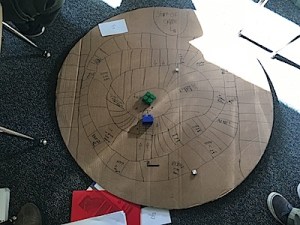 Vision Statement: Around is a free-for-all board game for 2 to 4 players in which players roll dice to move along a circular path to reach the end.
Set-Up: Players place their pieces at the Start, receives $50 in play money, and then rolls the dice to determine who goes first.
Progression: The game is played in turns.
- The player rolls the dice to find out the number of turns to move.
- After rolling the dice, the player moves that number of spaces anywhere on the game board.
- Some spaces will take or give money to the player.
- The player must move the exact number of spaces to reach the Finish.
Resolution: The game ends when one player reaches the Finish.
Diamond Dreams
 Vision Statement: Diamond Dreams is a Minecraft-themed board game for 2 to 4 players in which players try to reach a diamond block that rules everything.
Set-Up: Players place their character in one of four gray boxes around the edge of the board and are given 10 health points. Players role a die to determine who goes first.
Progression: The game is played in turns.
- Each player rolls a die to determine the number of spaces to move.
- The player can move only left, right, or forward.
- Some spaces have special properties:
- Lava: Lose 7 health points
- TNT: Lose 8 hit points
- Creeper: Lose 5 hit points
- Hole: Returns player to start
- Armor: Adds 5 hit points
- Wolf: Lowers damage done by monsters by half.
- If the player looses all of their hit points, they return to the start and regain them.
Resolution: The game ends when one player reaches the Diamond.
Of the three games, I’d say the scouts most enjoyed Diamond Dreams. It had the best presentation, the most complete rules, and the greater depth of game play. Of course, earning a Game Design merit badge is not about creating the best game, but learning what it is like to be a game designer — that the game does not end with the initial design, but is refined and polished based on the experience of the players who are playing the game.