Category Archives: Game Design
The Process of Writing Adventure Games
 When I first enrolled in college, my plan was to major in film production. That was until I discovered the computer and its power for creating interactive stories. So, you can understand why my favorite game genre is adventure games. I’ve designed and/or developed a number of adventure games throughout my career and I’ve approached their design through a number of ways.
Inspiration for a game can come from anywhere — personal experience, a topic of interest, a book or movie license, even a dream. But usually in the really of videogame development, you make the game you’re told to make.
The very first adventure game I designed (back in 1979) was based upon the British television show The Prisoner. The ideal way to design any genre of video game is to start with the player experience — determining how the player should feel while playing the game — and that’s how I began the design of this game. I wanted my game to recreate the same experience I had when watching the show: the experience of being in a menacingly-cheerful, surreal environment in which you were constantly monitored and controlled, where every opportunity was a deception and every move you made sent you back to square one, and yet by assertion your individuality and refusing to follow the rules, you could ultimately succeed.
I then invented game mechanics to create the game experience, and you can read in detail about how the gameplay works in the Wikipedia article about the game. The final step in the design process was to write the story exposition and dialog to support the both the play experience and game mechanics.

Another popular adventure game I designed and produced was I Have No Mouth, and I Must Scream. The game was based on Harlan Ellison’s classic short story about the last five human survivors of a world war waged by three computers from the world’s superpowers, and how the computers merged into one entity, AM, and tortured these poor unfortunates for eternity. We paired Harlan with a game writer, David Sears, who asked the question, “Why were these particular five people chosen?” and from there they created a new, vastly expanded version of the story that told the backstories of each of these people.
Once I had a story to work from, my next step was to find a game developer with a game engine suitable for developing an adventure game, and that lead me to hiring The Dreamers Guild to do the programming and artwork because they had created a suitable game engine for their game Faery Tale Adventure. I then created a series of puzzles that would unveil various pieces of the story and work with the mechanics of the game engine we were using, as well as expanding the dialog to provide hints for those puzzles. In fact, I wound up writing almost half the game’s dialog myself to support the game’s puzzles, and since my infant son was undergoing chemotherapy at the time (he’s fine now), I had no problem putting myself into a sufficiently black mood for writing dialog to match the nightmarish scenario.

The most recent adventure game I designed (in 2012) was for a client who simply told me, “I want a game about the prophesied end of the world in 2013.” The client wanted to use a game engine similar to some mystery games he directed me to on the web, and so I decided to start by writing a story about a teenage girl whose father, a pilot, went missing in the Bermuda triangle and her investigation to find out what happened to him leaders her to archeological sites throughout the world, where she discovers artifacts that will allow her to thwart and alien invasion that was prophesied to occur on December 21, 2013.
I collected lots of photographs of the places that our heroine would visit and researched the ancient civilizations whose artifacts she would uncover, and that inspired me to create the details of the world and the puzzles that needed to be solved. Unfortunately after I handed my game design off to the client, someone decided to turn my Amelia Earhart-inspired heroine into a bubbly tourist just looking for some fun in the sun while in Bermuda, but that’s the way game development goes sometimes — just as in movies, the writer doesn’t always have final say! I’ve never looked at the final version myself, but if you are interested, you can download it here.

In conclusion, I’ve written adventure games beginning either with the player experience, the story, or with the game engine or mechanics as my starting point. While I prefer beginning by defining the player experience, it is critical to have all three elements support each other regardless of the starting point, as should the puzzles and dialog.
Player Types and Game Mechanics
 On Saturday evening I taught a session of my introductory game production class at the Los Angeles Film School. I don’t normally teach on Saturdays, but we postponed a Tuesday night class to the weekend because that night I had been invited to give a lecture about Gamification and Learning to an Educational Technology class art Loyola Marymount University. So, this was one of those times when work spilled over into the weekend.
My Saturday lecture was about the human motivations that game designers tap into to make games engaging, and how designers should first determine what motivations they want the player experience to satisfy and then select devise the game mechanics that will create that play experience. (Novice game designers will often start planning a game based around game mechanics without consideration to the player experience, and that can lead to an unsatisfactory play aesthetic.)
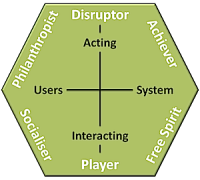
For the lab following the lecture, I decided to have my LA Film School students do a gamification exercise similar to what I did for the LMU class earlier in the week. Not only did I think the exercise would be an good way to focus on the link between player motivations and game mechanics without the distraction of other game elements, but it gave me an excuse to use Andrzej Marczewski’s Gamification Inspiration Cards again.
I had my eight students that night break up into two teams of four, and each had to create a gamified system for solving one of several business problems I offered to them. Team One chose the task of training security guards to protect a building, and Team One selected the task of improving membership at a Health Club.
 My student’s next step was to create a three-stage “User Journey” for their system’s uses. Team One decided to have their security guards get started by entering into a training session; once guards were able to attain an 80% score on a Standard Operating Procedure test, they would then be assigned to the lobby station, where they had to check the ID’s of people entering the building; and if the guards were able to catch three “ringers” who had false ID’s, the guards were promoted to making security rounds throughout the building.
Team One elected to pursue Players, who are motivated by rewards. This is the gamified system they devised:
- Onboarding: New guards would take a series of tests on Standard Operating Procedures. They would receive achievement badges for answering various categories of questions correctly, and for each badge they earned, they could enter a lottery for winning prizes. If the trainees answered 80% of their test questions properly, they would move on to the next phase.
- Habit Building: After passing training, guards would be stationed in the lobby, where they would check employee ID’s. However, to test the guards’ diligence, “ringers” would occasionally arrive with false ID’s. The narrative provided to the guards that these were Ninjas who were trying to infiltrate the building. Guards who spotted the “Ninjas” with the false ID’s would be recognized on a leaderboard, and if they spotted 3 Ninjas, they would move on to the final phase.
- Mastery: Guards who graduated from the lobby station were assigned to patrol the building. They worked under a time limit mechanic for completing their rounds, and if they did, they would receive rewards, such as vacation time.
 Team Two created a User Journey in which health club members were on-onboarded by filling out a membership form; they then developed the habit of visiting the health club through incentives for using the basic equipment; and when they achieved mastery, they were able to use the advanced equipment.
Team Two elected to pursue Achievers, who are motivated by Mastery. Achievers are looking to learn new things and improve themselves; they want challenges to overcome. Here is the gamified system they devised:
- Onboarding: New customers would be recruited through signposting via advertising. Once they come into the location, they would be shown tutorials about using the equipment.
- Habit Building: After signing, new customers would be allowed to use the Basic exercise equipment. As they gained experience with the equipment, they would gain points and level up to new ranks. Upon receiving a certain rank, they would move on to the final stage.
- Mastery: Customers who achieved mastery with the Basic equipment would be allowed to use Expert equipment. They would earn achievement badges for repeated use of categories of equipment, but if they failed to come into the club regularly, they would lose the right to use the Expert equipment and have to go back to the Basic equipment until they regained their rank.
Team One elected to have a single spokesman to “pitch” their gamification proposal to me, whereas Team One presented their proposal as a team effort. However, both did an excellent job and earned a full 100% grade for the assignment, and I think they learned about the importance of finding the right game mechanics to motivate different types of players.
What impresses me most about this assignment is that even though they are Game Production (and not Business or Marketing) students, my students always seem to enjoy gamifying a business problem. But perhaps I shouldn’t be surprised. After all, gamification is all about finding the fun in a non-game activity.






 David Mullich