Category Archives: Game Design
Why Do We Play Games?
 We play games because they’re FUN!
Duh!
Okay, okay. That’s not much of a blog post, so we can’t stop there. Let’s take a close look into what makes games fun to play.
Game designer Horst Streck describes fun as “the enjoyment of pleasure.” So, not only does an experience have to be pleasurable to be fun, one has to actively enjoy it. That is, one needs to be receptive to the pleasurable sensations. For example, a shoulder rub can be very pleasurable at times. But if someone tries to rub your shoulders when you’re trying to concentrate on a frustrating, time-sensitive task, you may find the experience annoying. For you to enjoy the sensation, you have to be a willing participant. No one can make you have fun; you need motivation to be receptive to fun.
MMO game pioneer Professor Richard Bartle, famous for the defining the Bartle Player Types in virtual worlds, says that when we play a game, we experiment with four main motivations:
- Achievement: Trying to get more points
- Immersion: Imagining oneself in the game world
- Competition: Trying to defeat opponents
- Cooperation: Working together as a team
Bartle is also famous for describing the four Bartle Player Types he’s identified in virtual worlds – Achievers, Explorers, Killers, and Socializers – suggesting that each of us finds different things to be fun.
Now, Bartle has said that his model only applies to players in multi-user dungeons, but different game designers have different models for what players find to be fun. Game Designers use the term “play value” for the reasons why a particular player enjoys playing a particular game. XEODesign CEO Nicole Lazzaro describes what she calls the Four Keys of Fun for describing the play value of a game:
- Easy Fun (Novelty): Curiosity from exploration, role-play, and creativity.
- Hard Fun (Challenge): Fiero, the epic win, from achieving a difficult goal.
- People Fun (Friendship): Amusement from competition and cooperation.
- Serious Fun (Meaning): Excitement from changing the player and their world.
A game such as Dungeons & Dragons might be fun to some people due to its Novelty aspect, according to Lazzaro’s Four Keys, while Tetris provides hard fun through Challenge.
Again, this is but one of several theories as to why we play games.
The landmark paper MDA: A Formal Approach to Game Design and Game Research written by game designers Robin Hunicke, Marc LeBlanc and Robert Zubek in 2004, divided aesthetics within games into eight categories:
- Sensation: Game as sense-pleasure
- Fantasy: Game as make-believe
- Narrative:Game as unfolding story
- Challenge: Game as obstacle course
- Fellowship: Game as social framework
- Discovery: Game as uncharted territory
- Expression: Game as soap box
- Submission (or Abnegation):Game as mindless pastime
According to the paper, when game designers create games, they tend to focus on the actions of a games first. When the player performs that action and interacts with the game, they experience the dynamic of that interaction, which in turn produces aesthetics, or emotions, for the player. Hunicke and her colleagues recommended that game designers should first determine what aesthetics they want for the player and then determine the mechanics that will elicit those feelings.
Gamification designer Victor Manrique, proprietor of the Epic Win Blog, writes that the specific reason that people play games is that games allow them to experience emotions that are closely related to the main factors of happiness. Thus, we play games because they make us happy. So, we again have to ask a question: what is happiness?
Psychologist Martin Seligman provides the acronym PERMA in his book Flourish: A Visionary New Understanding of Happiness and Well-being to summarize the factors that seem to make people happy:
- Pleasure: tasty food, warm baths, etc.
- Engagement (or flow): the absorption of an enjoyed yet challenging activity
- Relationships: social ties have turned out to be extremely reliable indicator of happiness
- Meaning: a perceived quest or belonging to something bigger
- Accomplishments: having realized tangible goals.
In another book, Game On, game designer John Radoff, lists 42 things that are fun, and mostly all of them involve emotions that are related to a PERMA factor. Here are a few:
- Relaxing: Pleasure
- Competition: Engagement
- Organizing Groups of People: Relationships
- Improving Society: Meaning
- Triumph Over Conflict: Accomplishments
Dr. Steven Reiss, Psychology and Psychiatry professor emeritus at the Ohio State University, categorizes our motivations in even finer detail by describing 16 different human motivators and their object of desire. If we were to take Reiss’ work and associate these objects of desires with the goals in a particular game, we can come to the conclusion that when we play, it seems that our motivations for playing are closely linked to our general human motivations.
- Power: Influence (Balance of Power)
- Curiosity: Knowledge (Civilization)
- Independence: Self-reliance (Oregon Trail)
- Acceptance: Being part of a group (Guild Wars 2)
- Order: Organization (Tetris)
- Saving: Collecting things (Farmville)
- Honor: Loyalty (Football)
- Idealism: Social justice (Amnesty the Game)
- Social Contact: Companionship (Pictionary)
- Family: Raising children (The Sims)
- Status: Social standing (World of Warcraft)
- Vengeance: getting even (Angry Birds)
- Romance: Sex and beauty (Leisure Suit Larry)
- Physical Activity: Exercise (Twister)
- Tranquility: Emotional calm (Candy Crush)
- Eating: Food (Pac-Man)
Don’t snicker! I once had a girlfriend during the Golden Age of arcade games who loved (healthy) eating, and she told me in all seriousness that the reason why she enjoyed playing Ms. Pac-Man is that as she watched the character consume dots, it satisfied her urge to eat!
Of course, many players can’t explain well why we like to play a particular game as well as my ex-girlfriend could, so game designers will look towards Behavioral Psychology and other models to better understand why certain aspects of a game appeal to particular players.
Ubisoft Creative Director designer Jason VandenBerghe turned to Behavior Psychology – specifically to the Big Five personality traits – for a talk he gave at the 2012 Game Developers Conference. In this talk, called “Domains of Play”, he presented the five elements of a game that appeal to primary human motivations.
- Novelty: Distinguishes open, imaginative experiences from repeating, conventional ones. Some games, such as World of Warcraft, rely on surprises and fantasy for providing fun, whereas for others, like Trivial Pursuit, the fun is in recalling known facts about the real world.
- Challenge: Determined by much effort or self-control the player is expected to use in order to achieve the game’s goals. Some games, such as Tetris, are fun because they are so challenging, whereas others, like Solitaire, the fun is that they are mindless pastimes.
- Stimulation: Specifies is the emotional element and social engagement of play. Games like Pictionary can be fun to play because of the humor and excitement of interacting with your friends, whereas others, like Chess, are more cerebral enjoyment.
- Harmony: Reflects the rules of player-to-player (or game system) interaction and whether the goal of the game is to harm or to help. Doom is fun to play because you are trying to harm the other players, whereas the fun in SimCity is in building a city.
- Threat: Reflects the game’s capacity to trigger negative emotions in the player. Games like Poker can be fun to play because of the risk of losing, but other games, like Candy Crush, are fun to play because you simply progress forward without ever losing.
As you can see, game designers put a lot of thought into determining just what makes games fun to play because it helps them to figure out what is wrong when playtesters report that there game is not fun at all. There are a lot of different models and theories as to exactly what different people find fun. Anyone interested in game design should keep current on the research into this topic, because you never want to be in the position of saying “Duh”, when your development team, or your marketing person, or your boss asks you why players will want to play your game concept.
Augmenting Reality at the USC GamePipe Lab

Twice a year I attend demo days at the University of Southern California’s GamePipe Showcase to see what game engineering students in the world-renowned USC Games program have accomplished. This semi-annual event features the work of multidisciplinary, collaborative teams of programmers, artists and game designers, who demonstrate to event attendees the games they conceived, designed and built for various platforms, including work from USC’s mobile, networked artificial intelligence, immersive and advanced games courses. The event introduces students to host of industry scouts who may purchase and produce the games for mass audiences, as well as hire program graduates to develop the games of the future.
Last week I attended the Spring Showcase event hosted by USC Viterbi School of Engineering Professor Mike Zyda at the USC GamePipe Laboratory EGG-Building, where the culmination of more than a year’s worth of student teams’s collaboration, creativity and engineering is presented. This time I was particularly interested in augmented and virtual reality projects because these are hot topics in game design right now, USC has been in the forefront of virtual reality development (former GamePipe Lab instructor Laird Malamed is now Chief Operating Officer of Oculus VR, developers of the Oculus Rift VR headset) and I happen to be doing some consulting with a client in those areas.
Here are some of the projects that captured my attention last week.
Dragon Runner
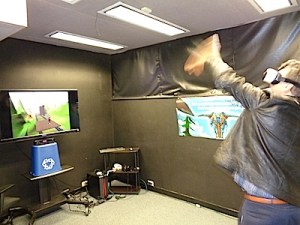
Your camp has been overtaken. Fire and ash overwhelm the camp. The only thing between you and freedom is a few miles of train track…and a huge, menacing dragon! Dragon Runner VR is a virtual reality game developed using the Samsung VR Gear and Microsoft Kinect, allowing players to step into a 3-D virtual world where they must dodge under bridges, dart around rocks, and skillfully move around their cart as you escape the fireballs. I managed to get in my day’s exercise by dodging obstacles, crouching to avoid low-hanging barriers, and using my arms to fling fireballs at scaly enemies.
The five-person student team that developed the game have formed a company to make a meaningful impact in the emerging virtual reality and immersive environment platforms. You can learn more about the team and their projects on the Void Dimensions website.
TikiPong
 This multiplayer game for mixed reality platforms simulates a traditional beer pong match against an opponent. Developed by a team of seven for USC’s Advanced Mobile Devices and Game Consoles class using Project Tango, which brings spatial perception to Android devices through advanced image processing techniques and special vision sensors, TikiPong features trippy visual effects to simulate drunkenness and add gameplay elements that are not found in traditional beer pong.
I found this game to be a lot of fun to play. Players move their fingers along the left edge of the screen to set the trajectory and force of a ball so that it flies through a floating hoop and into a beer bottle for points. Seeing your opponent in the game’s background adds to the social and immersive experience of the game. To find out more about the game and the team that developed it, watch this YouTube video.
ZombieEscape VR
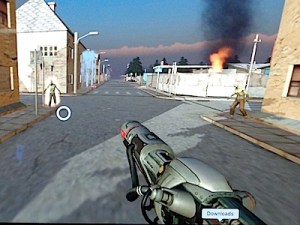 This zombie apocalypse virtual reality game was developed for iOS and Android using Google Cardboard. The story premise is that a global viral pandemic wipes out over 80% of the world population, causing the dead to rise and feed on the living. Players travel automatically through their environment and must shoot zombies coming towards them using three choices of guns : pistol, rifle, fire gun. Players can change weapon by looking down and clicking the menu. Different guns cause levels of damage to zombies. Players can also shoot the power-up packages to recover their health.
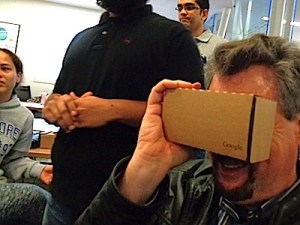
I found using the Google Cardboard, which is a VR headset quite literally made from cardboard into which a mobile phone running the game is mounted, to be a much more enjoyable and immersive experience than heavier headsets like the Oculus Rift. Yet while I liked the zombie apocalypse theme, I would have preferred more freedom of movement than this rail shooter game provided.
ZombieEscape VR was developed by a six-person team lead by Saksham Kashyap over a three-month period. You can learn more about the game and the team that developed it by visiting its website.
As always, the creativity and technical prowess of the USC Games students was impressive, and it was exciting to see how these kids are bending our reality to create a new gaming future.






 David Mullich