Author Archives: David Mullich
How Star Trek Influenced My Career
 With all the excitement surrounding by the release of the Star Wars Episode VII: The Force Awakens move trailer the other week as well as the announcement today that CBS would be launching a new Star Trek television series in 2017, someone asked me, “Which has had a bigger impact on you: Star Wars or Star Trek?” Although I am as excited as everyone else is to see the new George Lucas-less Star Wars films, this is not a difficult question for me to answer: of the two, Star Trek has been a far bigger influence on my life, not just as a source of entertainment but also in my career as a videogame producer.
 It began on September 8, 1966 — at 8:20pm, to be precise. I was eight years old, watching television, when I suddenly remembered that a really neat show I read about in TV Guide was on. I switched the channel over to NBC, and I was immediately became hooked for life. The show was, of course, Star Trek. Originally pitched by creator Gene Roddenberry to the network as a “Wagon Train to the stars,” Star Trek chronicled the adventures of the starship USS Enterprise and its crew on its five-year mission “to explore strange new worlds, to seek out new life and new civilizations, to boldly go where no man has gone before.”
 I had always been a science fiction fan, but this show was different. Initially, I think it was the futuristic technology that attracted me: phaser weapons that could stun or dematerialized, depending on the setting; voice-actuated computers that could hold the entirety of humanity’s knowledge in its memory banks; transporters that could teleport people from space to a planet’s surface; and warp drive that transcended the speed of light and could propel starships to the farthest reaches of the galaxy. I drew my version of the starship controls and pasted them on a TV table so that I could co-pilot the Starship Enterprise along with the bridge crew each week.
 I continued to watch Star Trek throughout my childhood, thanks to the show’s success in syndication after its initial three-year run, as well as to a short-lived animated version that ran on Saturday mornings. The characters on the show became like virtual friends to me because, like all good television shows, it was based upon a “family”: Captain James T. Kirk, the brash but supremely capable commander the Starship Enterprise, advised by his logical, alien First Officer, Mr. Spock, and the impassioned Dr. Leonard “Bones” McCoy. The show impressed upon me with the value of diversity and how even two people from different planets could be “brothers.”
Even the supporting cast consisted of diverse and appealing characters: Asian hobby-loving helmsman Lt. Hikaru Sulu; Russian navigator Ensign Pavel Chekov, whose heavy accent sometimes provided comic relief; African communications office Lt. Nyota Uhura, blessed with competency in multiple languages as well as a lovely singing voice; and especially, the ever-reliable Scottish chief engineer, Lt. Commander Montgomery “Scotty” Scott. I put together my own collection of futuristic “engineering tools” and would go play in the laundry room to pretending that I was Scotty making repairs to the ships’ engines.
 I became a card-carrying (literally) Star Trek fan, or “Trekkie,” joining the official fan club. I collected Star Trek “technical manuals” and glued together model kits of phasers, tricorders, communicators, and the U.S.S. Enterprise herself. I attended Star Trek conventions, even convincing my mom to take me to one in San Francisco. And I read novelizations of all the live action and animated episodes.
I learned to appreciate that the stories themselves were more sophisticated than most other television fare. Star Trek was notable for hiring leading contemporary science fiction writers such as Robert Bloch, Norman Spinrad, Theodore Sturgeon, and Harlan Ellison to write its scripts. The show often utilized the setting of a starship visiting alien civilizations to comment on social issues of the 1960s United States, including sexism, racism, nationalism, and global war. These ideas inspired me to create my own Star Trek works. I filmed a Super8 live-action Star Trek movie for which I created the phaser and transporter effects by drawing them with colored marking pens frame by frame directly on the film. I also wrote a short story about a conspiracy within Starfleet.
 My first opportunity to have my Star Trek inspired work to actually get published came in 1976, when Star Trek creator Gene Roddenberry’s executive assistant, Susan Sackett, launched a monthly fan magazine called the Star Trektennial Newsletter in honor of the show’s tenth anniversary, and of course I was a subscriber. One month she held a cartoon contest, and I submitted so many entries I not only won the contest, she made the fanzine’s cartoonist throughout the rest of its run.
 That was also the year that I also enrolled in college, but I couldn’t decide whether I wanted to be an artist, a writer, or a filmmaker, so I listed my major as “Undecided” until I figured out a career path for myself. In my sophomore year I enrolled in an Introduction to Computer Science course mainly to fulfill my general education requirements and partly because I enjoyed some of the Star Trek episodes featuring computers. One day as I was waiting in the Computer Lab to use the shared printer to print out my homework, I started typing out a Star Trek game. It then struck me that a computer was just as valid a medium for telling as story as was a typewriter, an easel, or a camera. I got so excited by the idea of interactive storytelling that I immediately went over to the Administration Office and changed my major to Computer Science.
The following year, my COBOL (a business programming language) instructor noticed that I was using the campus mainframe for printing out pictures of the Starship Enterprise using punch cards. I expected him to reprimanded me, but instead he offered me a job as a clerk in his computer store, Rainbow Computing, that he owned along with a couple of the other professors. While I was working in the store, one of the other customers, Sherwin Steffin, told me that he ran a small software publishing company and asked me to write some games for him. And so that was my start in the game industry.
 The very first game I made for Edu-Ware was about space exploration, although it was not a Star Trek game. It an expansion scenario to a text-based science fiction role-playing game called Space, created by Steffin’s business partner, Steve Pederson. The game consisted of two scenarios: Shaman, in which the player’s goal was to convert interplanetary colonists to your religion; and Psychodelia, in which players could take various drugs to enhance their mental skills, but at a risk to their physical ones. After I graduated from college, I joined the company full-time as a game designer and programmer, and one of my long-term projects was to redesign Space as a trilogy of graphics-based role-playing games, the first of which, Empire I: World Builders, won Electronic Games magazine’s aware for “Best Science Fiction/Fantasy Computer Game” of 1983. It was a nice feather in my cap, but it wasn’t Trek.
 I did have a brush with Star Trek during my time at Edu-Ware when Bjo Trimble walked into our Canoga Park offices. Bjo, along with her husband John, is considered to be one of the most influential fans of her generation. The Trimbles were behind the successful “Save Star Trek” campaign, generally credited with allowing the series to run for a third season rather than being canceled after two. They also ran the campaign to have the first of NASA’s space shuttles named Enterprise. Bjo had come to our company to ask about educational software for children with disabilities, but I, of course, spent time talking Trek with her.
 My next brush with Star Trek came several years later when I was looking for work, as people in the game industry so often are. I was on the Paramount Studios lot to interview for a position as a liaison to companies making interactive products based on Paramount properties. Star Trek: The Next Generation was filming on the lot at the time. After the interview concluded, I asked for directions to the Star Trek production offices. I had hoped to tell Susan Sackett my story about how Star Trek inspired my career in the industry, since she had written a book titled Letters to Star Trek about similar experiences, but unfortunately, it was late on a Friday afternoon, and Susan was too busy trying to wrap things up to leave for the weekend to deal with an unexpected visitor (she did send me a nice note afterwards, apologizing for not having time to talk). While I was there, I was able to peek down the hallway and see The Great Bird of the Galaxy himself, Star Trek creator Gene Roddenberry, talking on the telephone in his office.
 By the way, Star Trek: The Next Generation was just as much as an influence on me as The Original Series was. Even my wife, Charlotte, who is not normally a science fiction fan, watched episodes of the show with me every week. We’d watch it together when our baby son Ben was in the hospital being treated with chemotherapy, and it was one of the things that got us through a terrible ordeal. I’m happy to report that Ben (standing next to Spock in this picture taken of our family at Star Trek: The Experience) is now a grown man and studying biology at my alma mater, Cal State Northridge.
 I had yet another brush with Star Trek in 1994. While I was in San Francisco attending the annual Game Developers Conference and sat in on a session where author Harlan Ellison and game designer David Sears were discussing how they were adapting Harlan’s classic short story I Have No Mouth, And I Must Scream into a video game. I have to admit that I was very jealous. No only was that my favorite short story, but Harlan had written my favorite Star Trek episode, “City on the Edge of Forever.” I should be the one working with him!
As fate would have it, I wound up producing the project. A few months after GDC, the company publishing the game, Cyberdreams, contacted me about working for them as a producer. What made this opportunity even more exciting of me was that David Sears had left the project and the company needed someone to work with Harlan in finishing the design of the game. Did someone say “dream job”?
 Of course, it wasn’t going to be that easy. Harlan had a reputation for being difficult, and I knew that going in. I had seen him talk on panels on science fiction conventions, and I knew that he enjoyed being an iconoclast — someone who attacks what others hold sacred, but I enjoyed that about him too. He infamously appeared with the rest of The Original Series cast on an episode of Tom Snyder’s Tomorrow show about Star Trek‘s enduring appeal, and Harlan spent the entire time ripping into the show and it’s fandom. (At a Star Trek convention I once asked James Doohan, who played Scotty, what he thought about what Harlan said on that show, and Doohan replied, “I wanted to punch him in the nose.”)
 And, man, did Harlan live up to his reputation in person! As soon as I arrived at his house, he began hurling insults at me (the worse was “you think like a television producer.”). I remained calm and composed, and when I showed him our work on the game so far, the rain of barbs subsided. Slowly I gained his trust that I was handling his story well, and we learned to work together very well. He would read some of the dialog that I wrote for the game and tell me that it was “shit”, but that would just get me to try harder to emulate his writing style. I would also read his dialog and tell him when I thought he could do better, and he’d trudge back to his office and come back with scenes that worked better for the game.
 When it came time to cast voice-over actors to record the game’s dialog, I immediately thought of John DeLancie, who played the omnipotent and annoying entity named “Q” on many Star Trek: The Next Generation episodes, for playing the role of the story’s antagonist, the insane supercomputer, AM. One of my former co-workers knew John DeLancie’s phone number, and so I spoke to the actor about playing the part, but when I told Harlan, he was firm: he didn’t want any Star Trek actors in the game. So, I told him, “All right. Then I want YOU to play the role. You’d be perfect at playing an insane computer.” And I was right, he was.
 The finished game wound up winning just about every game industry award there was. However, what was most meaningful to me was this “Letter To The Editor” Harlan wrote to Computer Gaming World when the game won its Best Adventure Game of the Year award:
“David Sears and I worked very hard on I Have No Mouth, and I Must Scream. And we both get our accolades in your presentation. But someone else who had as much, or more, to do with bringing this project to fruition… is David Mullich. He was the project manager and designer after David Sears moved on. He worked endlessly, and with what Balzac called ‘clean hands and composure’ to produce a property that would not shame either of us. It simply would not have won your award had not David Mullich mounted the barricades.”
 All well and good, but my dream of making a Star Trek game did not come until six years later when Activision hired me to produce a Trek-themed real-time strategy game that Mad Doc Software was developing for them. The game, tentatively called Starfleet Admiral, was to be a real-time strategy space combat game involving ships across all the Star Trek movies and television shows. We developed a first-playable prototype of the game, but although the vice president of our division said that it was the best prototype he had seen in his ten years at Activision, the game got cancelled due to a falling out with the developer over another project they were developing with us.
 Well, that wasn’t the only reason. My immediate manager was losing faith in the drawing power of the Star Trek license and thought that Star Trek Admiral relied too much on Trek history as its appeal, and I was given the directive to make a Star Trek game that wasn’t about Star Trek. So, my assistant producer, Dan Hagerty, devised an alien race and spaceships that would be the focus of our new game, which we developed with a Hungarian developer called Digital Reality who had developed a 3D engine that impressed up when we met with them at the Electronic Entertainment Expo. We made several trips to Budapest, where we had a great time working with Digital Reality and its CEO, Gabor Fehrer, proved to be a delightful host.
Everything was going well on the project, and then suddenly, everything having to do with Star Trek imploded. First, Star Trek: Enterprise came out on television, and it bombed in the ratings. Then, Star Trek: Nemesis came out in the movie theater, and it bombed at the box office. We had actually been invited to an advance screening of the film on the Paramount Studios lot, but when our Paramount liaison, Harry Lang, asked us what we thought of the film as we came out of the theater, all we could do was smile and mumble something noncommittal. However, back at Activision headquarters, the executives determined that Paramount was no longer supporting the Star Trek franchise with quality product, cancelled all of the Star Trek games it had in development, and I was sent to work on other projects. I never had a chance to work on a Star Trek game again.
 Actually, it was my brother Jon who had the most success with Star Trek. Jon has long been involved in community theater, and although I never considered him to be a Trek fan growing up, he had the brilliant idea of rewriting the Gilbert & Sullivan comic opera H.M.S. Pinafore as a Star Trek musical adventure. Jon’s production of the U.S.S. Pinafore: An Out Space Operetta debuted at the Crown City Theater to rave reviews, and it caught the attention of former Starlog Magazine editor Kerry O’Quinn and his close friend Nichelle Nichols, who played Uhura on the original series. Jon (second from right in the photo) convinced them, along with fan favorite episode The Trouble With Tribbles author David Gerrold, to do a panel after one of his performances. Unfortunately, I had a prior commitment that night, and I missed this chance to meet these three people who I so admired.
 Yet Star Trek continued to work its serendipitous influence on me, and a couple of months later, the former editor of Softalk Magazine, Margot Comstock, who had supported my work since my early days in the game industry, contacted me out of the blue and suggested that I should meet a friend of hers — Kerry O’Quinn, the Starlog Magazine founder who was part of the Star Trek panel at Jon’s musical. I was a huge fan of Starlog when growing up, which covered Star Trek, Star Wars, and everything else in the realm of science fiction, and so I jumped at the chance to meet him. We met for dinner at Kitchen24 in Hollywood, and for a couple of hours entertained me with stories about Star Trek creator Gene Roddenberry, author Arthur C. Clarke, and so many of my other idols.
 Kerry was kind enough to invite me to his birthday party a short time later, and he spent the evening discussing his career with Starlog and other ventures. What made the evening especially memorable that his close friend Nichelle Nichols was there. Throughout my childhood and teen years, I considered her to be the most beautiful woman in television, and I have to say that, at 77-years-young, she was just as lovely as ever.
 Star Trek continues to be a presence in my life. For the past couple of years at my teaching position at The Los Angeles Film School, I’ve dressed as Captain Kirk for Halloween, my goatee notwistanding. Famed Doom co-creator John Romero did the embellishment to this photo of me. Last year, I took a quick picture of me for Facebook, but there were dark circles under my eyes. I did a real quick and dirty job in Photoshop of fixing them before posting it, but John surprised me by stepping in and doing the job right.
 Last week, after dressing as Kirk for the school costume contest, I got into the elevator and another instructor asked me if I was a Star Trek fan. When I answered with an enthusiastic “Yes!”, he then introduced me to another passenger in the elevator: actress Gianna Simone, who played a member of the Enterprise bridge crew in the film Star Trek Into Darkness. It seems that no matter what I do, or where I go, the incredible universe that Gene Roddenberry created nearly 50 years ago continues to affect my life in the most amazing and unexpected ways.
More Treats Than Tricks At IndieCade
 When I was a kid, I loved going trick-or-treating on Halloween: dressing up in costume, going from house to house, and filling my bag up with treats. I was crushed when, as a highschooler, I went to one house where I was told, “Aren’t you a little old for this?” and I realized it was all over. Fortunately, one is never too old for video games, and on the weekend before Halloween, I went from booth to booth at IndieCade, where I was able to indulge my sweet tooth for all things interactive.
 The IndieCade Festival, or The International Festival of Independent Games, is a yearly event, held in Culver City, California since 2009, featuring indie games from around the world, an annual award show celebrating 12 different innovation award categories, and a three-day conference including a professional conference track, business networking, social activities, tournaments and entertainment, as well as fun programs for the entire family. The Festival is not just a celebration of indie games, its creators and the innovation within the industry. It also curates and recognizes those that the organizers identify as the top indie games of the year. More than 200 games of all types are selected by the Festival Jury and were made available to play.
 One of the games I played was an IndieCade finalist called 60 Seconds!, created by Polish game developer Robot Gentleman Studios, who describes the game as “a dark comedy atomic adventure of scavenge and survival.” The premise is that the government’s early wanting systems gives you just 60 seconds to take cover in the fallout shelter under your house. During that one minute, you must make a mad rush through your procedurally generated house to gather all the supplies you need to survive. The decisions you make in the first 60 seconds will determine how the rest of the game will play out. How many days will you last? Will there be enough to eat? Can you risk going outside. It’s an interesting twist, front-loading many of the player’s decisions. It was a fun game to try out, but I have to admit… I was even more intrigued by the game developer’s hat.
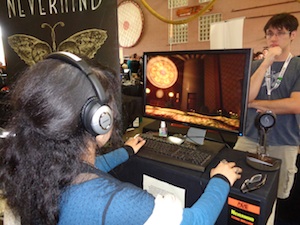 Another game I played was just the thing to get me in the Halloween spirit. Nevermind is a biofeedback-enhanced adventure horror game that takes you into the dark and twisted world of the subconscious. As you explore surreal labyrinths and solve the puzzles of the mind, a biofeedback sensor attached to your ear monitors how scared or stressed you become moment-to-moment. If you let your fears get the best of you, the game will become harder. If you’re able to calm yourself in the face of terror, the game will be more forgiving. The game started as a 2012 MFA thesis project at USC’s Interactive Media Program, led by game developer Erin Reynolds, who returned to academia to pursue new ways to create “positive” games for traditional gaming audiences. After an academic year, Erin and the Nevermind student development team were able to create one fully-functional level—a proof of concept that demonstrated Nevermind’s unique vision and the feasibility of the core technology. The game is now available on Steam for Windows and Mac.
 Virtual reality had a big presence at IndieCade this year, with about a quarter of the booths having virtual reality headsets. One that I played was Xing: The Land Beyond, a first-person puzzle adventure game. Players find themselves on a mysterious floating island, in an afterlife where they must uncover secrets as to who they are and why they are there. Gameplay involves exploration, solving environment-based puzzles and gaining/using powers such as rain and snow to progress through levels. Developer White Lotus Interactive began the game in 2013 as a Kickstarter project and hope to launch it next year. Developed using Unreal Engine 4, the game features 3-Denvironmental puzzles, an integrated day-night cycle, weather control, and a story told through poetry.
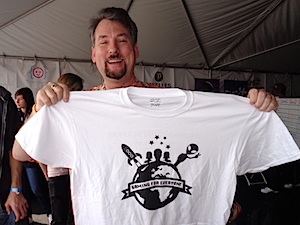 Another big presence at the show was advocacy for diversity in game development. The Gaming Is For Everyone pavilion housed tables for groups seeing gender and racial diversity in game development:
- Different Games Collective is a grassroots volunteer-run collaborative of a half-dozen core members, as well as an extended network of contributing members and a host of volunteer supporters that creates community resources and events such as game design workshops and lectures to support marginalized voices in DIY and independent games.
- Pixelles is a non-profit organization dedicated to empowering more women to make and change games, founded by Tanya Short and Rebecca Cohen-Palacios. Pixelles organizes free monthly workshops, a mentorship program for aspiring women-in-games, game jams, socials and more.
- Fresh Out Of Tokens is a weekly podcast addressing issues of diversity, inclusion, intersectionality and feminism in gaming.
- The Code Liberation Foundation offers free development workshops in order to facilitate the creation of video game titles by women.
One interesting game I played in the Gaming For Everyone pavilion was one designed for players with sight impairment. Turning off the Screen‘s initiative is to take a closer look at accessibility in game design, development, and architecture in order to open games to an even bigger market. Turning off’s current project is adapting Fullbright’s debut game Gone Home to take a closer look how to modify existing games that have already been enjoyed by audiences in order to look at what goes into universal design.
 Speaking of advocacy, a welcome sight for me at any industry event is the Extra Life booth. Extra Life is a charity organization of gamers doing what they do best to help sick and injured children at their chosen Children’s Miracle Network Hospital. Simply sign up, commit to play games for 24 hours from November 7, 2015 – November 8, 2015 (or any day of your choosing), and ask your family and friends to support your efforts! The money that you raise through Extra Life will go directly to your chosen Children’s Miracle Network Hospital as ‘unrestricted funds’. This means that the hospital decides where and how to spend the money to ensure the dollars you raise make the biggest impact in the lives of the kids they treat. For example, the money you raise will go to fund research and training, purchase life-saving equipment and pay for uncompensated care.
And that concludes my wrap-up of my Saturday afternoon at IndieCade. I came to see all the games, and left feeling impressed by the ingenuity and devotion of the independent game development comment and by all the advocacy groups that seek to turn games into a meaningful experience for people.






 David Mullich