Author Archives: David Mullich
The PC Gaming Show Highlights Virtual Reality On “The Only True Democratic Gaming Platform”
 Apparently writing this blog qualifies me to be a member of the game industry press. A couple of week ago I received a media invitation to attend The PC Gaming Show that was live streamed today from The Theater in Ace Hotel in downtown Los Angeles, where I just happened to be working on a consulting gig about five blocks away. So, I took an extended lunch hour to attend the event and bring back this report to you, my loyal readers.
The PC Gaming Show is the second annual event for video game developers, publishers, hardware companies, press and fans during E3, the Electronic Entertainment Expo, which opens at the Los Angeles Convention Center tomorrow. The event, a live-streamed on Twitch and YouTube Gaming, was created by PC Gamer magazine to shine a light on exciting, innovative and unconventional projects happening across the personal computer world. The sponsors this year included AMD, Bohemia Interactive, Frontier Developments, Razer, and Tripwire Interactive, and it was the first time that the show was free and open to the public (which kind of diluted the coolness of my media invite).
 The venue for the event was a delicately restored, 1,600-seat movie palace from the 1920s with a three-story, 2,300 square foot grand lobby, an ornate open balcony and mezzanine and a vaulted ceiling with thousands of tiny mirrors that glimmer when lit. The theater is the flagship theater for the movie studio United Artists, and like many movie theaters, the seat rows sink in toward the front of the orchestra section, so ticket holders there must look up at the stage. However, this time ticket holders were not to see a movie, but the latest in gaming for personal computers.
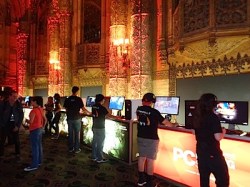 As a warm-up act before the show, there were AMD computers in the lobby set up for playing such games as open world military tactical shooter Arma III from Bohemia Interactive, space trading and combat simulator Elite: Dangerous from Frontier Development, and action-adventure stealth game Hitman from IO Interactive. I tried my hand at zombie apocalypse FPS Killer Floor 2 by Tripwire Interactive and was very please with myself for wiping out a legion of Zeds before it was time for the show to begin.
 The 90-minute show (thankfully, an hour shorter than last year’s overlong show) opened with an on-stage shopping spree, “The Steam Speedrun presented by Razer,” where one lucky gamer had the chance to fill her Steam electronic shopping cart with as many games as possible in three minutes, all on Razer’s dime — $1152 worth of dimes, in fact — as well as a full set of Razer peripherals. But she said her favorite catch was a copy of the new Doom from Bethesda Softworks (who says women don’t like to play FPS games?)
Next, Sean Plott, an e-sports commentator for StarCraft II and a former professional StarCraft: Brood War player who goes by the handle “Day[9]”, hosted mixture of screenings of the latest game trailers along with exclusive new footage, updated details on popular game franchises, and conversations with their developers on a set resembling a late night talk show. He’s a funny, charismatic guy whose voice reminds me of Jim Parsons from The Big Bang Theory. Day[9] had good chemistry with a whirlwind of developers, many of whom wore rainbow ribbons in sympathy for the victims of the tragic Orlando shoots just the day before..
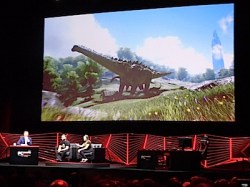 First up was Jesse Rapczak, cofounder of Studio Wildcard, to discuss Ark: Survival Evolved, an action-adventure survival game in which players can feed, tame and ride over sixty types of dinosaurs. Players must gather resources to craft weapons and shelters for surviving in this primitive and dangerous environment. The game blends cooperation between players and competition between groups. Mods, Rapczak says, are also a big part of Ark, and the development team has already decided to use a community-made mod that minimizes technology and includes more resources for living off the land as an official mod for the game, which will be released at the end of the year.
 Modding was also an important aspect of the next game, Mount and Blade II: Banner Lord, a stand-alone expansion pack developed by the Turkish company TaleWorlds Entertainment for publisher Paradox Interactive. The expansion features a new multiplayer mode that allows for up to 250 players, split into two teams, to wage siege combat using catapults, ballistas, and battering rams without the RPG and map elements from the single-player mode. Community manager Frank Elliot said that the fan community were an essential part of developing this “prequel” game, as the development team provided them with all the development tools needed to make mods.
 Community-made mods was not the only feature discussed by PC game developers; virtual reality was another hot topics. Advanced Micro Devices President and CEO Lisa Su came onstage to discuss all of the hardware her company is manufacturing to support vr in games. AMD is angling to lower the cost of virtual reality, targeting the field with a new line of graphics hardware priced at $199—half or less the cost of comparable products. Su said the first chips based on its new Polaris design are expected to arrive in graphics cards for personal computers at the end of June. The company aims to help push the starting cost of PCs that can deliver VR experiences as low as $799 from above $1,000. Su also showed off Alienware’ virtual reality backpack, which resembled something Tom Cruise might ware in a futuristic warfare film, designed in conjunction with Zero Latency’s free-roam multiplayer VR experience. However, the device is still an early working concept that doesn’t even have a name as of now.
Virtual reality’s impact on gaming was demonstrated by Tripwire Interactive’s John Gibson. Although he initially came out to discuss Killing Floor 2 and its new features he was shortly joined by Anna Sweet of Oculus to announce that soon players will be able to blast open heads and scatter entrails in vr, courtesy of Killing Floor Incursion developed for the Oculus Touch, a a pair of controllers used for the Rift in selected VR games, and are mirrors of each other – one for each hand. They are lightweight, wireless handheld motion controllers featuring a joystick, buttons, and two triggers- one for grabbing and one for shooting or firing. The controllers are fully tracked in 3D space by the Constellation system, so that the user sees them in virtual reality responding to their real world counterpart, giving the user the sensation of their hands being present in the virtual space.
 The show ended with legendary game producer Warren Spector coming on stage to support development for PC games. He reminded the audience that all development work is done on PC’s, and that’s where innovation comes from. Personal computers grow in capability as technology advances, and developers take advantage of that and the hardware’s open architecture. Consoles may have consistent controls, but that’s also their weakness. The core of PC gaming is its mouse and keyboard interface, giving players control that they can also customize. It is, Spector says, the only truly democratic gaming platform.
Of course, there were many more games presented at the event, but unfortunately that’s all I have time to write about now — I have a trade show to see! But as someone who started his career developing PC games, it was exciting to “media representative” to this event, and while PC gaming has steadily been losing market share to consoles, online, and mobile, it’s a platform that’s still alive and kicking.
Making Player Choices Matter
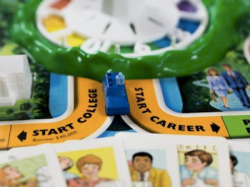 This presidential election has got to be one of the craziest in America’s history. All the rules we’re used to politicians following seem to have been thrown out the window, and yet we’re still faced with making a decision which will have a significant impact on our country’s future. And that has got me thinking, perhaps as a distraction, about the impact of player choices in games.
As game designer Sid Meier says, games are a series of interesting decisions. All games are about choices, even if the choice is as simple as whether to move left or move right at any given moment. Now, there is nothing wrong about simple choices; classic games like Pac-Man and Space Invaders are all about moving left or right at the right moment. What does matter is the information the game provides to the player in making those decisions and the impact of those decisions on the game’s goals.
Here are a series of decisions I present to my game design class in a discussion of player choices.
- You are at a fork in the road. If you go left, you will find a gold coin worth 10 doubloons. But if you go right, you will find another gold coin worth 10 doubloons. Which path do you choose? This is what is called a hallow choice. No matter the choice, the player will receive the same outcome. This is poor design: choices should matter in games.
- You are at a fork in the road. If you go left, you will find a gold coin worth 10 doubloons. But if you go right, you will find a gold coin worth only 5 doubloons. Which path do you choose? This an obvious choice. One outcome is clearly superior to the other, and so it really isn’t a choice at all. This too is poor design.
- You are at a fork in the road. If you go left, you will find a gold coin worth 10 doubloons. But if you go right, you will find two gold coins worth 5 doubloons each. Which path do you choose? These two choices provide the player with rewards of equal monetary value. However, there may be reasons for choosing one reward over another. Perhaps the 10 doubloon coin is less cumbersome and lighter to carry than the two 5 doubloon coins. On the other hand, perhaps the player will later need to buy an item worth five doubloons from a vendor who can’t make change. This would be a minor decision, because the different choices have only a small impact on the player meeting his or her goals.
- You are at a fork in the road. If you go left, you will find a bronze coin worth 10 doubloons. But if you go right, you will find the Golden Coin of Zeus, also worth 10 doubloons. Which path do you choose? This may seem like a minor decision, since the two coins are worth the same, but there is also a dramatic element here, based on the coin’s description. (If the game’s storyline has been about Greek mythology, the choices is even more dramatic). The decision here may not be meaningful in terms of the game’s goals, but it may be meaningful in terms of the player’s immersion into the game’s story.
- You are at a fork in the road. If you go left, you will find a pile of gold coins. But if you go right, you will find another pile of gold coins. The two piles have different amounts of gold coins, but you don’t know which is greater. Which path do you choose? Although one choice is likely better than the other, the player just doesn’t have enough information to make a decision, so the decision really isn’t meaningful. This is an uniformed decision, and is another example of poor design.
- You are at a fork in the road. If you go left, you will find a 5 doubloon coin. But if you choose the right path, you will find either a 10 doubloon coin or nothing. Which path do you choose? Now things are getting more interesting! This is an informed decision. The player has enough information to make a meaningful choice, but due to the lack of certainty in outcomes, the choice is not obvious. Actually, the choice here is whether or not to take a risk.
- You are at a fork in the road. If you go left, you will find a 10 doubloon magical coin that will double in value every 10 days until it reaches a maximum value of 2,400 doubloons in 100 days. But if you choose the right path, you will find a 10 doubloon magical coin that will turn into a flying steed worth 3,500 doubloons in 150 days. Which path do you choose? These are both long-term decisions having effects that will not be felt immediately, although a decision made now will have far-reaching effects.
- You are at a fork in the road. If you go left, you will find a 10 doubloon gold coin. But if you choose the right path, you will be attacked by a dragon that might kill you, but if you survive, you will get its treasure of 100 doubloons. Which path do you choose? This is a weighted decision, with pros and cons for each choice. The left path offers safety but the right path offers wealth.
- You are at a fork in the road. If you go left, you will will be able to rescue your beloved dog, who is drowning in the river. But if you choose the right path, you will be able to save a human stranger, who is also drowning in the river. You can only rescue one Which path do you choose? This is an ethical dilemma. There are no good choices. Something will be gained and something will be lost. In these types of situations, a player’s values are put to the test.
The further down the list, the more interesting the type of decision being presented. At least in theory. I’ve been distressed to find that every time I present the dilemma scenario to my students, almost all of them choose the dog over the human. I’ve been considering offering the scenario of having the students choose between their dog and their Game Design instructor, but given the nastiness of today’s political climate, I’m afraid to dicover the answer.





 David Mullich