Author Archives: David Mullich
What Can Game Developers Learn From The 2016 Presidential Election?
 Like many other people, I was shocked when Donald Trump was elected President of the United States. I considered him to be too inexperienced and divisive for the position for him to have any real chance of winning the election. Even when the polls showed the race to be tightening up in the days before the election, I thought that Hillary Clinton had enough electoral votes locked up for a landslide victory. I was so sure that Hillary’s win was a foregone conclusion, that rather than spending Tuesday night watching the election results, I decided to go see Doctor Strange instead. However, when I exited the movie theater, it seemed I had been transported to an alternate universe, because it was Trump who had won by a landslide of electoral votes.
Pundits and Democratic leaders from Michael Moore to Bernie Sanders blamed Hillary’s loss on the fact that Trump did a far better job of appealing to the concerns of the angry and embittered middle-class workers of the Rust Belt states who felt abandoned by the Democrats. Worse, everyone who supported Donald Trump was painted by the Hillary campaign as being stupid, bigoted and mysogynistic. Such name-calling did not attract any Trump supporters to Hillary’s side, but what it did do was make Trump supporters hesitant to admit in polls that they were supporting Trump, and so the polling data was off. Finally, Trump supporters were more enthusiastic about their candidate than were Hillary supporters, who didn’t work as hard at bringing other people to the voting booth with them.
A couple of days after the election, game journalist Dean Takashashi asked in a Facebook post, “What does/should the game industry do in a post-election Trump world?” and I answered with some lessons from the election that might apply to game development. Here is an expanded version of my reply:
- Try to meet to the needs of all your players — not just the vocal ones, not just the hard core ones, and not just what you designed your metrics to measure. Your audience is might be made up of players who spend a lot of time each day playing your game, and more casual ones who only have a few minutes here and there to play; those who play for high scores and achievements, and those who just play for the story or social experience; those who try to dissect every rule and metagame new strategies, and those who are just looking for an enjoyable pastime. If you only pay attention to the ones who post on your forums or social media networks, you may be ignoring problems the vast majority of your audience are experiencing.
- Never dismiss any of your players as being stupid of wrong-headed. If they find your game confusing, they’re right — it is confusing for them. If they find your game boring, they’re right — it is not fun for them. Rather than telling them that they’re wrong, try to see things from their point of view and find ways to satisfy their needs.
- Players will often give you solutions to their problems rather than telling you what their problems actually are, but since they aren’t expert game designers, often their solutions aren’t the best ones. For example, they may complain that your first-person shooter needs more powerful guns when really the reason the game is too difficult is that there isn’t enough ammunition to pick up in the level. So, when your players start giving you solution, try to figure out why they are giving that solution, and maybe you can come up with a better one.
- Your metrics will only measure what you’ve designed them to measure, especially when dealing with quantitative data. Try to get some qualitative data from your players too, because people on the fence could suddenly change their playing habits.
- When answering playtest feedback surveys, players will often tell you what they think you want to hear to avoid hurting your feelings about finding problems with your work or to avoid sounding stupid or unskilled themselves. Where possible, have playtest feedback done by a neutral party, and write your questions so that they are unbiased as possible. You goal should be to learn what your player’s experiences are, not get validation for your existing opinions.
- As screenwriter William Goldman famously observed, “Nobody knows anything.” You can get all the expert opinion and follow conventional wisdom all you want, but nobody knows with certainty what’s going to work. Success depends as much on luck as anything else.
None of this will make you feel better about the election if you were unhappy with the results, but as the dust settles and we get back to our lives, maybe we can take away a few things that will make our work, at least, a little more sane than this crazy election cycle.
Crayons, Circles And Diamonds Inspire Games At The Fall 2016 Bill Hart Merit Badge Midway
 This Saturday I again volunteered at a local merit badge midway to run a workshop for the game design merit badge that I helped to create for the Boy Scouts of America. To earn this merit badge, the scouts not only have to create a game of their own design, but also engage in the process of playtesting and redesign for at least three iterations. Now, the average merit badge takes about ten hours of a scout’s time to complete, and Game Design is no exception. So, in my three-hour workshop, I help scouts to either get started on the merit badge or to finish it up. And therein lies a problem: how to deal with a dozen scouts at different stages during the limited time I have with them.
This time, I decided to try something different. Although I did my normal process of doing a “classroom lecture” about the elements of a game, different types of play value, game design terms, and intellectual property protection, I broke up the lecture into four segments for the scouts who were just starting their merit badge, this time I had these scouts do playtesting between the segments for the scouts who had already completed their games. This had the double benefit of breaking up the lecture for the scouts starting their merit badge, while providing playtesters for the scouts who were finishing up. And overall, it worked quite well.
To playtest a game in my workshop, scouts must first contact me with a vision statement, play value description, and initial set of rules for a game they want to make, and if I approve it, they can proceed with making a game to bring in. Only three scouts did the prerequisites this time, but the rest who attended the workshop got to playtest their games.
Here were the games that we playtested.
Crayon Wars
 Vision Statement: Crayon Wars is a free-for-all party game where players uses crayons as money to defeat the opponent. The game has play value of challenge because you have to practice to be better. It has stimulation because it is exciting and threat because you are challenging each other and it is fun to play
Set-Up: Each player is given 2 crayons for lives and two crayons for buying stuff.
Progression: Players take turns moving play around the circle to the left
The first player can buy something or skip and save up for later. Each turn players get 2 crayons for money. You can also attack after the first round.
There are 12 items you can buy
- plane 2
- helicopter 3
- army men 4
- bazooka 5 strong against planes +1 crayon
- 5. jet 5
- health pack 6 plus 2 health
- take it 7 2 crayons health taken away
- tank 8
- hill 9 stops tank
- Godzilla’s wife 10 stops Godzilla
- Godzilla 11 defeats volcanoes
- volcano 12 +2 crayons every turn
To attack, you pick a token to attack with. It damages the other player’s token or their health the value of your token and your token will go down in value the amount of damage you did. You can attack the other players health after attacking all of their resources.
Resolution: The game ends when someone’s health goes to zero.
Around
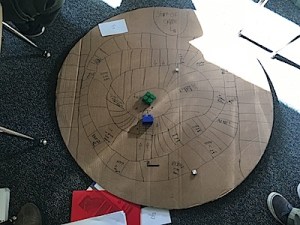 Vision Statement: Around is a free-for-all board game for 2 to 4 players in which players roll dice to move along a circular path to reach the end.
Set-Up: Players place their pieces at the Start, receives $50 in play money, and then rolls the dice to determine who goes first.
Progression: The game is played in turns.
- The player rolls the dice to find out the number of turns to move.
- After rolling the dice, the player moves that number of spaces anywhere on the game board.
- Some spaces will take or give money to the player.
- The player must move the exact number of spaces to reach the Finish.
Resolution: The game ends when one player reaches the Finish.
Diamond Dreams
 Vision Statement: Diamond Dreams is a Minecraft-themed board game for 2 to 4 players in which players try to reach a diamond block that rules everything.
Set-Up: Players place their character in one of four gray boxes around the edge of the board and are given 10 health points. Players role a die to determine who goes first.
Progression: The game is played in turns.
- Each player rolls a die to determine the number of spaces to move.
- The player can move only left, right, or forward.
- Some spaces have special properties:
- Lava: Lose 7 health points
- TNT: Lose 8 hit points
- Creeper: Lose 5 hit points
- Hole: Returns player to start
- Armor: Adds 5 hit points
- Wolf: Lowers damage done by monsters by half.
- If the player looses all of their hit points, they return to the start and regain them.
Resolution: The game ends when one player reaches the Diamond.
Of the three games, I’d say the scouts most enjoyed Diamond Dreams. It had the best presentation, the most complete rules, and the greater depth of game play. Of course, earning a Game Design merit badge is not about creating the best game, but learning what it is like to be a game designer — that the game does not end with the initial design, but is refined and polished based on the experience of the players who are playing the game.





 David Mullich