Monthly Archives: September 2016
Lessons Learned About The Use Of Randomness In Games
 Like many other people of my generation, the very first board game I played as a young child was Milton Bradley’s Candyland. The game involves players finding King Kandy, the lost king of Candy Land, by traveling along winding, linear track consisting mostly of red, green, blue, yellow, orange and purple spaces. Players take turns removing the top card from a stack, most of which show one of six colors, and then moving their marker ahead to the next space of that color. There is no strategic skill involved in playing the game: the winner is essentially predetermined when the cards are randomly shuffled at the start of the game.
I soon moved on to another Milton Bradley board game, The Game of Life. The game depicts players’ travel through life, from college to retirement, with jobs, marriage, and possible children along the way. Here, one random element takes the form of a wheel at the board’s center that players take turns spinning to determine the number of spaces they move along the game’s track. There are a handful of intersections where players choose to go one direction or another as well handful of choices about insurance and investments, but for the most part it too is a game of luck.
Eventually I graduated to the Parker Brothers real estate game, Monopoly. As most readers know, this is a game in which the player’s roll two dice to determine the number of spaces they move clockwise around the board, and depending upon which space they land on, making decisions about whether or not to buy unowned properties, paying “rent” to players who own property, or drawing from shuffled cards for randomly determined helpful or harmful events.
While the dice and cards do offer a significant amount of randomness, the gameplay does involve strategic, resource management and negotiation skills. Whereas games like Candyland and Life, in which luck largely determines a player’s success, engage only the youngest of players, a game like Monopoly, where a certain amount of skill is necessary to do well in the game, can remain engaging to players for many years after being introduced to the game.
One lesson that game designers can learn from playing games like this is how to balance the amount of randomness in the game against a player’s skill level. All game’s need a certain amount of skill — from understanding the basic procedures and rules of the game to making strategic decisions about how to achieve the game’s goals. However, randomness can be used help players succeed in a game despite low skills. Now, while luck-based games can be appealing to children, games in which randomness largely determines success can cause older players to feel a lack of control, or worse, feelings of hopelessness, while playing the game.
While a game designer can allow for the occasional random event that can progress low-skilled players forward or set back very skilled players to level the playing field when players of different skill levels are playing against each other, the amount of randomness in a game should not negate player skill entirely. This is something you can gauge when playtesting the game with other players, who can tell you if they feel their decisions do not really matter in determining whether they win or lose the game.
I learned a lot about game design by playing board games and seeing the role randomness played with spinners, card, and dice, but my higher-level education in-game design came about when I entered college and learned about Dungeons & Dragons from my classmates. Dungeons & Dragons is, of course, the famous tabletop role-playing game in which players portray characters embarking upon imaginary adventures within a fantasy setting.
An essential component of this game is a set of polyhedral dice, which have 4, 6, 8, 10 and 20 sides. These are not only for determining the outcome of player decisions in the game, but also for a very important use of randomness in a game: variety and surprise. As Jason Vandenberghe explained in his GDC 2012 talk, The 5 Domains of Play, Novelty is the presence or lack of new, interesting, dramatic, or beautiful things in the game, and is one of the major determiners of whether a player likes a particular game. Dungeons & Dragons is a game based on a very high degree of Novelty, not only from the interesting and dramatic scenarios forming the role-playing aspects of the game, but also from surprises and variations introduced by the random elements.
For example, a typical Dungeons & Dragons scenario might involve a party of players having a random encounter with a creature in a forest clearing. However, the type of creature it is — whether it be a common deer or a very uncommon unicorn — is determined by a role of the die. This allows players to play the same scenario several times but have very different experiences due to the variety of the encounters. The trick for the game designer, though, is to make sure that the variation is still within the player’s skill level, so that players are not too often presented with surprise challenges that are beyond their ability to overcome.
It was as an adult that I most began to appreciate another use of randomness in games, and that was through my experience playing games of chance in Las Vegas. I’ll never forget the excitement of watching the roulette wheel at Caesar’s Palace as the steel ball go ’round and ’round, and the anticipation that built up inside me waiting to see which slot the ball would fall into. Yet, I felt a different emotions, those of tension and suspense, when sitting at the blackjack tables and not knowing whether the money I bet would be lost or whether my risk would be rewarded.
In games of chance, randomness does play a huge role in determining a player’s success. However, unlike games of pure luck, the player does make choices that also help determine his or her success. Yet in some games, like blackjack or poker, some of the information for making those decisions is hidden from the player, and this situation can stimulate feelings of thrills and anxiety. Other feelings, those of excitement and suspense, can occur when there are known and palpable risks, such as losing sums of money, while playing a game. Game designers, by balancing the amount of randomness, information, risk and reward in a game can similarly spark a range of emotions in their players.
So, as I graduated from games of luck to games of chance in my game playing education, here is what I learned about how to properly use randomness in games:
- Give unskilled players an opportunity to be successful, but not so much that they feel their choices don’t matter.
- Add variety and surprises to increase a game’s replayability.
- Use uncertainty to give player’s feelings of excitement and suspense.
How To Work With A Maestro of Game Music
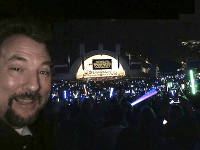 This weekend my wife and I went to the Hollywood Bowl outdoor amphitheater to watch John Williams conduct the Los Angeles Philharmonic as they played some of William’s most famous film scores, particularly the ones to the Star Wars films. Of course, light sabers were a very popular souvenir item among the audience, and Star Wars fans waved their swords in time with the rhythm as Williams conducted The Imperial March (also known as Darth Vader’s Theme). The show, called “John Williams: Maestro of the Movies” also included film clips that accompanied some of the pieces Williams performed.
We had attended William’s other performances at the Bowl several times before, but this year fellow film composer David Newman opened the show by conducting the Philharmonic as they played the scores to a number of films, including The Godfather and North By Northwest. Between a couple of the pieces Newman stopped to emphasize how important that a score serve the film in which it plays, becoming an entirely new experience from what it was on the page once it is married to the imagery of the film.
As an example, Newman explained how score composer Bernard Herrmann drew his inspiration for the film’s classic crop duster sequence from a Spanish dance called the Fandango. Because North By Northwest is essentially a chase story, the score is composed with driving, dancing rhythms. And yet, when one watches the film, one thinks not of dancing, but of the protagonist being chased headlong through the music.
Now, this blog is about video games and not films, but some music composers are maestros of both movies and game music. Michael Giacchino, who composes many of J.J. Abrams film scores, began as a game producer for Disney Interactive, thinking he could hire himself to write music for the games he produce. He indeed composed music for the Sega Genesis game Gargoyles, the SNES game Maui Mallard in Cold Shadow and the various console versions of The Lion King. Another composer who has worked in both the game and film industries is John Ottman, who both scores and edits many of Bryan Singer’s films, composed the soundtrack for I Have No Mouth and I Must Scream for me.
One thing that I have learned about both film and game composers is that they are hired onto a project long before the visual part of the project reaches its finished form. The film composer needs to have the music written by the time the final edit of the film is completed, and the composer will conduct the musicians in the recording session while watching the film play onscreen. A game composer is likewise brought onto a project long months before the game is completed, but due to the interactive nature of video games, the game experience is different for each player, and so the composer doesn’t watch someone play the game while the music is recorded. So, even more than with film music, the game composer relies on having a clear understanding from the creative team about what the final experience needs to be like.
When I start working with a music composer, I already have formed at least a preliminary idea of how many musical pieces I will need from him or her. Usually I will want a different musical piece for each of the game’s main mechanics: exploring, building, fighting, and so on. These need to be looping pieces that play continuously through that mechanic’s core loop. Often I will also want variations of each piece for different settings in the game: a desert, a jungle, a city, and so on. As David Newman illustrated in his story about the North by Northwest score, a musical genre can be used in unexpected ways to create an entirely new experienced when paired with the visual element of a movie or game, and so I typically don’t tell my composer what music genre I’m interested in. Instead, I will explain the emotion that the piece should convey: excitement, fear, suspense, and so on, as well as the pacing and context of the game sequence in which it appears. Sometimes the choices the composer makes for the delivered piece surprises me, but when I play it in the game sequence, it usually works.
My job as a game director and designer is to decide the experience I want the player to have, but I leave it to the music experts to figure out how to convey that experience through their compositions. And if our visions successfully synch up, we’ll hopefully have the players perform the mechanics in time with the rhythm.






 David Mullich