Blog Archives
Remembering Wes Craven: Principled Man of Fear
 I love horror. Not real-life horror like disease and poverty, but fantasy-horror. My favorite holiday is Halloween, my favorite Disneyland attraction is The Haunted Mansion, and when I was a kid, I made my own haunted house ride, charging neighborhood kids twenty-five cents to pull them on a wagon past scary scenes I set up in my garage. But mostly, I loved watching watching Universal horror movies (my favorite was the Wolfman).
As I grew up, my tastes in horror became more sophisticated. When I went to the movies with my friends, we watched Friday the Thirteenth, Halloween, and all the other slasher films aimed at the teenage audience. But my favorite horror film of all was A Nightmare on Elmstreet, directed by Wes Craven, who passed away yesterday at the age of 76 after a losing battle with brain cancer.
A Nightmare on Elm Street contains many biographical elements, taking inspiration from director Wes Craven’s childhood. The basis of the film was inspired by several newspaper articles printed in the Los Angeles Times in the 1970s on a group of Khmer refugees, who, after fleeing to the United States from the results of American bombing in Cambodia, were suffering disturbing nightmares, after which they refused to sleep. Some of the men died in their sleep soon after. Medical authorities called the phenomenon Asian Death Syndrome.
The film’s villain, Freddy Krueger, draws heavily from Craven’s early life. One night, a young Craven saw an elderly man walking on the sidepath outside the window of his home. The man stopped to glance at a startled Craven, and then walked off. This served as the inspiration for Krueger. Initially, Fred Krueger was intended to be a child molester, but Craven eventually decided to characterize him as a child murderer to avoid being accused of exploiting a spate of highly publicized child molestation cases that occurred in California around the time of production of the film.
By Craven’s account, his own adolescent experiences led to the naming of Freddy Krueger. He had been bullied at school by a child named Fred Krueger, and named his villain accordingly. Craven strove to make Krueger different from other horror-film villains of the era. “A lot of the killers were wearing masks: Leatherface, Michael Myers, Jason,” he recalled in 2014. “I wanted my villain to have a ‘mask,’ but be able to talk and taunt and threaten. So I thought of him being burned and scarred.” He also felt the killer should use something other than a knife, which was too common. “So I thought, How about a glove with steak knives?”
What I most enjoyed about the film was that it was in some ways a thinking person’s horror film. By having the villain, Freddy Krueger, invade his victims’ dreams, the film toyed with the audience’s perception by blurring the boundary between the real and the imaginary. The film itself preys on archetypal fears and imagery: the myth of the bogeyman, the vulnerability of a sleeping victim, and the power of the unconscious conjuring up the worst horrors imaginable.
A Nightmare On Elm Street is considered by many, including me, to be one of the best films of 1984, so imagine my delight when, twelve years later, I was meeting with film’s director about making a new horror project, but in my own creative medium, video games.
I was the Creative Director of a small game publisher called Cyberdreams, which specialized in working with famous names from the fields of science fiction, fantasy and horror in adapting their works to video games. Previously, I had worked with writer Harlan Ellison in creating a game version of his classic short story I Have No Mouth, And I Must Scream as well as artist H.R. Giger on using his macabre art as the inspiration for a game called Dark Seed. And now I was meeting with a master of film horror, Wes Craven.
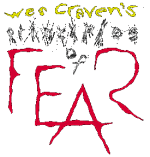 Craven had approached us with a concept called Principles of Fear, which was about exploring the various causes of fear. The goal was to create an action-adventure game which encompasses all levels of human fear and conflict within a challenging game scenario. Although many games did justice in rendering ferocious combat, and others take great care in presenting a psychological challenge, few successfully combine both elements.
As Craven described his ideas across several meetings, I found him to be an extremely intelligent, erudite and charming man. He was also a master storyteller, in person as well as on-screen. I knew right away that working with him would be delight.
I contracted game developer Asylum Entertainment, whose credits included the military strategy adventure Allied General for SSI and SimFarm for Maxis, to develop the CD-ROM action-adventure. I also found working with Asylum and its president, Brett Durett, to be yet another delightful experience, as we worker together to turn Wes Craven’s insights on the essence of fear into a compelling three-dimensional game taking place in what was essentially a haunted house.
We had thought we had succeeded when we demonstrated an early prototype of the game at the 1997 Electronic Entertainment Expo when About Games awarded our game a Bronze Medal award for Best of E3 — Interactive Fiction.
Unfortunately, Wes became deeply involved in developing a new movie at this time, and we only had access to his manager, who apparently had little understanding of games or the process of making them. When I demonstrated our award-winning E3 demo to her, it did not meet whatever expectations she had about what the video game would be like. She insisted on canceling the project and we could not talk her out of it.
And so I woke up from our dream of working with Wes Craven with nothing to show for it but some good memories of our meetings with him. Now with his passing, I’ll never again have a chance to apply his Principles of Fear. Lost opportunities are one horror that I do not enjoy at all.
Remembering the fun of making games at the 2015 Apple ][ Reunion Party
 For this week’s blog post I had planned to write about my experiences at E3, the Electronic Entertainment Expo, but then I received an invitation to attend an even more noteworthy event — a reunion at the home of Doom developer John Romero for many of us who had developed games for the Apple II computer. In addition to being a historic figure in game development himself, John has a deep love for the history of Apple II games. John’s first published game, Scout Search, appeared in the June 1984 issue of inCider, a popular Apple II magazine during the 1980s, and he went on to develop a number of Apple II games, both through his own company, and later, at Origin Systems. And while he has since gone on bigger and better things (did I mention that was one of the developers of Doom?), he is an avid collector of Apple II games, hardware and memorabilia.
My own introduction to the Apple II was through Gene Sprouse, one of my instructors at Cal State University, Northridge. I was enrolled in his COBOL business programming course, but when he found that I was using the university’s computer to print out pictures of the starship Enterprise, he asked me to stay after class. But instead of criticizing me for wasting valuable computer time, he offered me a job. Gene and several other partners owned Rainbow Computing, the second computer store to open in Los Angeles, and wanted me to work as a clerk in his store. Of course, I happily accepted.
Not long after I started working at Rainbow Computing, Gene and his main partner, Glenn Dollar, became registered dealers of a new computer called the Apple II. Prior to this time, computers were sold to hobbyists, because they had to be assembled and were difficult to use. However, the Apple II, created by engineer Steve Wozniak and his business partner, Steve Jobs, was designed for home use. It could be connected to the family’s home television set and came with game paddles.
However, there wasn’t much software (what the kids these days would call “apps”) available for it when it game out, not even games. But the machine did come with its own, easy-to-use, programming language, BASIC. So, what a lot of our customers would do after purchasing an Apple II was to program their own software. Then, they might make some copies of it (on standard audio cassette tape), photocopy some documentation, put everything into a ziplock bag, and then bring it to our store to sell. We eventually received such an inventory of games and other software to sell that we opened up a mail-order business, and filling those orders became my responsibility.
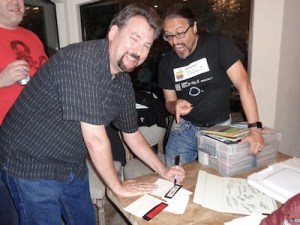 John asks me to sign his copies of The Prisoner and Prisoner 2. John asks me to sign his copies of The Prisoner and Prisoner 2. |
Some of our customers also decided to start their own game companies — Ken Williams of Sierra Online, Dave Gordon of Programma International, and Sherwin Steffin of Edu-Ware Services. Upon learning that I was studying computer science and had an interest in games, Sherwin asked me if I would write some games for his company. So, while I was finishing up my degree, I created Space II (a text-based RPG), Windfall (an oil crisis simulation), and Network (a television programming experience) for Edu-Ware, before joining the company full-time when I graduated. During my time at Edu-Ware, I programmed my most well-known Apple II games, the text-based adventure The Prisoner, and its hi-res graphics update, Prisoner 2.
 Looking over the Apple II hardware partygoers brought to be signed, with Softape co-founder Gary Koffler Looking over the Apple II hardware partygoers brought to be signed, with Softape co-founder Gary Koffler |
Another major software publisher of this early era was Softape. Co-founded by William Smith, Bill Depew and Gary Koffler, The company published computer games, utilities and productivity programs for the Apple II family. Softape produced a newsletter magazine Softalk, but it was taken over by Margot Comstock and Al Tommervik in 1980 and re-designed into the Apple II enthusiast magazine Softalk. The startup capital for Softalk came money Margot had won on the television game show Password. Margot told host Allen Ludden that she wanted to use her winnings to buy a computer, and after several trips to various computer stores, she settled on the Apple II.
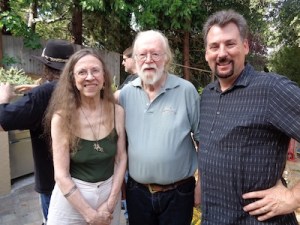 With Softalk founders Margot Comstock and Al Tommervick. With Softalk founders Margot Comstock and Al Tommervick. |
It is impossible to overstate the influence Softalk had in forging a community out of all these “mom-and-pop” companies started by devotees of the Apple II. Unlike other computer magazines that generally focused on a specific, narrow subject matter or market segment, Softalk gave broad coverage to all parts of the Apple world of the time, from programming tips to game playing, from business to home use, including computing as an industry, a hobby, a tool, a toy, and a culture.
 With Assembly Lines author, Scott Wagner. With Assembly Lines author, Scott Wagner. |
Another characteristic of the magazine was a playful, insider-like voice. The experts in those early days seemed to chat in their own relaxed language about the techniques and elements of their world. One of these experts was Roger Wagner, who wrote a column (and eventually a book) on programming in assembly language for the Apple II. I probably learned more about sophisticated programming from Roger than I did in college, allowing me to program graphics engines, natural language parsers, and maze generators for my games in the Apple’s 6502 assembly language.
Eventually, I went on to form my own game publishing company, Electric Transit in 1985. We specialized in real-time 3D simulations games for the Apple II (and the IBM PC). Because games were still being sold through thousands of individual mom-and-pop retailers throughout the country, and, so we needed a distributor to get our product to those retailers. We turned to another young company that had started just a couple of years before us, Electronic Arts, and we became their first affiliated label software publisher. Unfortunately, being the first, EA made a lot of initial mistakes with us, such as overestimating orders of our product, and within two years, we were out of business.
 With Dick Tracy programmer, Steve Baker. With Dick Tracy programmer, Steve Baker. |
I then joined The Walt Disney Company in 1987 as its very first game producer. I produced a number of games for the Apple II (as well as other platforms) at Disney, and my last Apple II game was based on the film Dick Tracy. Programmed by Steve Baker, it was one of the most technically sophisticated Apple games I ever produced, thanks to Steve’s audio routines, but two months before it was complete, our marketing department determined that the market for Apple II games had died out and requested the project to be cancelled.
 With our gracious host, John Romero. With our gracious host, John Romero. |
Flash forward 10 years: John Romero holds a party at his company Ion Storm for a reunion of Apple II game developers. When I received the invitation, nothing could stop me from hopping on a plane to Dallas. There I met some of the people that produced some of my favorite Apple II games, including Dan Gorlin of Choplifter fame.
Flash forward another 15 years, to last week. While I’m preparing for E3, I receive a Facebook message from Softape co-founder Gary Koffler that John was holding another reunion party at his home in the Santa Cruz area that weekend. It took surprisingly little effort to convince my wife, Char, to make the five-and-a-half hour drive up to attend the party (it helps that we decided to spend the night at a hotel along the beach.
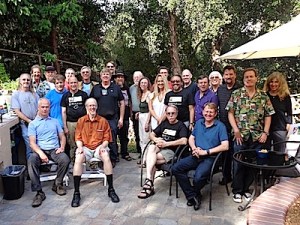 Partygoers in the Casa Romero backyard. Partygoers in the Casa Romero backyard. |
We arrived a couple of hours late, and the party is in full force. John and his wife, Brenda, have a lovely home in the forested area. Too my delight, I see the house is decorated with items from John’s games and games in general. But best of all were the terrific people who showed up. In addition to the ones pictured above, here are some of the people I had the pleasure of seeing again (some, after a decade or two) or whom I have long admired but never had a chance to meet before.
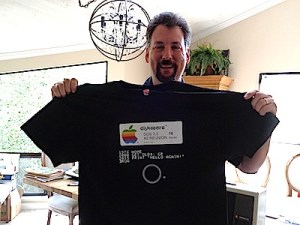 2015 Apple ][ Reunion t-shirt. 2015 Apple ][ Reunion t-shirt. |
Af about 11pm, Char and I started to nod off, so we had to take our leave. John was nice enough to make t-shirts for us to remember the event. It was sad to go, but I hear that John is already planning another of these reunions, one with hopefully even more of us Apple II veterans in attendance.






 David Mullich