Blog Archives
Should You Start Your Own Game Studio?
 This morning a young man contacted me to get advice about starting his own game development studio. As is usually the case when I listen to requests like this, the man knew nothing about game development and nothing about running a business. What he had was an Idea, which is better than some people who just like the idea of having their own game studio but don’t even know what kind of game they would like to make.
To get the conversation going, the first question I ask people looking for my advice is, “Do you want to make a game, or do you want to make a business?” That’s an important distinction because most games are not successful. You have to may have to make several games before you have any hopes of making a profit. So, unless you are just making a game to scratch an item off your bucket list, you need to plan for the long haul and come up with a plan that will sustain you until you have a legitimate business going.
The first step in setting up a company is to do some research to find out how the game industry works, especially if you haven’t worked in it before. Visit the game industry website Gamasutra every day to read stories on the success and failure of other companies, follow movers and shakers on social media, visit retail and online stores to learn about sales and distribution, and attend industry-related meetings, conferences, and trade shows.
Next, you need to come up with a plan. A business plan. One way to get started is to follow this commonly used template for a business model.
Customer Segments
Who are your customers and what are they looking for in a game? If you say you are making your game “for everyone”, then you don’t understand your customers, because game players are not a homogenous group. Typical demographics used to target players for a particular game include age, gender, favorite genre, skill level, preferred play session length and income level (which may be a constraint on how much they can afford to pay for your game).
Value Proposition
How will you satisfy your customer’s entertainment needs with your particular game? Players play games for many different reasons: to be challenged, to chill out for a while, to participate in a story, to learn new things, for excitement, for mental stimulation. Once you determine how your game provides entertainment, then you need to figure out what will make your game special. There are thousands of games on the market place, so what makes your game sufficiently compelling and different that people will want to play yours?
Key Resources
What resources are required to maintain your business model? In the game industry, your key resources are you development team — the designers, programmers, artists and audio specialists who are making the game. Unless you are using your first game as a training exercise for them, you will need to find experienced developers. You should also hire a lawyer to establish your studio as a legitimate business and to provide legal advice on contracts. It is also a good idea to hire an accountant or business consultant to manage your financials. If your studio is more than a few people, you may also need an office manager and/or a human resources professional. Then there’s marketing and sales to consider. Once your game is a few months away from its launch date, marketing can easily take up 25% or more of your time — do you want to handle that yourself, or at least hire a marketing consultant?
Key Activities
What activities are required to build the business? For this, you need to bring your development and marketing staff together to figure out all the steps required to make and market your game. Get them into a room and spend a few days hammering out an initial task list and schedule. Rely on their expertise for telling you what the key activities are, although you can set priorities, goals and deadlines (that your staff agrees are doable).
Cost Structure
What are the costs for developing and marketing your game? The main costs of developing a game are the salaries of your game developers (you were planning to pay them, weren’t you?), but there’s also equipment, furniture, supplies, office rental, electricity, telephone, internet, legal fees, insurance, and all the million other things involved in running any business. You should also set aside a budget for marketing your game.
Channels
How will you find your customers and promote your game to them? Channels for promoting your game include advertising, public relations (press releases, reviews, publicity stunts), and social media (Facebook, Twitter, YouTube, etc.) Then, how will you deliver the game to them — through a retail store, via mail order, or via digital distribution?
Strategic Partners
What partners are needed to maintain your business model? Distribution is the area where most game studios need to find a business partner. If you are planning to distribute your game through retail stores, then you are going to have to enter into a distribution relationship with an established publisher like Electronic Arts or Sony Computer Entertainment. In addition to distribution, publishers can provide you with marketing assistance, the benefit of their experience in developing other games, and perhaps most importantly, financing of your development costs. However, there is a price for that: they will also take a significant portion of the sales revenues as well as exercise creative control over the game.
Customer Relations
How will you attract, convert and retain customers? A marketing and public relations strategy can attract players, and a well-crafted value proposition can convert them to paying customers, but maintaining their loyalty involves community management and technical support programs that shows you are paying attention to them and responding to any problems they are experiencing.
Revenue Stream
How many potential paying customers are there, and how will you earn revenue from them? Many games are a single purchase, but some have a monthly subscription, sell virtual goods, or host paid advertising. As part of your initial research, you should look at how your competitors are making money from their game and how large their customer base appears to be.
That’s the beginning of a plan, but a plan needs funding if it’s going to become a reality. So, how are you going to fund your business? Do you have a relationship with any angel investors or venture capitalists, have you secured a bank loan, are your reinvesting profits from another of your businesses, or is your Great Aunt Edna willing to give you your inheritance early? Because unless you have some money to actually pay people to turn your idea into a product, that’s all the advice I’m going to give you for today!
Innovation On Display At IndieCade 2016
 The IndieCade Festival is the country’s biggest event dedicated to celebrating games made by independent developers (those not supported by game studios). Last weekend was the ninth Festival, and this year it was held at the University of Southern California’s School of Cinematic Arts, which is home to USC Games, the most prestigious educational program for game design in the country. I was only able to attend IndieCade on its last day, Sunday, but as always, I was impressed by the imagination and passion behind the games on display.
Gaming Is For Everyone
Diversity remains a hot topic in the game industry, and Intel supported this issue by sponsoring the Gaming Is For Everyone exhibit. This was my first stop of the morning, and I could have easily spent the rest of my time in this one room.
 Games for Change (G4C) is a non-profit organization promoting and facilitating the development of games for social impact, which includes learning, civics and health. G4C hosts public arcades, funds game design challenges, workshops, and produces the annual G4C Festival, which highlights games for good and brings together developers, social innovators and funders to further develop the field of impact games. Through G4C Lab, it consults with organizations on social impact game strategies and often pair game developers with cause-related organizations to executive produce games. . Among the more fascinating games at its table was We Are Chicago, developed by Culture Shock Games. In this first person narrative-driven adventure game using real stories, you play a high school kid from Chicago who’s best friend has disappeared, is threatened by gangsters at school, and finds the shootings on your block to be the only constant in your life. As you explore your relationships to uncover what really matters, you learn the important of friends and family sticking together to keep each other safe. We Are Chicago has earned a number of honors and received IndieCade 2016’s Developer Choice Award.
 I’ve long been an enthusiastic supporter of women in game development, and so I had to stop by the GirlsMakeGames table. Girls Make Games is a series of international summer camps, workshops and game jams designed to encourage girls to explore the world of video games and development. The camps are run by LearnDistrict, an educational company based in San Jose, CA. We are committed to providing students with access to knowledge through our games and programs like Girls Make Games workshops. Their goal to teach 1 million girls around the world how to make games by 2020, and if anyone can do it, they can.
 One gentleman I especially enjoyed talking to was Marcelo Viana Neto, an artist, educator, and game designer who also shares an interest in games and education. While earning his Master’s Degree in Digital Arts and New Media at University of California, Santa Cruz, he developed a curriculum for an introductory course on video game game design and development for youth ages 12 and up, with little-to-no game-making experience. The explicit nature of Radical Play is to expose students to a variety of design methodologies, diverse array of game development software, and novel game play experiences to encourage student self-expression through video game design. His course also aims to develop students’ sense of autonomy, by using a variety of classroom management techniques, and allowing students to choose their game-making tools and creative path.
Innovative Input Devices
 I decided to put one of the exhibits I visited at the Gaming Is For Everyone pavilion under a separate header for some of the innovative input devices I saw at the Festival. XTH Sense calls itself the world’s first biocreative instrument and next evolution in sensory expression. The XTH Sense harnesses the power of your body to let you interact with connected devices, musical and video software, games and virtual reality in a highly personalized and engaging way. Using multiple biophysical sensors, the XTH Sense captures various sounds from your body, such as muscles contracting, blood flowing, the heart beating, as well as your motion data and temperature. These sounds and data represent your expressive signature. With the XTH Software Suite you can use your expressive signature to control musical parameters, create digital drawings, interact with game mechanics and play in virtual reality (VR). It also makes for a cool wristband.
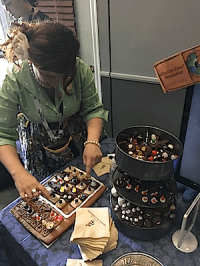 I was feeling a bit peckish when I game across the most delicious game to satisfy my IndieCade appetite. The Order of the Oven Mitt is a tabletop, completely edible game for all ages that will get you laughing and strategizing while you satisfy your sweet tooth. Created by game designer Jenn Sandercock of Inquisment, this non-competitive game’s components, other than the Sacred Tome, are edible. This includes the main board and the edible-ink pens used to decorate and personalize your Knight. This design choice means the entire sacred space can be eaten, so that there is no evidence left of it. This yummy game is designed foster friendship, curiosity and challenge, and as the cherry on top, it won IndieCade 2016’s Interaction Award.
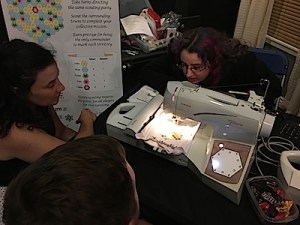 They say you reap what you sew, and this was never truer than it is with Threadsteading, a two-player game for a modified quilting machine. The quilting machine is a computer-controlled longarm quilting machine, which moves a sewing head around a 12′ x 2.5′ area to stitch 2D paths. Players act as competing commanders of a team of royal scouts tasked with exploring a hex-gridded domain of varying terrain difficulty. Gameplay is turn-based and designed around the unique constraints of the platform. Because the output is essentially a single “pen” position over time, each turn must pick up where the previous turn left off; because the final artifact is a quilt, the rules should encourage an even spread of lines across the surface—ideally, a quilt has neither large unsewn portions nor multiple stitched lines on top of each other. This truly unique game, created by Disney Research Pittsburgh, deservedly won IndieCade 2016’s Technology Award.
 However, the most, um, intimate input device I’ve ever used in a game came courtesy of Infinite-0: Dreams of Space. The video game is a conceptual portrait on the life & influence of three generations of women artists: Eugenia Butler, Eugenia P. Butler, and the game’s designer, Corazon Del Sol. The central character is a pair of three legs that the player uses a controller in the shape of a vagina to navigate a series of planetary vignettes, with theme elements that oscillate between absurd dreaminess and narrative vehicles that explore the archetypes of woman-hood. The player scampers through the territory of a creative self, attaining material signifiers that raise her stature in the world, but she also holds power to destroy what she’s created for herself. Dreams, which seeks to embrace the absolute freedom to succeed creatively in respective cultural paradigms, won IndieCade 2016’s Visual Design Award.
Tabletop and Live-Action Roleplaying Games
I spend so much of my time involved with video games that when I go to events like this, I am attracted to the non-video games. Here are a few that caught my eye.
 Fracture is a competitive tabletop game where each player strives for diversity. The game is played using a set of smart hexagonal tiles called AutomaTiles by its inventor, Jonathan Bobrow, that communicate with one another to determine the board state. The tiles simulate a population of different colors that simply “want” to be around colors different from themselves. Each player is assigned a color and is given the goal to keep the population together, but make their own color touch only other colors. Players quickly realize they need to manage their ability to prevent others from winning while moving themselves forward. I learned this a bit to late when, just as I was about to make my winning move, I lost to another player.
 Keeping the Candle Lit is is a live-action freeform game inspired by blackbox theater techniques and abstract play. Designed by Shoshanna Kessack, who drew her inspiration from being raised as a Conservative Jew, the game immerses players in a story about three generations of women in one family fighting as partisans during the war. Having escaped the grasp of the Nazis, they have taken to the woods of Europe to fight back in armed resistance. The women are from a traditional Jewish background and have spent their lives steeped in their culture and religion. Confronted with this wide-open world fraught with danger, they must decide what part of their past traditions they wish to preserve, and what legacy they will carry with them to be passed down to future generations. A session runs for four hours, requires three players and two facilitators who will also play supplemental roles.
 Bad News is an installation-based game that combines procedural generation, deep simulation, and live performance. Set in the summer of 1979, gameplay takes place in a procedurally generated American small town with over a century of simulated history. When an unidentified body is discovered in the town, a mortician’s assistant—the player—is tasked with tracking down a next of kin to inform him or her of the death. To do this, the player explores the town and converses with its residents to discover the identities of both the deceased and next of kin, as well as the current location of the latter. Whenever the player encounters a town resident, an improvisational actor reveals himself to perform the character live, adhering to the character’s generated personality, life history, and knowledge. Created by a team of PhD students at the University of California, Santa Cruz, Bad News is designed to showcase the humor, drama, and tragedy of everyday life, and the game won IndieCade 2016’s Audience Choice Award.
Luck: When Planning Meets Opportunity
 IndieCade is not just about the games developed by independent game developers, but the indie game spirit. And no one embodied that more at IndieCade than two of my Los Angeles Film School students, Robert Rose and Josh Weston. Although the game they had submitted, Nightmare, was not selected by IndieCade, the two received free passes for their efforts. By accident they walked into a meeting room where a representative from Oculus Rift was being pitched game ideas. Instead of backing out of the room, they decided to pitch the game they had developed in class and were rewarded with the promise of a follow-up discussion. I was thrilled to see their indie spirit paying off.





 David Mullich