Blog Archives
Recall And Possession At The USC GamePipe Lab Fall 15 Demo Day
 Last Thursday I attended the University of Southern California’s GamePipe Lab’s semi-annual Demo Day held at the Egg Building just outside the university’s Los Angeles campus, and yet again I was impressed by the exceptional work of some of the best and brightest game development students in the country.
For USC Viterbi School of Engineering Professor Mike Zyda and his students in the USC Games program, the Fall 2015 Demo Day event is an opportunity to show off four months’s worth of collaboration, creativity and computer design. It’s also the students’ introduction to a host of industry scouts who may purchase and publish the games when they are completed next Spring, as well as hire program graduates to design, program, and produce the games of the future. I make an effort to attend Demo Day every six months to help me set aspirations for my own students at The Los Angeles Film School.
Here are two of the games that I had the opportunity to take for a spin.
Recall
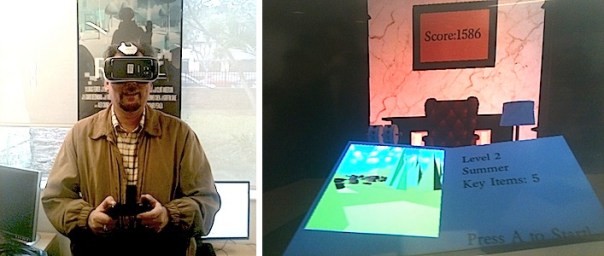
Recall is a virtual reality game that helps players learn what they really want to know. Actually, the students say that it is more than a game – it is a virtual reality “mind-hack.” Inspired by the spatial and imagery based mnemonic techniques of competitive memorizers, Recall is a tool to improve a player’s memory that puts them in VR “mind-palaces” constructed for their own “digital documents”. In essence, it turns your documents into playable “levels” designed for easy memorization.
The idea is the player chooses which information they would like to remember – a .PDF, .doc, .ppt, web page, etc. Recall then slices the document into small, digestible packets and procedurally generates an explorable, interactive virtual reality world based on the amount of information in the document. When the player enters this new memory palace, they will find their sliced document in “framed” packets with associated key-objects placed along a path. This singular path will take them through their entire document.
In the demo version I tried, the goal was to find a collection of 3-D objects in a virtual reality landscape, and then later recall where on the landscape I found each object. The graphics were rudimentary at this point in development, and I found the text “packet” associated with each item a bit hard to read, but I thought the concept was promising. I particularly enjoyed ease of motion of the 3D headset, which received input from the game via an Android phone snapped into the front of the headset. It was a much more comfortable experience than wearing heavy Oculus Rift headset and renewed my excitement about the potential of virtual reality games.
Possession
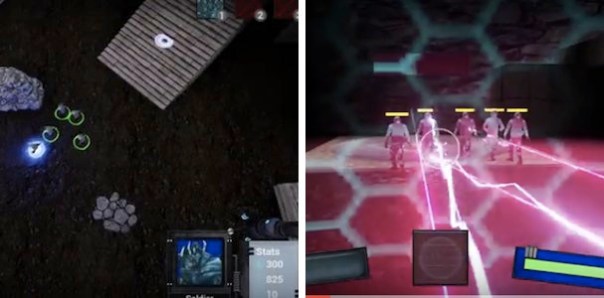
Possession combines that battlefield tactics of a Real-Time Strategy game with the visceral experience of a First-Person Shooter. The player commands squads of units, organizes attack and defense strategies and manages and control resources. But what makes this game unique is that the players can put themselves in the position of a single soldier by switching game modes with a single button push.
Whether it be to put yourself in the position of a sniper to kill enemy units from across the map, go on a rampage as a super-soldier in a huge battle, command a tank to wreak havoc upon your enemy, or organize all of your forces from the comfort of your base – you not only get to command your army, you get to be the army.
Unfortunately, the concept reminds me of the old Saturday Night Live sketch about Shimmer: “It’s is both a floor wax and a dessert topping!” That’s always the danger with combining two game genres, and indeed I found it a bit disorienting to be switching between RPG and FPS modes, and there were times where I was so immersed in my own first-person conflict that I forgot about managing my troops elsewhere on the battlefield.
However, the game still has another six months to go in development, and I’m hopeful they’ll tweak the design to create a more cohesive play experience. I was actually blown away by the technical and artistic competence displayed in just four months of development. If my own students could do that kind of work in such amount of time, I’d be very proud indeed.
I had a meeting to attend on my own campus, so I wasn’t able to try out more games that day, but you can bet I’ll be back in May to see how things progressed for these great student teams. If you’d like to find out more about these and other GamePipe student projects, please visit USC GamePipe Laboratory Fall 2015 Showcase.
Brainstorming Ideas And Turning Them Into Concepts
 All games start out as ideas. Some games come from one powerful idea, but most are formed by combining many ideas to create a unique whole. It’s very possible that initial ideas will be (or should be) abandoned, and lots of new ideas will be considered during the process. It is usually the responsibility of a game designer to come up with ideas for a new game, but often the entire development team participates in generating ideas during what is called a brainstorming session. At one game development studio I worked at, Jet Morgan Games, we always kicked off a new game project for a client by inviting everyone in the company — designers, producers, programmers, artists, even the bookkeeper — into the conference room for an initial brainstorming session.
Brainstorming is a group creativity technique in which members work together to find a solution to a specific problem by gathering a list of ideas spontaneously contributed by everyone in the group. In games, brainstorming is used to generate a large number of ideas about game’s concept, mechanics, setting, characters, etc. The term “brainstorming” was popularized by advertising executive Alex Faickney Osborn in the 1953 book Applied Imagination.
Osborn’s method of brainstorming has four general rules:
- Focus on quantity: Try to come up with more ideas than you think you need because you may discover you need them later. You may find that some ideas that sounded really good during a brainstorming session turned out not to be so good when they’re actually implemented, and you’ll have to turn to other ideas.
- Withhold criticism: Don’t inhibit members by judging their ideas, even if they seem unrelated to the problem you’re trying to solve. Besides, ideas that sounded bad during a brainstorming session may actually turn out to be the ones that lead to solution that your are trying to solve.
- Welcome unusual ideas: “Outside the box” ideas are great, even if they seem unworkable or inappropriate, because they can help stimulate other ideas.
- Combine and improve ideas: This is why you don’t rule out any idea as inappropriate, unworkable, or bad. All ideas can serve as fuel for generating better ideas.
Here is a brainstorming exercise I do with my students at The Los Angeles Film School.
I divided my students into groups of three and ask them to come up with 100 game ideas in one hour. I give them 100 ideas as their goal so that they will stay focused on quantity rather than quality, and I keep the time limited so that they don’t spend too long on the exercise. I want them to keep a fast pace. However, I do give them the restriction that it needs to be a game that their group can develop within a two-week period (the remainder of the course).
I allow them to leave the room and go to a more playful environment, such as a lounge or somewhere outside. Anywhere that can help stimulate their imaginations. I do require for them to write down their ideas. Ideally, they should use a whiteboard because it’s best to put ideas on a wall for everyone to see, but that’s not always possible, so I allow them to use index cards, post-it notes, or just sheets of paper.
When they return from their completing their assignment (in all the times I’ve given this assignment, no student group has failed to come up with 100 ideas), I tell them not to get too attached to their ideas, because they are going to narrow it them down their lists. I explain that while there is no such thing as a bad idea during the brainstorming session, there are lots of reasons to set aside ideas afterwards:
- Technical Feasibility: The programmers don’t know how to implement the properly.
- Market Opportunity: The marketing people doesn’t think there’s a market for the idea.
- Artistic Considerations: The development team decides they just don’t like the idea.
- Design Experience: The designers don’t think they can make engaging gameplay based on the idea.
- Innovation Needs: The idea just isn’t innovative enough to stand out from the competition.
- Marketing Goals: The idea doesn’t fit in with the company’s long-range marketing plan.
- Business and Cost Restrictions: The projected revenues for the idea are less than the projected costs of implementing it.
With these idea filters in mind, I then have the students edit their 100 game idea lists down to the top 5 to 10 ideas and discuss each thoroughly. I have ask them to remain positive during their discussions and discuss the strengths of each idea.
Next, I have them narrow down their list down to their three favorite ideas and for each one, write a 3-to-5 concept treatment describing the game’s theme, play mechanics, controls, art style, storyline, and audio.
If I had more time in my class, I’d have them create a mock advertisement and packaging for their game and then hold focus group sessions with target customers to determine which ideas resonated with them more. If you are working for a real game development company, this may be something you should try so that you have a better idea about the appeal of your game idea before you spend too much development money on it.






 David Mullich