Blog Archives
A Game Designer Is Not The Same Thing As A Game Artist
 There seems to be a common misconception that a game designer is the same thing as a game artist. Students and wannabe game developers have told me that want to be a game designer and create all the concept artwork for a game — or, alternately, they are concerned that about not much skilled in drawing. Apparently, they have the perception that a game designer’s come up with an idea for a game, draws a lot of sketches about how that game should look, and then passes those sketches off to someone else to do while waiting for their royalty checks to roll in.
That fact is that game designers do not need to be very good at drawing. At most, a typical game designer may sketch out the structure of the game’s menu, the placement of buttons and other user interface elements on a screen, or the layout of a level. However, there are many good tools that can assist you in these tasks.
Writing is a far more valuable skill for a game designer to have, as well as the drive to work hard throughout the game’s development.
These are the main tasks of a game designer:
- Take a game idea (the idea may be someone else’s, such as the manager of a studio or a producer at a publisher) and work out all the details that make it a complete design: goals, obstacles, resources, rules, controls, story, and so on. For a large-scale game, this means creating one or multiple game design documents that are hundreds of pages long, full of tables, formulas, and diagrams explaining how the game will work in sufficient detail that all the programmers, artists, and sound engineers can figure out what their tasks are.
- Possibly create a rough paper or digital prototype of the game to test and nail down the rules and other game elements before it goes on to the development team.
- Conduct playtest sessions with groups of playtesters, record their reactions to the game, analyze the results, and make necessary modifications to the design that will create the experience they were trying to create.
The task of creating sketches for a game’s characters, objects, and environments is that of a concept artist. Some game designers are also concept artists, but most are not. Concept artists are specialists who are skilled in illustration or fine art.
They are also commercial artists, in that they have a client (the designer) for whom they work. They create illustrations of the game characters, objects and environments described by the game designer, and if approved, these illustrations are used by the other artists on the art team for to create models, textures, animations, and levels.
Game designers and game artists both apply creativity in their craft, but their skills and responsibilities are very different from each other.
Trying My Digits At Teaching Analog Game Design
 I grew up playing popular board games with my family — Candyland, Chutes and Ladders, Operation, Life, Clue, Monopoly, Scrabble, Risk, Stratego. Eventually, I began to design my own boardgames for fun. In my college years, I discovered Dungeons & Dragons, and that role-playing game helped me form my early ideas about game design as I began to develop video games. Three decades later, when I was working at the Spinmaster toy company, I renewed my interest in board games by participating in the company’s weekly board game playtesting sessions.
One of the classes in our game program at The Los Angeles Film School is Analog Game Theory, which introduces students to game design principles for board and card games that do not require technology to create engaging experiences. Our AGT instructor moved out of state recently, and while we were waiting for to bring aboard a replacement instructor, I was given the opportunity to teach the class, and what a fun time it was for me!
During each of the first three class sessions, I had the students play and then analyze a board game — Carcasonne, Puerto Rico, and Settlers of Catan, respectively. After discussing the considerations that the game designers made in creating each of the games, I had the students do a quick game jam, making a game games based upon a particular play value, a game mechanic, or use of randomness for a game element other than player movement. Then, for the last seven sessions of the class, I divided the students into three teams to develop a final project for our bi-monthly Analog Game Fair.
It was the physical aspects of the games that most concerned me, having only worked professionally in digital games, but I was very pleasantly surprised with the polish that some of the students brought to their games.
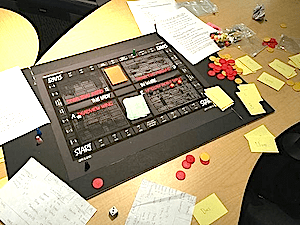 Lady In White was a horror-themed game created by a three-person team. Players would roll dice to move spaces around the game board to collect resources needed build graves and other graveyard structures used to collect souls with the goal of collecting a certain number of souls to win the game. The player could collect the more common resources, Dirt and Wood, by passing them as they moved around the board. However, the more rare resources could only be obtained by landing on a specific space or by purchasing them using the game’s currency, gold. Gold was collected by landing on marked spaces or by drawing a card with a random effect. These cards could also have negative effects on the player such as losing all of the resources they had collected so far.
The game board fit into the game’s theme well, but there was a problem with the game resources. First, the difficulty of acquiring the resources for the various graveyard structures did not correspond to the amount of souls each structure could capture. After doing some quick analysis of the cost of various structures in terms of gold, it was obvious there was only one structure worth of purchasing. Also, the game had too many resources with too little differentiation between them, so the game was basically about collecting resources as quick as you can to generate enough souls to win the game. Finally, when four players played the game, it took too long to generate enough souls to win, and we wound up quitting the game after an hour, as there was too little variety to keep us occupied. Many of these flaws should have been found in the three playtest sessions we had before Game Fair, but it appears that the players who were playtesting the game were not critical enough.
 Outfall was a board game inspired by the computer role-playing game Fall Out. Players start the game by choosing which character class to play, which determine which of four stats would be used for determining success with other characters. Throughout the game players would draw equipment cards that would be used to modify their states. When players landed on board location representing an enemy character or one occupied by another player, they would do battle by rolling dice and referring to their stats to determine which one the battle, usually with some positive benefit to the winner and a negative penalty to the loser, with the effects varying based on their character class. Equipment cards are drawn by players to reveal a potential item that they could use towards a players stats. Other elements that added uncertainty to the game were additional cards that the players could collect and play at various points in the game to add benefits to themselves or penalize others.
This game was made by a four-person student team, but the team was hampered by two of its members being frequently absent during production. As a result, the game components lacked the polish of the other two games made in the class. The gameplay was fairly simple, yet it was engaging. Overall, it was a fun premise that could have been made richer given more time (and more involvement from the rest of the team.
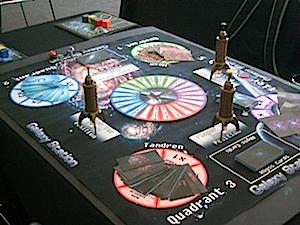 The final game presented at our Game Fair was Galaxy Station, made by another three-student team. In this game, players traveled around a game board collecting materials necessary to enhance their spacecraft, which each enhancement bestowing certain benefits. The final version of the game featured gorgeous-looking components, but what really captivated me was a game mechanics that rotated the central path on the board with each phase of the game, opening up different paths and opportunities for players to collect rate resources from the circular side paths. The game was eye-catching from a visual stand-point and its gameplay was compelling as well.
All in all, my experience in teaching a class about creating board games turned out to be an even more fun experience than I anticipated, and it made me want to start playing board games again, although perhaps checking out some more recent games that are a bit more innovative than the ones from my youth.