Blog Archives
Why Do We Play Games?
 We play games because they’re FUN!
Duh!
Okay, okay. That’s not much of a blog post, so we can’t stop there. Let’s take a close look into what makes games fun to play.
Game designer Horst Streck describes fun as “the enjoyment of pleasure.” So, not only does an experience have to be pleasurable to be fun, one has to actively enjoy it. That is, one needs to be receptive to the pleasurable sensations. For example, a shoulder rub can be very pleasurable at times. But if someone tries to rub your shoulders when you’re trying to concentrate on a frustrating, time-sensitive task, you may find the experience annoying. For you to enjoy the sensation, you have to be a willing participant. No one can make you have fun; you need motivation to be receptive to fun.
MMO game pioneer Professor Richard Bartle, famous for the defining the Bartle Player Types in virtual worlds, says that when we play a game, we experiment with four main motivations:
- Achievement: Trying to get more points
- Immersion: Imagining oneself in the game world
- Competition: Trying to defeat opponents
- Cooperation: Working together as a team
Bartle is also famous for describing the four Bartle Player Types he’s identified in virtual worlds – Achievers, Explorers, Killers, and Socializers – suggesting that each of us finds different things to be fun.
Now, Bartle has said that his model only applies to players in multi-user dungeons, but different game designers have different models for what players find to be fun. Game Designers use the term “play value” for the reasons why a particular player enjoys playing a particular game. XEODesign CEO Nicole Lazzaro describes what she calls the Four Keys of Fun for describing the play value of a game:
- Easy Fun (Novelty): Curiosity from exploration, role-play, and creativity.
- Hard Fun (Challenge): Fiero, the epic win, from achieving a difficult goal.
- People Fun (Friendship): Amusement from competition and cooperation.
- Serious Fun (Meaning): Excitement from changing the player and their world.
A game such as Dungeons & Dragons might be fun to some people due to its Novelty aspect, according to Lazzaro’s Four Keys, while Tetris provides hard fun through Challenge.
Again, this is but one of several theories as to why we play games.
The landmark paper MDA: A Formal Approach to Game Design and Game Research written by game designers Robin Hunicke, Marc LeBlanc and Robert Zubek in 2004, divided aesthetics within games into eight categories:
- Sensation: Game as sense-pleasure
- Fantasy: Game as make-believe
- Narrative:Game as unfolding story
- Challenge: Game as obstacle course
- Fellowship: Game as social framework
- Discovery: Game as uncharted territory
- Expression: Game as soap box
- Submission (or Abnegation):Game as mindless pastime
According to the paper, when game designers create games, they tend to focus on the actions of a games first. When the player performs that action and interacts with the game, they experience the dynamic of that interaction, which in turn produces aesthetics, or emotions, for the player. Hunicke and her colleagues recommended that game designers should first determine what aesthetics they want for the player and then determine the mechanics that will elicit those feelings.
Gamification designer Victor Manrique, proprietor of the Epic Win Blog, writes that the specific reason that people play games is that games allow them to experience emotions that are closely related to the main factors of happiness. Thus, we play games because they make us happy. So, we again have to ask a question: what is happiness?
Psychologist Martin Seligman provides the acronym PERMA in his book Flourish: A Visionary New Understanding of Happiness and Well-being to summarize the factors that seem to make people happy:
- Pleasure: tasty food, warm baths, etc.
- Engagement (or flow): the absorption of an enjoyed yet challenging activity
- Relationships: social ties have turned out to be extremely reliable indicator of happiness
- Meaning: a perceived quest or belonging to something bigger
- Accomplishments: having realized tangible goals.
In another book, Game On, game designer John Radoff, lists 42 things that are fun, and mostly all of them involve emotions that are related to a PERMA factor. Here are a few:
- Relaxing: Pleasure
- Competition: Engagement
- Organizing Groups of People: Relationships
- Improving Society: Meaning
- Triumph Over Conflict: Accomplishments
Dr. Steven Reiss, Psychology and Psychiatry professor emeritus at the Ohio State University, categorizes our motivations in even finer detail by describing 16 different human motivators and their object of desire. If we were to take Reiss’ work and associate these objects of desires with the goals in a particular game, we can come to the conclusion that when we play, it seems that our motivations for playing are closely linked to our general human motivations.
- Power: Influence (Balance of Power)
- Curiosity: Knowledge (Civilization)
- Independence: Self-reliance (Oregon Trail)
- Acceptance: Being part of a group (Guild Wars 2)
- Order: Organization (Tetris)
- Saving: Collecting things (Farmville)
- Honor: Loyalty (Football)
- Idealism: Social justice (Amnesty the Game)
- Social Contact: Companionship (Pictionary)
- Family: Raising children (The Sims)
- Status: Social standing (World of Warcraft)
- Vengeance: getting even (Angry Birds)
- Romance: Sex and beauty (Leisure Suit Larry)
- Physical Activity: Exercise (Twister)
- Tranquility: Emotional calm (Candy Crush)
- Eating: Food (Pac-Man)
Don’t snicker! I once had a girlfriend during the Golden Age of arcade games who loved (healthy) eating, and she told me in all seriousness that the reason why she enjoyed playing Ms. Pac-Man is that as she watched the character consume dots, it satisfied her urge to eat!
Of course, many players can’t explain well why we like to play a particular game as well as my ex-girlfriend could, so game designers will look towards Behavioral Psychology and other models to better understand why certain aspects of a game appeal to particular players.
Ubisoft Creative Director designer Jason VandenBerghe turned to Behavior Psychology – specifically to the Big Five personality traits – for a talk he gave at the 2012 Game Developers Conference. In this talk, called “Domains of Play”, he presented the five elements of a game that appeal to primary human motivations.
- Novelty: Distinguishes open, imaginative experiences from repeating, conventional ones. Some games, such as World of Warcraft, rely on surprises and fantasy for providing fun, whereas for others, like Trivial Pursuit, the fun is in recalling known facts about the real world.
- Challenge: Determined by much effort or self-control the player is expected to use in order to achieve the game’s goals. Some games, such as Tetris, are fun because they are so challenging, whereas others, like Solitaire, the fun is that they are mindless pastimes.
- Stimulation: Specifies is the emotional element and social engagement of play. Games like Pictionary can be fun to play because of the humor and excitement of interacting with your friends, whereas others, like Chess, are more cerebral enjoyment.
- Harmony: Reflects the rules of player-to-player (or game system) interaction and whether the goal of the game is to harm or to help. Doom is fun to play because you are trying to harm the other players, whereas the fun in SimCity is in building a city.
- Threat: Reflects the game’s capacity to trigger negative emotions in the player. Games like Poker can be fun to play because of the risk of losing, but other games, like Candy Crush, are fun to play because you simply progress forward without ever losing.
As you can see, game designers put a lot of thought into determining just what makes games fun to play because it helps them to figure out what is wrong when playtesters report that there game is not fun at all. There are a lot of different models and theories as to exactly what different people find fun. Anyone interested in game design should keep current on the research into this topic, because you never want to be in the position of saying “Duh”, when your development team, or your marketing person, or your boss asks you why players will want to play your game concept.
Card, Dice And Bowling Games At The Spring 2016 Bill Hart Merit Badge Midway
 For the second time this year I volunteered at a local merit badge midway to run a workshop for the game design merit badge that I helped to create for the Boy Scouts of America. Last weekend I ran one session of my three-hour workshop at the Bill Hart District Merit Badge Midway in Santa Clarita, near Los Angeles. I also ran a Digital Technology Merit Badge workshop, but — come on! — it’s the games we’re interested in!
To playtest a game in my workshop, scouts must first contact me with a vision statement, play value description, and initial set of rules for a game they want to make, and if I approve it, they can proceed with making a game to bring in. Only three scouts did the prerequisites this time, but the rest who attended the workshop got to playtest their games.
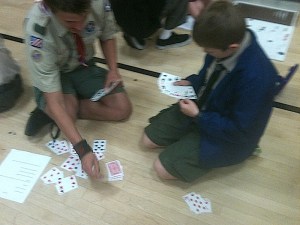 Blitz
Blitz
by Alan, Troop 2222
Vision Statement: Blitz is a 2-to-4 player card game in which each player tries to match all their cards before the other players do.
Play Value: Surprise and luck.
Set-Up: Shuffle the deck and deal each player 7 cards.
Progression: The youngest person draws cards one at a time until the draw one matching the face value of a card in already in their hand. The player then puts down the two matching cards.Play continues from youngest to oldest, and then back to the youngest.
Resolution: The game ends when all the cards have been drawn. The player with the most matches, wins.
Resources: Cards, matches.
 Lucky Strike
by Andrew, Troop 2
Vision Statement: Lucky Strike is a game of chance bowling board game in which each player races from home to the bowling alley. The first one to the bowling alley wins.
Play Value: This game is fun to play because it has an imaginative property where you imagine you’re bowling for fun at a bowling alley.
Set-Up: Place the player pieces on the “home” space. Line up the bowling pins on the bowling lane. There will be a foul line where the the person playing will flick the ball down the lane. The marble will be placed at the foul line. There will be spaces on the main game board for the following cards: Gutter, 1-4, 5-7, 8-9, and Strike. The cards will be shuffled and placed on the spaces.
Progression:
The play starts with the youngest player and the oldest player goes last.
The player will flick the marble down the bowling lane, knocking over pins. When flicking the marble, it must stay behind the foul line. The player cannot pass the foul line when flicking the marble. If they do, they lose a turn.
The player will pick up the card corresponding to the number of pins knocked down. If the player knocked over 5 pins, they would pick up the 5-7 pin card. That player would then follow the directions of the card and move their piece on the game board down the path to the bowling alley.
- You get 1 Credit every time it’s your turn
- There are 4 types of land forms — Mountain, Ocean, Forest — each with a different cost
- You can gain one of the following items when you take down a different land form — Ammo, Wild Cat, Wild Dog, Damage x2 — each with a different cost and damage
- There are four types of cities — City, Airport, Skyscraper,
- Metropolis — each with a different cost
- There are 8 types of weapons — Combound Bow, Shotgun, Sword, Revolver, Uzi, Long Sword, AK 48, Mini-Gun — each with a different cost, damage and ammo
Resolution: The first player to reach the bowling alley wins.
Resources:
- Bowling lane: Separate from the game board. (made of cardboard)
- Game Board: There are places for 4 game players. They will follow a path which starts at home and finishes at the bowling alley.
- Marble (bowling ball)
- Bowling pins: ( If unable to find small pins, I plan on using toy soldiers or frosting tips)
- 7 cards each of the following values: Gutter Ball, 1-4, 5-7, 8-9, Strike
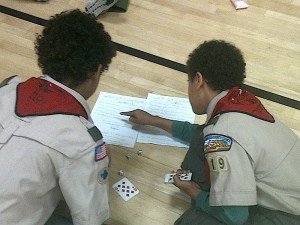 War of Chance
by Jake, Troop 2222
Vision Statement: War of Chance is a free-for-all card and dice game where players compete to get the most points.
Play Value: Competition and surprise.
Resources: Gold
Set-Up: Deal out all the cards among the players. Give each player one die.
Sequence of Play:
- Each player rolls their die
- Player with lowest number finds the difference between his roll and the highest roll
- Player with the lowest score gives player with the highest score an amount of cards equal to the difference between rolls
- Repeat for 15 rounds
Resolution: The game ends after 15 rounds. The players then tally their points (cards at face value, Jacks=11, Queens=12, Kings=13, Aces=15 ***If playing with Jokers, Jokers= -7points***). The player with the most points wins.
Resources: Cards, die rolls, points.
The two card games were a good deal of fun for the scouts, but it was Andrew’s Lucky Strike board game that really bowled them over. There can be fun in simplicity, but immersion is a great tool for drawing players into the magic circle of play.






 David Mullich