Blog Archives
Innovators Learn To 10x Their MVP At Game Thinking LIVE 17
 Amy Jo Kim has a unique understanding of games. Having worked closely with Will Wright on The Sims and Raph Koster on Ultima Online as a social game designer, she knows how game development has been so successful at creating innovative apps that engage their users almost to the point of addiction. She’s generously shared the knowledge she gained with others through her 2000 book Community Building on the Web and her TEDx talk “Collaboration & Community-Building”, inspiring Fortune to name her as a top 10 influencer in digital games. But what makes Amy Jo’s understanding of games unique is that she sees how game design techniques can be applied to a wide range of applications, and she’s used that insight as in her role as a startup coach to help thousands of entrepreneurs innovate faster and smarter.
Amy Jo has encapsulated this insight into a framework that she calls “Game Thinking”, an integrated system for accelerating innovation and driving sustained engagement through a powerful blend of game design, systems thinking, agile/lean practices, and design thinking. Don’t be mislead by its name into believing that this is all child’s play: it’s a proven approach that Amy Jo has used to bring deeply compelling ideas to life while working with clients like Happify, eBay and Netflix.
Game Thinking is comprised of the following steps based on the habits and practices of breakthrough innovators:
- Clarifying your product strategy by formulating clear, testable hypotheses for developing your MVP.
- Mobilizing a thin, high-value, high-need slice of your target market — what Amy Jo calls your “superfans” — for getting feedback on your hypotheses.
- Running quick, focused screening interviews with your superfans to dramatically accelerate your ability to find exactly the right customers to listen to.
- Turning research insights into actionable design through the use of Job Stories, a powerful, cutting-edge design technique that will add speed, agility and focus to your product development.
- Sketching your customer’s journey from Discovery to Mastery so that it is organized around skill-building, learning and empowerment.
- Building iterative prototypes of working systems based on a pleasurable core learning loop providing skill-building feedback, progress and investment.
- Conducting low-fidelity, high-learning play-tests that let you start iterating rapidly with confidence.
- Validating your strategy using road-mapping technique that will streamline and focus your iteration and help you create a deeply engaging product that will delight your customers.
Although this system sounds simple enough, successfully implementing it does take work and guidance. That’s one reason why Amy Jo decided to hold a 2-day workshop called Game Thinking LIVE at the Marriott Waterfront near San Francisco last weekend. The event was attended both teams from large companies like Tesla and Intuit as well individual innovators and entrepreneurs along with virtual participants who joined from around the world through online video streaming — all eager to learn a system for better, faster product design. I was thrilled to be asked by Amy Jo to participate in the event as one of the coaches there to guide attendees through the Game Thinking process and help them apply it to their own projects.
Did I call the event a 2-day workshop? It was a far richer experience than that! It actually began a month or two prior with an introductory online course featuring short videos and step-by-step templates that take took attendees through the basics of Game Thinking. This allowed attended absorb the material at their own pace, and arrive at the event primed and ready to deepen their understanding and apply the techniques to their projects.
By having a foundational understanding of Game Thinking already in place, there was no need for attendees to sit through boring PowerPoint demonstrations that typically comprise workshops. Instead, Amy Jo organized the first day into a talk show type format: a casual, free-flowing conversation with experts and innovators who are leading the way in Game Thinking. The day’s topics included:
- What REALLY makes games engaging: Raph Koster, author of A Theory of Fun, explained how “fun” is just another word for “learning” and since all apps involves skill building, they can be transformed into an engaging experience.
- Customer Discovery on Steroids: Scott Kim, game designer at Age of Learning, and Mike Sellers, professor at Indiana University, described their experiences in finding the right customers to listen to for early prototype feedback.
- Piggyback on Customer Habits: Megan Mahdavi, CEO of Sunreach, Cindy Alvarez, Design Research Leader at Microsoft, and Laura Klein, author of Build Better Products, discussed how developing user experiences without conducting proper research on customer habits is just guessing.
- Systems Thinking: Raph Koster, Mike Sellers, and Dan Olsen, author of Lean Product Playbook, explained how not to think of your app not just as individual components, but as a dynamic, integrated system.
- Build a Path to Mastery: Robin Yang, Product Manager of Code Combat, and Margaret Wallace, CEO of Playmatics, emphasized the important of identifying the correct target group for testing your product.
- Bring your Learning Loop to Life: Raph Koster and Scott Kim, gave us a deep look at how game designers use learning loops to engage users in the habit-building phase of their customer journey.
- Better, Faster Product Experiments: Dan Olsen and Casey Winters, Growth Advisor at Greylock Partners, described how online companies grow through experimentation and metrics.
- Rethinking Design Thinking: Laura Klein, Cindy Alvarez, and Erika Hall, author of Just Enough Research, held a hilarious but through-provoking discussion on how the design process needs to be restructured to challenge personal biases and confront deeper issues in product design.
During the lunch break, some of us split up into informal “unconference” sessions centering around topics such as “Games and Learning” and “Virtual and Augmented Reality,” while others played collaborative party games to keep their creative juices flowing.
At first, I wondered whether the talk show format and games might be more entertaining than informative for the attendees, but everyone I talked to assured me that they got a lot of value out of the experience. As Marshall McLuhan famously said, “Anyone who tries to make a distinction between education and entertainment doesn’t know the first thing about either.” And isn’t that really the essence of Game Thinking?
Day 2 was structured quite differently. Attendees spent the day working with the Game Thinking coaches to apply Amy Jo’s Toolkit to their individual projects, and then get feedback and advice from guest experts. As I wrote above, I was one of the coaches, along with Jaxton Cheah of TalentIntelligence Singapore, Duff Gardner of Protocol M Ventures, Curtis Gilbert of itMatters, Inc, Karthik Vijayakumar of DesignYourThinking, and Felipe Lara of New York Film Academy.
Each of us coaches were paired up with groups of attendees. My assigned group consisted of six individual innovators: Dan, who was providing online strategies for business start-ups; Sjeord, who was training employees in positive thinking; Ray, who was creating a system to help non-STEM graduates find careers; Patrick, who wanted to incorporate gifting into his book purchasing app; Brian, who was developing a viral video app; and Susan, who was selling a one-day break-making kit. I have to say, Susan’s Tomorrow Bread was a big hit with everyone when she served up hot slices of fresh-made bread to complement the event’s delicious food.
While I originally thought we could go through Amy Jo’s process in one day, all six of my group wanted to focus on developing Superfan Screeners and Speed Interviews. I quickly realized that was intuitive for me after thirty-five years of game development, required new ways of thinking and discipline from these entrepreneurs. They had a natural inclination to want to target mass market customers rather than SuperFans and to offer preconceived solutions instead of ferreting out their customer’s needs. It was several hours of hard work to guide them through this part of the process, but it seemed to pay off for everyone at the end.
The final couple of hours of the day was devoted to each attendee pitching their product to a panel of Game Thinking mentors: Mike Sellers, Raph Koster, Margaret Wallace, and Erin Hoffman-John, CEO of Sense of Wonder. As I listened to the mentors give their feedback, I appreciated how this was pure gold for the attendees. Where else on Earth can innovators get this kind of expert advice on their products?
And this advice doesn’t end with the weekend. After the event, attendees will continue to learn and stay in touch with the mentors, coaches and fellow attendees through Amy Jo’s Game Thinking Academy — her curated learning community of experts and enthusiasts who provide weekly updates and a monthly Q&A within a private supportive environment.
It was clear to me the benefits that the attendees got from Game Thinking LIVE, but I had to ask Amy Jo what she had hoped to get out of hosting the event. “I want to build a community and spread the idea of Game Thinking.”, she explained to me. Well, she certainly succeeded on that score — at least a few of us have discussed plans about how we wanted to work together afterwards to help others entrepreneurs develop their MVPs.
As for spreading the concept of Game Thinking, I did see some roadblocks. As excited as the individual entrepreneurs were about Amy Jo’s process for running faster, smarter MVP experiments, some of the product managers from big companies that I talked to during the breaks told me about the problems they had convincing their management to change their old way of thinking that just wastes time and effort building the wrong product or feature. Such a change can’t be done through a two-day workshop; it will require a long conversation with technology leaders.
Hopefully, Game Thinking LIVE will become a regular event, and Amy Jo will continue to spread the word about Game Thinking as more and more people sign up for her Game Thinking Academy. In my own experience as a consultant, it pains me to see entrepreneurs take the wrong approach in developing their MVP, and I would like to see more innovators take Amy Jo’s surer path to a successful launch.
Dice and Drawbridges Inspire Games Designed By Scouts At Balboa Oaks Spring 17 Merit Badge Midway
 Several times a year I volunteer at local merit badge midways to run workshops for the Game Design Merit Badge that I helped to create for the Boy Scouts of America. On Saturday I led a three-hour workshop at the Balboa Oaks Merit Badge Midway in Los Angeles’ San Fernando Valley, and as with every time I’ve run these workshops, I was impressed with the wide variety of games these young men designed.
My workshops always begin with a Socratic-dialog-heavy talk about the various elements that comprise a game, the different ways we can describe a game’s play value (what makes it fun to play), and how intellectual property rights apply to games. I then do an exercise with the boys in making changes to game rules to see what effects those have on players, using set of Spider-Man tic-tac-toe sets. (You’d be amazed at the number of variations on tic-tac-toe the scouts have come up with over the past couple of years). With each of these topics, the scouts satisfy various merit badge requirements.
The more advanced (and most fun) requirements involve the scouts proposing a game concept, and once I approve it, prototyping their game and playtesting it with other scouts.
Here are some of the games the scouts designed last weekend.
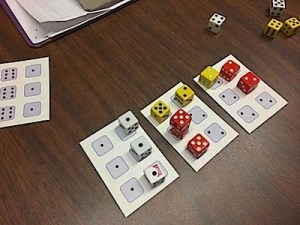
Match Em
by Nate Y, Troop 773
This dice game looks deceptively simple, but I found it to be the most engaging game of the day to play.
Vision Statement: A free-for-all dice game where 2-4 players roll dice in an effort to be the first person to collect 3 Match’em cards.
Play Value: Challenge.
Set-Up: 2-4 people can play.
- Three cards are taken from the deck and laid on the table, face up. Cards will display a picture of 6 dice. The object of the game is to roll your dice until you can match what is displayed on one of the cards.
- Each player has six dice. Players will roll 1 die to determine who starts the game. Highest roll wins. Players who roll the same number must re-roll against each other until a winner is determined. Once the starting player is determined, turns move clockwise from the starting player.
Progression:
- Three cards are taken from the deck and laid on the table, face up. Cards will display a picture of 6 dice. The object of the game is to roll your dice until you can match what is displayed on one of the cards.
- Each player will take turns rolling their dice once. After a player rolls their dice, any matching numbers can be placed next to the card they want to obtain. Those dice are now “locked in” to the card. Any non-matching numbers will be taken back to re-roll on their next turn. Multiple players can work on the same card as other players. The first person to match all 6 dice on card wins that card and they take it from the table. All dice that were locked on that card will be returned to the players and a new card will be pulled from the deck to replace it. The first player to obtain 3 cards wins the game.
- Take back rule: At the beginning of their turn, a player has the option to take back all their dice and re-roll them. This can be helpful if a player wants to work on a new card or attempt to steal a card that another player is currently working on. This must be done at the beginning of the player’s turn. No dice can be taken back after the player has rolled on their turn.
Resolution: The first player to collect 3 Match Em cards wins.
Resources: Dice, Match Em cards
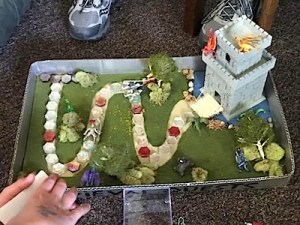
Medieval Quests
by Grayson R, Troop 351
This was the most visually impressive game at the workshop. Grayson R of Troop 1 created this board game to teach players about knights, kings, queens, people, weapons, foods, customs and other information of the medieval time period.
Vision Statement: A medieval board game in which 2-4 players answer questions related to Medieval times in a race to reach a castle.
Play Value: Novelty.
Set-Up: 2-4 people can play.
- Each player takes a game piece and puts it at the starting point, on the brown tile.
- Place dragon cards and treasure cards in card holder.
- The youngest player goes first.
Progression:
-
Each Player takes drawing a white dragon card and reading the question to the player on his/her left (the answer is located underneath the question).
-
If the question is answered correctly, then the player who answered the questions correctly will move the amount of spaces indicated in the parenthesis after the answer.
-
If the question is answered incorrectly, the player will remain where they are and not move forward.
-
If a player lands on a red tile, a red treasure card will be drawn and the directions followed.
- The person to the player’s left has the next turn.
Resolution: The first player to get to the castle will win the game.
Resources: 40 dragon cards (white), 12 red treasure cards (red)
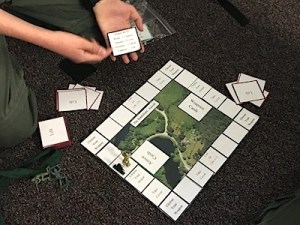
The Battlefield: Airsoft
by Tristan R, Troop 351
Many scouts prefer to make board games in these workshops because the visual element of the board is fun to build and makes gameplay easy to understand. Most of these board games tend to be simple races, but Tristan built one with combat elements.
Vision Statement: A free-for-all board game with an air soft theme in which the objective is the be the last player standing.
.Play Value: Challenge and Threat. It is Challenge because the players will be able to get more advanced airsoft weapons and armor at different places in the game which will help them to defeat their opponents easier. It is is Threat because the players will be able to get better weapons and armor and have the threat of being eliminated.
Set-Up:
-
Each player (4 player game) begins the game with 10 Life Cards.
-
Each player begins on the Start space.
Progression:
-
Each player rolls the dice during that player’s turn and moves that many spaces.
-
If a player lands on a Weapons Space, he draws a Weapon card. The Weapon card will list the Range, Damage, Accuracy and Capacity of that weapon. The player may use that weapon on that turn or can save it for another turn.
-
If a player lands on an Armor Space, he draws an Armor card. The Armor card will list the Safety Value for that Armor (example = “Can be redeemed for +1 Life”). This card can be saved to be used during a battle where another player is using a Weapon card against them.
-
If a player lands on a Cover Space, he is protected from any battle or weapon and can not be damaged.
-
If a player is damaged by a weapon, he must give up the correct number of Life Cards that the particular Weapon Card states unless he has an Armor Card that protects him from giving up any Life Cards.
-
If a player lands on a Loss of Life Space, he must turn in the number of Life Cards listed on that space.
Resolution:
- Players are eliminated when they have lost all their Life Cards.
- The game continues until only one player is left standing with Life Cards.
Resources: Lives, Dice (movement points), Range, Damage, Accuracy, Capacity and Safety Value.
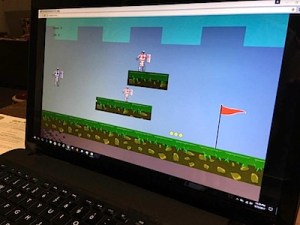
The Knight’s Templar
by Dylan M, Troop 1003
Video games are the most difficult type of games to do at these merit badge workshops because of the limited time to make improvements to your game after making your playtest observations. But Dylan M. of Troop 1003 managed to earn his Game Design merit badge with this platformer.
Vision Statement: A single-player electronic 2D platformer set in a medieval kingdom in which the protagonist must defeat enemies to save his kingdom.
Play Value: Challenge.
Set-Up:
- Player starts at the left edge of the level with 4 Lives, 10 Health and 0 Score.
Progression:
- Controls: arrow keys (left, right= move left, right, up=jump).
- Enemies: All enemies die upon collision. However, unless the player jumps on them from above, collision also takes away 1 Health from player.
- Scoring:
- Killing an enemy: 5 points.
- Collecting gold: 2 points.
Resolution: The game ends when player gets all the 4 keys and unlocks door, which completes level.
Resources: Score, Keys, Health, Lives
As always, the scouts were very inventive, given the limited resources and time they had available. Even better, they were not only proud of the games they made, they really enjoyed playing other scout’s games. After all, as I explained to them, creating fun experiences for others to enjoy is what game design is all about.





 David Mullich