Category Archives: My Career
Virtual Reality Is In Play At The Los Angeles Film School Game Fair
 Each month the Los Angeles Film School’s Game Production program holds a Game Fair to showcase the games our students are developing in their classes. Throughout the month of June I taught Game Design Project 1, which is an upper-division course where students work together in teams to design and create a prototype of a game that they will complete in Game Design Project 2. Both of the student teams in my class had decided to work on virtual reality projects, and I was so impressed with what they accomplished in just four weeks that I just had to also showcase them in my blog post for this week.
Confined
 Confined is a survival-horror game for players who are interested in the development of VR. Resource management and good shooting skills are vital to your survival. Since you are going to experience the game from your own perspective it will really add to the immersion and threat of the game, and unlike Resident Evil 7 that had a VR function, Confined will be designed for VR rather than have it as a side feature. Now I ask you is being trapped underground really the worst thing to happen or is not knowing if you are alone down there worse?
For their Game Fair prototype, I gave the team a goal of implementing their flashlight mechanic for navigating through a dark, spooky lab and at least one puzzle to solve. The puzzle they created took the form of a room littered with books, and the player had to find the one book that was out of the ordinary. That book turned out to be the only book that remained on a bookshelf that could only be found by searching though the room with a flashlight before its batteries ran out. When the player picked up the book with their virtual hand, a secret door would open, allowing the player to escape.
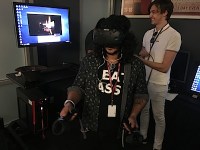 The players at Game Fair reported that this environment perfectly captured the right mood for a scary, horror game. This mood was enhanced by the darkness and limited view through the virtual reality headset. However, the avatar movement needed some work, because the player avatar would teleport short distances instead of walk and often would teleport right though the bookcase they were trying to reach. But all in all, they were very excited about this game and saw its potential.
Development team:
- Eric Castillo (Project Manager, Lead Designer, Programmer)
- Will Mackey (Game Designer, Level Designer)
- Vlad Altshuler (Co-Programmer, Lead Audio, Game Designer)
- Jared Delatorre (Lead Level Designer, Marketer)
- Jesus Soto (Lead Programmer, Level Designer, Mascot)
- Anthony Reese (Lead Artist)
Eyes Wide Open
 Eyes Now Open is a action packed level based first person VR shooter with a focus on tactical high intensity combat. Fight with anything you can get your hands on as you run and gun attempting to escape three levels of a secret super-soldier facility called Blackgrove. You play as Finley, the only patient to survive the Treatment, altering your genetic make up allowing you to posses super human abilities called Meta-Upgrades. Use these abilities to alter time, electricity, plasma and electromagnetic energy to destroy the ones who took not only your mind but the one you cared for the most, your wife.
I gave this team the goal of implementing one of the Meta-Upgrades and a situation where that special ability would be useful. The team created a level in which the player started by choosing a gun from among an arsenal of weapons and then travel across the level to reach the exit. As the player went into the main hallway, a horde of enemies would spawn into the far end and rush toward the player. There were too many to kill with any of the weapons, unless the player activated the Alter Time Meta-Upgrade, which slowed down the enemies sufficiently to shoot them all.
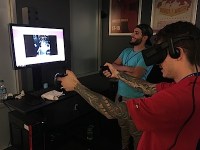 Everyone who played this at Game Fair found the controls easy to use and the action to be exciting. However, not understanding this was only a prototype to test the mechanics, they did complain about the enemies being unfinished models. They all enjoyed the immersion brought by the virtual reality headset, although several reported a slight feeling of motion sickness. When I played the game, I too found it both to be a thrilling experience but felt a bit queasy when turning. This is something the team will look into solving for the second month of the game’s development.
Development team:
- Jack Sabato (Project Manager / Lead Modeler / Assistant Texture Artist / Lead Writer)
- Hassan Wansa (Assistant Project Manager / Lead Programmer / Lead GUI)
- Brandon Deniz (Creative Director / Lead Level Designer / Assistant Modeler / Lead Texture Artist )
- Desmon Jernigan (Video Editor / Lead Story / Lead Dialog / Assistant Programmer / Lead Lighting Supervisor)
- Jeremy Garrett (Business Manager / Lead Sound / Assistant Modeler / Assistant Artist)
At our next Game Fair, which is about five weeks away, I’ll take a second look at these games to see how they progressed.
The Secret To Becoming A Game Designer
 The question I am asked most often is, “What to I need to do to become game designer?” That answer to that is both simple and obvious. It comes down to two words. Are you ready? Really? Okay, here is the big secret: design games.
Seriously, that’s all there is to it.
I began designing my own board games to play throughout my childhood — I also wrote short stories, drew comics and illustrations, made home movies, performed magic and puppet shows for the neighborhood kids, and built haunted house attractions in my garage. I was always creating, but the last two things I listed were especially important because game design is about creating experiences for others, not just entertaining yourself..
When I learned to program in college (which, at the time, the late 1970s, was the only way to learn), I created my first computer games. One of my professors was impressed with how I was using the university computer for creative purposes, hired me to work in a computer store he owned, and there I met a game publisher to hired me to design and program games for him to publish. Thus, I became a professional game designer.
So, again, you become a game designer by designing games. This will allow you to develop the needed skills and portfolio to get a job. There are also many resources today that I didn’t have access to when I started — books on game design; free, downloadable game engines; video tutorials; access to amateur and professional game designers for advice. If the best way for you to learn is in a classroom setting, many schools and colleges now offer game design, development, and programming degrees — but if you go that route, just be sure to pick one that has had success with its students actually getting jobs in the game industry.
If you are interested in being a board or card game designer, there aren’t many job openings for those positions. I did know a few professional board game designers when I worked for the Spinmaster toy company, and they all had degrees in industrial design, since they had to be able to professionally design the game components.
Most likely, if you want to be a professional board game designer, you are going to have to raise money to develop and possibly publish your game by yourself. So, you’ll also need to learn about running crowdfunding campaigns, attending board game conventions for networking and pitching, manufacturing, and possibly online sales and advertising too.
If you are interested in being a video game designer, be aware that it isn’t an entry level position, except perhaps on an indie team of other novice developers. More than likely, you will enter the industry at some other position — junior programmer, junior artist, level designer, assistant producer, or tester — and after a few years move over to a game designer position when you are presented with an opportunity to do so. So, that means you will also need to pick up skills in programming, art, level design (using a game engine) and/or project management to get that first job in the game industry (except, perhaps, a tester job, but it can be tough to get recognized for advancement when in the testing department of a large game company).
And always be designing games to add to your portfolio, if nothing else. Just like a programmer is always programming and an artist is always creating art, a game designer should be always creating games.






 David Mullich