Category Archives: My Career
Memories of H.R. Giger
 Yesterday Swiss surrealist, sculpture and set designer H. R. Giger who mined his own nightmares in creating phantasmagorical works of art passed away in a hospital near his home in Zürich, Switzerland after having suffered injuries in a fall. He was 74 years old.
I first became acquainted with Giger’s work through the cover art he created for the Emerson, Lake and Palmer album Brain Salad Surgery my brother had given me for Christmas. Like most of Giger’s creations, the cover was a highly idiosyncratic blend machines and biology that greatly appealed to me as a teenager who was a fan of science fiction, horror, and fantasy.
Years later, I encountered Giger’s work again in the 1979 film Alien. He was part of the creative team that won an Academy Award for visual effects the that landmark science fiction / horror film, having personally designed the alien creature through all stages of its life, from egg to face- hugger, to chest-burster, to eight-foot-tall monster. That movie, along with its sequel Aliens, remain two of my favorite films, in no small part due to Giger’s contributions.
You can therefore imagine how thrilled I was when I had an opportunity to meet Giger at his Zürich, home in 1995. I was working as a producer at video game publisher Cyberdreams, which developed games in collaboration with famous personalities in the fields of science fiction, fantasy and horror. Prior to me joining the company, Cyberdreams had published a point-and-click adventure game called Dark Seed about a writer named Mike Dawson, who had recently bought a mysterious old mansion. On his first night at the house, Mike has a nightmare about being imprisoned by a machine that shoots an alien embryo into his brain. He wakes up with a severe headache and, after taking some aspirins and a shower, explores the mansion. He finds clues about the previous owner’s death, which reveal the existence of a parallel universe called the Dark World ruled by sinister aliens called the Ancients. This Dark World is based on Giger’s art.
The game was a big enough success that I was assigned the task of producing a sequel. I hired game designer and novelist Raymond Benson to design the game, artist Jeff Hilbers to do the artwork for the “Normal World”, and developer Destiny Software Productions to do the programming and “Dark World” artwork. As with the first version of the game, all of the “Dark World” art was based upon Giger’s existing art collection.
 Six months into the project we had completed enough to visit Giger and get his feedback on our progress. Three of us traveled to Zürich: Cyberdreams Art Director Peter Delgado, an artist from Destiny Software Productions, and myself. After a very long plane flight and an overnight stay at our hotel, we hopped into a taxi and rode to Giger’s home, an unassuming two-story house in a middle-class residential neighborhood. The time was a little after 5p.m., but it was winter, so the entire street was dark except for a single light shining down upon Giger’s walkway. Standing in the middle of the light cone was Giger himself, clad entirely in black. The scene reminded me of the poster from The Exorcist.
Giger led us into his home, which was also clad entirely in black — floors, walls and ceilings. Most of the furnishing were modest, save for a biomechanical table and hairs in his living room that he had originally designed for three Giger Bars (the original was in Tokyo, and two more were built in his native Switzerland). Scattered throughout the house were samples of his artwork and sculptures. As we stared in awe at everything, Giger suddenly realized he had nothing to offer his guests, and so he jogged off to the corner market to get some tea and cookies.
When he returned, we sat down in his living room and attempted to make small talk (Giger’s command of English was minimal, but he tried hard). As he stroked the cat sitting in his lap, the cat farted. “Milky! You stink! You stink!”, Giger exclaimed, tossing the cat onto the floor. We thought then would be a good time to end the casual conversation and take a look at the game prototype we had brought with us.
After spending several minutes looking at our point-and-click adventure, Giger told us that he had a completely different idea for the game. He wanted to know if we could turn it into a game where the player climbed up a series of catwalks inside a pyramid, and when he got to the top, he would find himself in another pyramid, with the game being a succession of pyramids. Using my best diplomatic demeanor, I told him that that was very creative idea, but since this was a sequel to the previous game, fans would expect it to be an adventure game like the first one was.
This did not please Giger at all. “Mia, Mia”, he muttered to himself, referring to the name of his ex-wife, who was now acting as his agent. After a few moments, he wandered off to another part of the house, leaving us alone in the living room. After about fifteen minutes, I asked my art director, Peter, to look for him (Peter had met Giger on a previous visit, and the two seemed to get along well). When Peter returned, he said that he found Giger sitting in his badroom, apparently talking to his deceased girlfriend Li, who had committed suicide twenty years ago. We decided it would be a good time to leave.
The next evening we returned to Giger’s home, Giger’s manager Mia was there to greet us. She spoke English better than her ex-husband did, and after a round of introductions, she pressed on the issue of changing the game, I said that it was too late to move into a new direction. Giger and Mia then began speaking to each other in Swiss very energetically. I had taken two years of German in high school, and so I tried to follow what they were saying, but the only thing I understood is when they stopped their conversation to look at me, and Mia said, “Er spricht Schweiz Deutsch!” (“He speaks Swiss German!”).
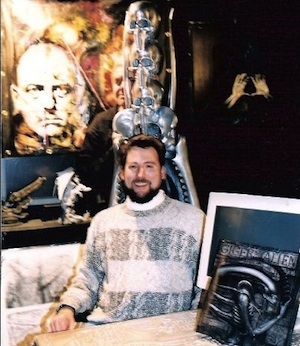 “However”, I interrupted. “Here’s what we can do. We can have the character walk all around the world on catwalks, just like in Giger’s idea. But we want to show off all of Giger’s wonderful artwork, so let’s leave the buildings in.” That concession seemed to please them, and the mood changed for the better. Giger relaxed and said that he was happy, and then suggested each of us take a picture sitting in one of the chairs from his Giger bar.
And that was the last opportunity I had to see Giger. The entire experience was truly surreal, and I’m very happy to have this photo as a momento of the experience and proof that it was not all a dream — or a nightmare!
Heroes of Might & Magic III: Remembering Erathia 15 Years Later
 This Friday marks the 15th anniversary of the release of Heroes of Might and Magic III: The Restoration of Erathia, which is arguably one of the most popular turn-based strategy games of all time. To commemorate the event, Ubisoft asked me, as the game’s development director, to write the story of its development, which I am reposting here.
The video game industry is a relatively small and tight-knit community, and most of the opportunities for the games I’ve developed came to me through someone I had previously known. Heroes of Might and Magic III was no exception.
I first met Jon Van Caneghem, the founder of New World Computing and chief designer of most of its games, in 1994. We were both speakers on a panel about “The Art and Craft of Game Design” at the annual Game Developers Conference in San Francisco. Jon was familiar with some of the games I had worked on in the past, such as Disney’s “DuckTales” and Harlan Ellison’s “I Have No Mouth, And I Must Scream”, and suggested that we should work together sometime.
That opportunity came three years later when New World Computing contacted me about becoming director for a new sequel in the Heroes of Might & Magic franchise. It was an exciting proposition but also a somewhat daunting one – Heroes of Might & Magic II, which was released the previous year, had just been named the sixth-best PC game of all time by PC Gamer magazine. What could I possibly do for an encore?
That is precisely the question I was asked by Trip Hawkins, president of The 3DO Company, which had recently purchased New World Computing. Trip made it the habit of personally interviewing every key employee joining the 3DO family (in my case, it was a phone interview, since I lived in the Los Angeles area, where New World was located, whereas The 3DO Company was based in the San Francisco area), and he wanted to know what I brought to the party.
Fortunately, I had an answer ready. I had spent about a week playing Heroes II and found it to be a remarkably addicting and well-designed game. However, my one qualm was with the art style. I thought the artwork looked about five years behind the times, and so my focus would be on bringing the graphics up to current standards. Trip seemed satisfied with my answer, and I could only hope that my bosses at New World agreed with me.
It turns out, they did. On my first day on the job, my manager told me that the company was unhappy with its current art direction and wanted me to “secretly” find a new art director among the art staff. So, on the pretense of introducing myself to everyone, I held one-to-one conversations with each artist. They were all capable artists, but one, Phelan Sykes, used our discussion to talk about how unhappy she was with the status quo. “I have found my art director”, I told myself, and as I later discovered, she was also the most talented artist in the company.
Another person I was happy to meet was Greg Fulton, a new employee New World had hired to be the lead designer the Heroes of Might & Magic III team I was putting together. Greg was hired on the same day I was, and we had never met each other previously, but we quickly became fast friends. I told Greg about my plan for upgrading the franchise’s art style from its past cartoony look to one that I called “extreme fantasy.” Greg showed me some artwork from the Warhammer tabletop miniatures game, proving to me that he knew exactly what I meant.
Together we went through galleries of fantasy artwork created by such great artists as Boris Vallejo, Larry Elmore and Rowina Morill, picking out images of heroes, creatures and environments that captured the look we were going after. We then arranged our collection into eight themed factions, up from the six that were featured in Heroes II.
My attention then turned to programming. My team started with only one programmer, George Ruof, who had worked on Heroes II. For the rest, I had to go outside the company, because the other staff programmers were dedicated to the studio’s other franchise, the Might & Magic role-playing game series. Luckily, my search didn’t take long as I was able to bring on two talented engineers who had programmed “I Have No Mouth, And I Must Scream” for me at another company – John Bolton, who I assigned to be lead programmer, and David Richey, who I hired as level editor programmer.
Since we were on a very tight development timeframe – fourteen months altogether – we decided to re-use the game engine that had been created for Heroes of Might & Magic II but added the new game features such as upgradeable fighting units, an underground level, a revamped magic system, and many more map objects to visit. However, David Richey completely revised the level editor so that the level designers had a very robust quest creation system they could use to create a wide variety of levels to explore and conduct warfare upon.
I soon found that each of my leads were so talented and got along with each other so well that I realized I was working with a dream team the likes of which I have never again experienced in my thirty-five years in game industry.
Greg Fulton worked very closely with Jon Van Caneghem on creating the stats for all the combat units and other game elements, modeling them first on Excel spreadsheets to test out whether verifying that everything was balanced before being programmed into the game. Greg also managed our assistant designer, Chris Vanover, who under the name “Sir Christian”, was our community manager and did a terrific job keeping the fans updated on progress with the game. In addition, Greg supervised our six-person level design team lead by Jennifer Bullard (Jennifer would later become assistant designer on Heroes of Might & Magic IV and took over community management under the name “Maranthea”).
Systems programmer John Krause, whom I worked with at my previous company; multiplayer programmer Jeff Leggett; and artificial intelligence programmer Gus Smedstad soon supplemented our three-person engineering team lead by John Bolton. (Gus would later become both lead programmer and lead designer on Heroes of Might & Magic IV). As the deadline fast approached and we got into “crunch time”, even General Manager Mark Caldwell came in to join the programming action.
I spent most of my time with lead artist Phelan Sykes and assistant lead artist Rebecca Riel, helping them adapt the twenty-person art team to the new art style as they created over 10,000 pieces of artwork for the game. Thankfully, the art team was more than up to the challenge, including illustrator George Almond, lead animator Adam McCarthy, user interface designer Scott White, and too many other talented artists to mention here. Phelan also oversaw the creation of the terrific cinematics created by our third-party vendors.
I would be remiss if I did not mention audio lead Rob King, who with the assistance of Paul Romero and Steve Baca, created the game’s dramatic music, sound effects and voice over.
I was lucky enough to be overseeing a very well oiled machine that actually required very little supervision on my part. I had few concerns when I left the project for a few days when my wife gave birth to our second son. When I returned to the office, my team surprised me by creating a new hero for the game, Sir Mullich, whose in-game description was, “Generally stoic, Sir Mullich is prone to spasmodic fits of uncoordinated excitement believed to intimidate his troops into working faster.” I was both touched and amused by this in-joke, and allowed them to keep it in the game.
Heroes of Might & Magic III launched on February 28, 1999, in precisely the fourteen months we estimated it would take to complete, a rarity in game development. Even more amazingly, many fans and critics heralded the game as being better than its predecessor. But most of all, I’m proudest of the wonderful team with whom I was privileged to work, many of whom I still remain in contact with fifteen years later. These incredible game developers are the real heroes of Might & Magic.






 David Mullich