Category Archives: Games and Society
Playing Games To Donate An “Extra Life” For Kids In Children’s Hospitals
 Our family has seen more than its fare share of kids in hospitals. Our youngest son, Ben, was diagnosed with neuroblastoma, a malignant tumor typically originating from the adrenal glands (as was his case), when he was three months old. For the next year or so, we made monthly visits to Children’s Hospital Los Angeles for chemotherapy, radiation therapy, and a total of three surgeries. The chemotherapy left him vulnerable to infection, which he contracted about every other month, requiring him to say in the hospital for a week or two. When that happened, my wife would stay with our infant son in the hospital during the day, and I would take over the night shift. Fortunately, our son is now cancer-free, thanks to the wonderful medical staff at CHLA.
However, our story does not end there. Each of our sons, both Ben and Tim, contracted Crohn’s Disease, a painful inflammatory bowel disease, when they went through puberty. Both of them had surgeries and now have to go into the hospital regularly for infusion treatment. We’ve gotten to know the rigors of hospital life very well.
 So you would not be surprised how one booth caught my attention as I was walking through the hallways of the Los Angeles Convention Center at the Electronic Entertainment Expo. It was for a charity called Extra Life, a community of gamers which who help sick and injured children at their chosen Children’s Miracle Network Hospital.
Extra Life began in 2008 as a way of honoring a young lady named Victoria Enmon. Tori’s battle against acute lymphoblastic leukemia inspired Sarcastic Gamer, an independent video gaming blog and community site, to send in video games and bought gifts to keep Tori’s spirits up despite numerous hospital stays and three bouts with the deadly disease.
Tragically, Tori lost her battle with cancer in January 2008. Later that year, Sarcastic Gamer held a 24-hour video game marathon to raise money for the hospital that treated and fought beside Tori. In 2008 and 2009 Extra Life raised a combined $302,000, 100 percent of which went directly to help kids like Tori at their local Children’s Miracle Network Hospital (Texas Children’s Hospital).
While thousands of gamers, more than 100 websites and more than 12,000 donors were happy to support Extra Life, many expressed their desire to raise money to help kids closer to home. Now charitable gamers cans simply sign up, commit to play games for 24 hours (the next event is from November 7, 2015 – November 8, 2015, but you can do it any day of your choosing), and ask your family and friends to support your efforts.
Once you complete registration, you’ll get an online fundraising page that you can customize by choosing which hospital you want to support, setting a fundraising goal and sharing your personal reason for why you’re participating in Extra Life. You’re able to unlock digital content and rewards by asking your family and friends to donate towards your efforts.
The money that you raise through Extra Life will go directly to your chosen Children’s Miracle Network Hospital as ‘unrestricted funds’. This means that the hospital decides where and how to spend the money to ensure the dollars you raise make the biggest impact in the lives of the kids they treat. For example, the money you raise will go to fund research and training, purchase life-saving equipment and pay for uncompensated care.
If you are interested in participating in this worthy cause, you can find out more at the Extra Life website.
Gamifying Diversity
 I spend an entire 6-hour day teaching about diversity in my Survey of the Video Game Industry class. The reason I devote one-tenth of the course to this topic is that 79% of responders to the International Game Developers Association’s 2014 Employee Satisfaction Survey said that they believed diversity to be very important to the industry, but only 28% thought that there was equal opportunity and treatment for all in the game industry. That tells me that we have a serious problem, and one step that I can take to work on that problem is to educate my game production students about the need for diversity.
My lab assignment for this topic is to have my students pick prominent game industry veterans belonging to under-represented or potentially discriminated groups — for examples, Gordon Bellamy (openly gay), T.Q. Jefferson (African-American), Jane McGonigal (female), and John Romero (Hispanic) — and do an in-class presentation on their lives and careers.
Because my students all want a career in game development, I am now in the process of gamifying all of my lectures and assignments. Here is what I did to gamify this assignment.
First, I introduced the elements of both surprise and choice into my student’s research subject selection. I hand out a sheet containing just the photographs (no names) of each of the game industry veteran they may use as a research subject. I next have each student either roll dice or draw a numbered slip of paper to determine their selection order. Once the order is determined, I have each student select their subject (with the restriction that no two students allowed to pick the same subject.)
I next tell my students to download a free QR code reader to their smart phones. (Before class, I put up sheets of paper, each with an image of one of the subjects — again, no names — an a QR Code, around the room.) The students then must go to the paper with their subject’s image and then user their smartphone to read the QR Code, which will cause their phone’s web browser to go to a web page I wrote containing a brief biographical sketch about the subject.
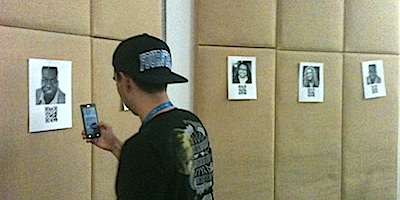
However, this biographical sketch does not contain all the information a students needs to do their presentation. However, it does contain clues for other images related to the subject. These images might be a game the subject worked on, a company he or she worked at, or some other aspect of his or her life. The student then find the images on other sheets I have put up around the room, and beneath each image is another QR Code for them to read with their smart phone. This will lead them to other pieces of information they need to complete their reports.
Once students have collected all the necessary information about their subjects, they must prepare a 5-minute biographical presentation to deliver to the rest of the class in the final hour of the presentation.
I’ve found that students have a lot more fun walking around the classroom and gathering information bit-by-bit using their smartphones and a bit of detective work then when I previously had students sit down at a computer and consult Wikipedia and other sources. And, hopefully, it will make the experience more memorable and the lesson more impactful too.





 David Mullich