Category Archives: Game Design
Making Player Choices Matter
 This presidential election has got to be one of the craziest in America’s history. All the rules we’re used to politicians following seem to have been thrown out the window, and yet we’re still faced with making a decision which will have a significant impact on our country’s future. And that has got me thinking, perhaps as a distraction, about the impact of player choices in games.
As game designer Sid Meier says, games are a series of interesting decisions. All games are about choices, even if the choice is as simple as whether to move left or move right at any given moment. Now, there is nothing wrong about simple choices; classic games like Pac-Man and Space Invaders are all about moving left or right at the right moment. What does matter is the information the game provides to the player in making those decisions and the impact of those decisions on the game’s goals.
Here are a series of decisions I present to my game design class in a discussion of player choices.
- You are at a fork in the road. If you go left, you will find a gold coin worth 10 doubloons. But if you go right, you will find another gold coin worth 10 doubloons. Which path do you choose? This is what is called a hallow choice. No matter the choice, the player will receive the same outcome. This is poor design: choices should matter in games.
- You are at a fork in the road. If you go left, you will find a gold coin worth 10 doubloons. But if you go right, you will find a gold coin worth only 5 doubloons. Which path do you choose? This an obvious choice. One outcome is clearly superior to the other, and so it really isn’t a choice at all. This too is poor design.
- You are at a fork in the road. If you go left, you will find a gold coin worth 10 doubloons. But if you go right, you will find two gold coins worth 5 doubloons each. Which path do you choose? These two choices provide the player with rewards of equal monetary value. However, there may be reasons for choosing one reward over another. Perhaps the 10 doubloon coin is less cumbersome and lighter to carry than the two 5 doubloon coins. On the other hand, perhaps the player will later need to buy an item worth five doubloons from a vendor who can’t make change. This would be a minor decision, because the different choices have only a small impact on the player meeting his or her goals.
- You are at a fork in the road. If you go left, you will find a bronze coin worth 10 doubloons. But if you go right, you will find the Golden Coin of Zeus, also worth 10 doubloons. Which path do you choose? This may seem like a minor decision, since the two coins are worth the same, but there is also a dramatic element here, based on the coin’s description. (If the game’s storyline has been about Greek mythology, the choices is even more dramatic). The decision here may not be meaningful in terms of the game’s goals, but it may be meaningful in terms of the player’s immersion into the game’s story.
- You are at a fork in the road. If you go left, you will find a pile of gold coins. But if you go right, you will find another pile of gold coins. The two piles have different amounts of gold coins, but you don’t know which is greater. Which path do you choose? Although one choice is likely better than the other, the player just doesn’t have enough information to make a decision, so the decision really isn’t meaningful. This is an uniformed decision, and is another example of poor design.
- You are at a fork in the road. If you go left, you will find a 5 doubloon coin. But if you choose the right path, you will find either a 10 doubloon coin or nothing. Which path do you choose? Now things are getting more interesting! This is an informed decision. The player has enough information to make a meaningful choice, but due to the lack of certainty in outcomes, the choice is not obvious. Actually, the choice here is whether or not to take a risk.
- You are at a fork in the road. If you go left, you will find a 10 doubloon magical coin that will double in value every 10 days until it reaches a maximum value of 2,400 doubloons in 100 days. But if you choose the right path, you will find a 10 doubloon magical coin that will turn into a flying steed worth 3,500 doubloons in 150 days. Which path do you choose? These are both long-term decisions having effects that will not be felt immediately, although a decision made now will have far-reaching effects.
- You are at a fork in the road. If you go left, you will find a 10 doubloon gold coin. But if you choose the right path, you will be attacked by a dragon that might kill you, but if you survive, you will get its treasure of 100 doubloons. Which path do you choose? This is a weighted decision, with pros and cons for each choice. The left path offers safety but the right path offers wealth.
- You are at a fork in the road. If you go left, you will will be able to rescue your beloved dog, who is drowning in the river. But if you choose the right path, you will be able to save a human stranger, who is also drowning in the river. You can only rescue one Which path do you choose? This is an ethical dilemma. There are no good choices. Something will be gained and something will be lost. In these types of situations, a player’s values are put to the test.
The further down the list, the more interesting the type of decision being presented. At least in theory. I’ve been distressed to find that every time I present the dilemma scenario to my students, almost all of them choose the dog over the human. I’ve been considering offering the scenario of having the students choose between their dog and their Game Design instructor, but given the nastiness of today’s political climate, I’m afraid to dicover the answer.
What Type of Gamer Are You Today?
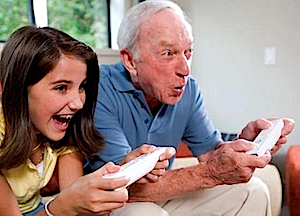 In my post from last week, I described the many different reasons why we play games. But if there are different reasons why people play gamer, doesn’t that suggest that there are different types of games? Now, if you ask a member of the self-described “gamer”culture, he or she (most likely it will be a “he”) will tell you that there is only one type of gamer: someone who plays hardcore shooting, fighting, or real-time strategy games; everyone else is not a “true” gamer. However, I suspect that the truth goes deeper than that.
I am hardly the first person to ponder the question of different player types. In 1996, Professor Richard Bartle, a game researcher best known for being the co-creator of MUD1 (the first Multi-User Dungeon) in 1978 and the author of the seminal book Designing Virtual Worlds, presented a paper that evolved into what is now called The Bartle Test of Gamer Psychology. This test is a series of questions and an accompanying scoring formula that classifies players of multiplayer online games (including MUDs and MMORPGs) into categories based on their gaming preferences. The result of the Bartle Test is the “Bartle Quotient”, which is calculated based on the answers to a series of 30 random questions in the test, and totals 200% across all categories, with no single category exceeding 100%.
The Bartle Test is based on a character theory. This character theory consists of four characters:
- Killers, who like to provoke and cause drama over other players.
- Achievers, who are competitive and enjoy beating difficult challenges.
- Explorers, who like to explore the world – not just its geography but also the finer details of the game mechanics.
- Socializers, who are often more interested in having relations with the other players than playing the game itself.
These character types are often described as a quadrant model where the X-axis represents preference for interacting with other players vs. exploring the world and the Y-axis represents preference for interaction vs. unilateral action.

In more recent years, practitioners of gamification, the process of applying game mechanics to non-game environments such as work, commerce, health, activism and education to motivate engagement and loyalty, have seized on Bartle’s Player Types to help them determine which game mechanics are most effective with different types of users. The problem is that the Bartle Player Types was meant to categorize the motivations of players in Multi-User Dungeons, and any attempt to apply them in a different environment is a misrepresentation of Bartle’s work.
One gamification designer whose work I do admire, Andrzej Marczewski, came up with an alternate set of user types, with some consultation with Richard Bartle, if I am not mistaken. In this model, there are six types of users:
- Socialisers are motivated by Relatedness. They want to interact with others and create social connections.
- Free Spirits are motivated by Autonomy and Self-Expression. They want to create and explore.
- Achievers are motivated by Mastery. They are looking to learn new things and improve themselves. They want challenges to overcome.
- Philanthropists are motivated by Purpose and Meaning. This group are altruistic, wanting to give to other people and enrich the lives of others in some way with no expectation of reward.
- Players are motivated by Rewards. They will do what is needed of them to collect rewards from a system. They are in it for themselves.
- Disruptors are motivated by Change. In general, they want to disrupt your system, either directly or through other users to force positive or negative change.
As I look through these user types, I can see myself and what motivates me when I play games or engage in other experiences. Yet I don’t always have the same motivations for each game I play or experience I engage in. As Johan Huizinga explained in his concept of the Magic Circle, when we engage in play (or any other type of ritual), we agree to take on different roles. When I play Tetris, I’m motivated by Mastery. When I play World of Warcraft, I’m motivated by Autonomy and Self-Expression. When I’m at the gambling tables of Las Vegas, I’m motivated by Rewards. And when I take on the role of teacher, I’m motivated by Purpose and Meaning.
As we play different games, perhaps we all are different types of gamers, based upon our mood or need at at the time.
So, what type of gamer am I? Depends on what game we’re playing today!






 David Mullich