Author Archives: David Mullich
Electrifying Education Through Gamification: Part 2 – Points, Badges, and Leaderboards

This is the second in a series about how teachers can use game mechanics to make their lessons more engaging, motivating and memorable. These posts are based not only on research I’ve done into how gamification is used by educators, but also on how I use game-thinking and game mechanics in my own classroom when I teach game design and production at The Los Angeles Film School.
Gamification is beginning to make its way into formal learning environments. Instead of courses consisting mainly of textbook learning and lectures, lessons are being built using game mechanics. In classroom settings, gamification can be implemented in a number of ways but the more common ones include challenges, points, levels, badges and leader boards Let’s look at how these mechanics can be used in the classroom.
Challenges
In games, players are constantly required to meet challenges, such as solve puzzles, break defeat, or complete quests in order to advance. It’s a major reason why we play games. The same elements can be applied to a gamified classroom, as homework and projects can be presented in a fun, yet challenging way.
For your next lesson, instead of starting your lecture with a list of learning objectives, start with a challenge.
For example, here are two typical objectives for teaching skills required to deliver an elevator pitch.
One: Determine the features, benefits and unique differentiation of your product.
Two: Write a 30-second speech that creatively incorporates those elements.
Well, scrap those objectives and provide the students with a challenge.
You’re in San Francisco attending the annual Game Developers Conference, hoping to find funding for a new game project. As you get into the elevator to head down to the lobby, someone calls out, “Hold the door, please”. In walks in the President of Activision Studios. You have 30 seconds to describe your game concept to him. What do you say?
Which scenario invites you to step up and give your best? By simply changing how your present assignments, you can transform the task into a much more enjoyable activity.
Points
When players successfully complete a challenge in a game, they receive a reward for their success. In school, students receive grades as their rewards. Unfortunately, there are several problems with a grade reward system. A student has to be sixty percent successful just to go from an F to a D. However, in designing games, we reward players for making even the smallest effort in the beginning of a game, to build confidence and keep them engaged. And for any students who were like me when I was in school, they go into class expecting an A, and anything less is demotivating.
As for students who get A’s with very little effort, earning another A is just not rewarding. But kids are very use to starting with a zero score or experience points at the beginning of a game, and earning a numeric reward that has no limit. Being able to earn your own personal best high score is perhaps the most frequently used reward system in games, and it’s incredibly successful. Numerical feedback like this is popular because it is easy to interpret and understand, and minor increases and decreases are easy to observe and quantify.
According to a 2014 survey conducted by TalentLMS, 89% of respondents report that they would become more engaged with a point system instead of grades. For you own reward system, consider throwing out the traditional grades. Have students begin with zero experience points and enable them to earn more by completing challenges.
Many games use a variety of systems to reward correct play including scores, experience, time remaining, and so on. You can do this in the classroom as well. Read an optional library book on the topic being taught in class? Receive “Reading” points.Use the final amount of experience points to determine student ability. But if you must use a traditional grading system, convert points to a letter grade when report cards are due.
Levels
Levels function in a similar way to points in a game to give the player a sense of progression. Players know that they are advancing in the game when they make it to the next level. Levels divide the game experience into discrete sections so that players can clearly see their progress. They can think about their performance and determine which strategies have been successful and which have failed.
Moreover, levels can be used to gate off certain features or rewards until the player has progressed through the more repetitive tasks of the lower levels. Likewise, the higher level will usually unlock more challenging tasks and goals, making the progression to the next level increasingly difficult.
In the classroom, you might use a leveling system to allow students “unlock” new challenges and receive rewards such as additional privileges and responsibilities within the class. Studies show that leveling systems are far more popular with students than are grades, but you need to carefully plan out level progression so as not to make any one student feel inferior to their peers due to being significantly behind.
Badges
Games often combine levels and points with an achievement system. Here is one system I created based upon digital worksheets developed by educational technologist Alice Keeler. When the students when students mark off that they have completed challenges, they are rewarded with badges. This gives them immediate feedback to motivate further achievement.
You might award students electronic or physical badges — even stickers! — to reward accomplishments. When students complete a lesson, give them a badge. These badges in turn increase the student’s overall rank, and unlock other more challenging lessons. Now, students have a clear picture of the path ahead of them and have fun along the way.The trick is to award badges wisely and in a meaningful way to make them more appreciated.
Badges can also be used recognition of specific achievements or ways to encourage students to go above and beyond. Game designers also use acheivements to reward players for doing something that perhaps not everyone would do, or finding something that not everyone would find. Get perfect attendance and complete all homework assignments on time for a month? Earn an “On Target“ badge! Badges allow for visual and public celebration of student achievement.
Even if badges are given for simply attempting an assignment, completing extra credit, or showing continued effort in reaching a goal, the mere recognition of effort can go a long way in motivating students to learn and is great tool for boosting student confidence.
Leaderboards
Another game mechanic used to recognize player achievement are leader boards. Since the earliest arcade games, leaderboards have been a great incentive for players to play a game over and over again to hone their skills, just so they can see their name on the high score table. The competitive nature of a leaderboard gives players something to strive for, and staves off the boredom of doing the same tasks repeatedly, as there is a perceived reward at the end of the experience.
Using leaderboards to display high scores on quizzes or badges awarded for achievements can be enough to kick-start student engagement. If students can see how their learning journeys are progressing in comparison to their peers, they may be motivated to push on through the difficult assignments just to rise to the top of the board.
However, use of a leaderboard in a classroom has to be carefully planned so that struggling students don’t become discouraged. Those at the bottom will need other incentives not to give up trying to climb the board, and the board needs to be frequently updated or cleared so that no one stays at the bottom for long.
PBL Systems
This collection of game mechanics is often called a PBL system, short for points, badges and leaderboards. To summarize, learning objectives are presented as challenges, points and levels are used to measure progression, badges recognize student accomplishment, and leaderboards encourage competition. With such a system, students are rewarded for success but not penalized for failure.
By learning within a system of rewards without harsh penalties, students are not afraid to step outside of their comfort zone and fail. And by removing their fear of failure, students are encouraged to learn. Although PBL systems are the most common way gamification is implemented, they are many more game mechanics available to motivate learners.
In my next post, I’ll describe additional game mechanics you can use to motivate students through their desire for accomplishment.
Electrifying Education Through Gamification: Part 1 – The Challenge
 Today I am starting a series of blog posts (and shortly, a series of YouTube videos) about how teachers can use game mechanics to make their lessons more engaging, motivating and memorable. These posts are based not only on research I’ve done into how gamification is used by educators, but also on how I use game-thinking and game mechanics in my own classroom when I teach game design and production at The Los Angeles Film School.
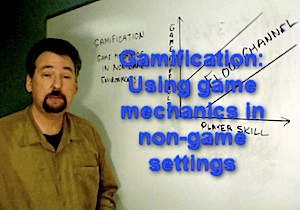
Think back to the last great game you played. What made it great? You probably felt completely captivated while playing it. The minutes passed by in a blur; you were utterly absorbed and your full attention was devoted to the task at hand. This state of energized focus is what game designers call “flow”. Psychology Mihaly Csikszentmihalyi created a model, known as the “flow channel,” to describe the environment where skill and difficulty increase just enough to ensure that an experience is neither frustrating nor boring. When game players reach a flow state, they are fully immersed in an experience, losing track of time and personal needs.
Is that how you would describe the students in a typical classroom? Probably not. Many kids think of school as it’s depicted in Ferris Bueller’s Day Off. To these students, school is boring and demotivating, when it should be exhilirating and engaging. What is it that traditional classrooms are doing wrong?
According to MIT, students remember only 10 percent of what they read, 20 percent of what they hear, and 50 percent of what they see demonstrated. But when students take an active role in their education, such when participating in a learning game or a virtual world, the retention rates skyrocket to 90 percent. Now, as any parent can tell you, most kids see homework as an unpleasant chore yet will happily toil for many hours grinding through quests in World of Warcraft and building elaborate structures in Minecraft. What makes “game work” more engaging than schoolwork?
One distinction is that schools typically reward students for compliance, thoroughness, and punctuality, whereas games reward players for experimentation, persistence, and play. The traditional educational model is passive and linear: the student sits at a desk and listens to a lecture; in a game, the experience is action-based and non-linear. If a student is struggling with a school subject, he is held back; however, when a player struggles with an obstacle, the game allows him to continue to try new strategies. There is little penalty for failure in a game, encouraging players to experiment.
In fact, failure itself serves as a learning tool: when players fail in a game, they acquire new knowledge and develop better skills. Such knowledge and skills become a resource for players, and the more players know, the better they become at playing the game. Game designer Raph Koster, author of A Theory of Fun, theorizes this process of constant learning is actually what makes games fun.
More and more educators are taking note that well designed games represent the best of learning design. Games are made of several design elements and work according to specific techniques. Games start easy and ramp up the difficulty level in such a way that players gain skills as they progress toward mastery. Games also provide models of desired behavior and give targeted feedback to direct players towards emulating that behavior. Game players regularly exhibit persistence, risk-taking, attention to detail, and problem solving — all behaviors that ideally would be regularly demonstrated in school.
How do we turn this game behavior into school behavior? That’s where gamfication comes in.
Gamification is the process of using a playful approach and game mechanics to engage people and solve problems. It’s purpose is to find out which of these elements and techniques should be used and how they should be used in non-game contexts. The final goal is to get people feel the deep levels of engagement experienced in games by approaching a flow state.
Gamification seeks to harness human motivation based on the premise that people play games because games are intrinsically rewarding and engaging. Although inventor and programmer Nick Pelling first coined the term in 2002, the concept has been in use for decades.
The boy scouts have long used merit badges to recognize a scout’s accomplishments in areas such as camping, electronics, and even game design, much in the same way that games now award achievements for players to display. Businesses use game-like techniques such as trading stamps, loyalty programs, and celebrations for the “one millionth customer” to encourage customer retention. Even the paying of taxes has been gamified through state lotteries.
But what would we do need to do to gamiify education? After all, schools already use several game-like elements. Students get points for completing assignments correctly. These points translate to achievements in the form of letter grades. Students are rewarded for desired behaviors and punished for undesirable ones using grades as a reward system.
And if students perform well, they “level up” at the end of every academic year.
Given all this, it would seem that school should already be the ultimate gamified experience. However, too often the traditional school environment results in boredom, cheating, and dropping out. There is still something missing from this environment, something that allows video games to excel at engaging kids.
Here is my YouTube video presentation of the above post.
In next week’s blog post, I’ll look at some of the game mechanics that have been used successfully to boost student engagement.






 David Mullich