Author Archives: David Mullich
Balboa Oaks Merit Badge Midway Produces Several Fun Games!
 Several times each year I run a Game Design Workshop at a nearby Boy Scout merit badge midway. One of the best managed of these events is the Balboa Oaks Merit Badge Midway, which requires scouts to preregister a couple of months in advance. This gives scouts time to fulfill a workshop’s prerequisites and take full advantage of their time with the merit badge counsellor. This is especially helpful to me when I run a workshop, because it allows scouts to come up with a game idea and create a prototype that they can bring into my workshop for playtesting.
I ran a Game Design Workshop at the Balboa Oaks Merit Badge Midway last Saturday, and I’d like to share some of the games that the scouts designed and brought to playtest.
Basketball Boardgame
 Daniel L. of Troop 316 designed a two-player basketball boardgame in which the player who scores ten points first wins.
At the beginning of the game the two players start out at opposite sides of the board. The two players flip a coin to decide who goes first. Then the starting player rolls a die and decides to go left, right, or forward. If a player rolls doubles, he draws a card out of a deck with fouls, blocks, and steals. With a flagrant foul, the player loses a turn; with a shooting foul, the other player gets two shots from the free throw line; with a personal foul,the opponent starts from the three point line; and with a offensive foul, the player loses a turn. If a player draws a steal card, the opponent loses a turn. If the player draws a block card, the opponent moves back to half court. The player’s main goal is to score some points by throwing a marble sized ball into a small basketball hoop.
Everyone who tested the game enjoyed it but found it a bit too easy at first. The designer’s solution was to require players to be closer to the net before making a throw.
Sonic Hedgehog
 Zachary L. of Troop 243 designed a multiplayer-player boardgame based on the videogame character Sonic the Hedgehog. In this game, players race around the board collecting 7 differently-colored emeralds as well as the final, single eighth emerald before going to the finish.
Players take turns rolling dice to move around the board. Certain paths lead to a treasure trove of same-colored emeralds, and the player entering the space can retrieve one of these. Landing in other spaces require the player to pick up Sonic Cards, which may direct the player to move to other locations, give up an emerald to another player, or take an emerald. In the final treasure trove, there is only one, eighth emerald.
While players enjoyed the homage to Sonic The Hedgehog, they wanted more challenge to the game. In response to this feedback, the designer added more cards that required players to move back along the path.
Card and Dice Game
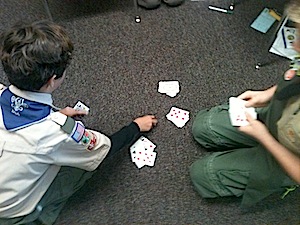 Logan K. of Troop 604 designed a multi-player card and dice game in which the objective was to get rid of all of your cards.
With two players, each player gets 10 cards. With three or more players, 7 cards are dealt. Players roll two dice to see who goes first, and the player with the highest number starts the game. The first player rolls the dice and based on the numbers rolled, decides which cards to discard. (For example, a player who rolls a 2 and a 5 can either discard all of his 2’s or all of his 5’s, or a 2 and a 5, or a 7. If a player cannot discard, he must draw a card from the pile and play passes to the left.) The first person to get rid of all his cards wins!
All of the playtesters loved playing this game. The designer tried a couple of rule variations, but ultimately stuck with the original rules.
The Exploration Game
 Ian B. of Troop 642 designed a multi-player board game in which the objective was to get to the finish while learning facts about famous explorers.
Players roll dice to determine the order in which they will take turns. During each player’s turn, the player rolls his dice and moves, beginning from the starting position, around the board. At various spaces around the board’s perimeter, the player must pick up a card and answer a question about a famous explorer in order to proceed. Each player must go to the color of his home port to win the game.
The playtesters found some of the questions too difficult, and so the designer removed the more difficult questions.
GeoMaze
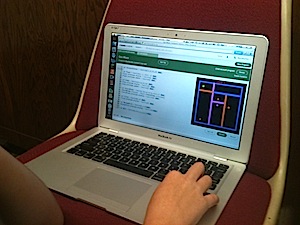 Riker W. of Troop 403 designed and programmed a single-player, top-down maze videogame with the progressively harder levels. The objective is to move the player to the green finish box while avoiding red enemies and other obstacles.
Using the arrow keys, the player moves to the green finish box in each level. The player dies if it touches a red enemy; when the player dies, the level is restarted. Colored walls can only be passed through while the player is the same color as the wall; the player can change his color moving the into a Color Changer of that same color. The player wins by completing all levels.
Playtesters enjoyed this game, but the designer found that it was unnecessarily complicated to have each Color Changer feature cycle through colors and instead decided to have each Color Changer remain a constant color.
Shooter
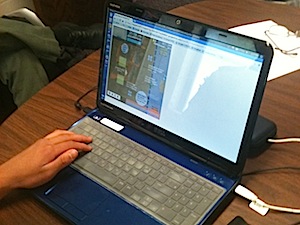 Sungbin C. of Troop 1 designed and programmed a single-player (with two-player option), top-down shooter videogame in which the object was to defeat enemies while reaching each level’s final destination.
The game starts when the player presses the start button after choosing his weapon type. During the game, the player has a limited amount of health, armor, and shield that will decrease upon impact with enemy projectiles; , however, these regenerate over time. The player uses W, A, S, D to move and space bar to shoot (in a two-player game, the other player uses arrow keys to move with enter button to shoot). The controls may be rebinded. The game ends by one player running out of health, which will bring them to another level or back to loadout-choosing page, where they can re-choose loadout, depending on the settings.
Playtesters enjoyed playing this game and didn’t have suggestions for changes or improvements. However, the designer thought that some of the buttons on the weapon selection page were too small, and increased their size for the final playtest session.
All in all, it was a great Midway. I was able to sign off six Game Design Merit Badges as completed, as well as three partial completes (these were last-minute additions to my workshop who weren’t able to bring a game prototype with them, but did get credit for learning about game terms, game jobs and the use of intellectual property during the lecture portion of the workshop).
The Process of Writing Adventure Games
 When I first enrolled in college, my plan was to major in film production. That was until I discovered the computer and its power for creating interactive stories. So, you can understand why my favorite game genre is adventure games. I’ve designed and/or developed a number of adventure games throughout my career and I’ve approached their design through a number of ways.
Inspiration for a game can come from anywhere — personal experience, a topic of interest, a book or movie license, even a dream. But usually in the really of videogame development, you make the game you’re told to make.
The very first adventure game I designed (back in 1979) was based upon the British television show The Prisoner. The ideal way to design any genre of video game is to start with the player experience — determining how the player should feel while playing the game — and that’s how I began the design of this game. I wanted my game to recreate the same experience I had when watching the show: the experience of being in a menacingly-cheerful, surreal environment in which you were constantly monitored and controlled, where every opportunity was a deception and every move you made sent you back to square one, and yet by assertion your individuality and refusing to follow the rules, you could ultimately succeed.
I then invented game mechanics to create the game experience, and you can read in detail about how the gameplay works in the Wikipedia article about the game. The final step in the design process was to write the story exposition and dialog to support the both the play experience and game mechanics.

Another popular adventure game I designed and produced was I Have No Mouth, and I Must Scream. The game was based on Harlan Ellison’s classic short story about the last five human survivors of a world war waged by three computers from the world’s superpowers, and how the computers merged into one entity, AM, and tortured these poor unfortunates for eternity. We paired Harlan with a game writer, David Sears, who asked the question, “Why were these particular five people chosen?” and from there they created a new, vastly expanded version of the story that told the backstories of each of these people.
Once I had a story to work from, my next step was to find a game developer with a game engine suitable for developing an adventure game, and that lead me to hiring The Dreamers Guild to do the programming and artwork because they had created a suitable game engine for their game Faery Tale Adventure. I then created a series of puzzles that would unveil various pieces of the story and work with the mechanics of the game engine we were using, as well as expanding the dialog to provide hints for those puzzles. In fact, I wound up writing almost half the game’s dialog myself to support the game’s puzzles, and since my infant son was undergoing chemotherapy at the time (he’s fine now), I had no problem putting myself into a sufficiently black mood for writing dialog to match the nightmarish scenario.

The most recent adventure game I designed (in 2012) was for a client who simply told me, “I want a game about the prophesied end of the world in 2013.” The client wanted to use a game engine similar to some mystery games he directed me to on the web, and so I decided to start by writing a story about a teenage girl whose father, a pilot, went missing in the Bermuda triangle and her investigation to find out what happened to him leaders her to archeological sites throughout the world, where she discovers artifacts that will allow her to thwart and alien invasion that was prophesied to occur on December 21, 2013.
I collected lots of photographs of the places that our heroine would visit and researched the ancient civilizations whose artifacts she would uncover, and that inspired me to create the details of the world and the puzzles that needed to be solved. Unfortunately after I handed my game design off to the client, someone decided to turn my Amelia Earhart-inspired heroine into a bubbly tourist just looking for some fun in the sun while in Bermuda, but that’s the way game development goes sometimes — just as in movies, the writer doesn’t always have final say! I’ve never looked at the final version myself, but if you are interested, you can download it here.

In conclusion, I’ve written adventure games beginning either with the player experience, the story, or with the game engine or mechanics as my starting point. While I prefer beginning by defining the player experience, it is critical to have all three elements support each other regardless of the starting point, as should the puzzles and dialog.






 David Mullich