Author Archives: David Mullich
Trying My Digits At Teaching Analog Game Design
 I grew up playing popular board games with my family — Candyland, Chutes and Ladders, Operation, Life, Clue, Monopoly, Scrabble, Risk, Stratego. Eventually, I began to design my own boardgames for fun. In my college years, I discovered Dungeons & Dragons, and that role-playing game helped me form my early ideas about game design as I began to develop video games. Three decades later, when I was working at the Spinmaster toy company, I renewed my interest in board games by participating in the company’s weekly board game playtesting sessions.
One of the classes in our game program at The Los Angeles Film School is Analog Game Theory, which introduces students to game design principles for board and card games that do not require technology to create engaging experiences. Our AGT instructor moved out of state recently, and while we were waiting for to bring aboard a replacement instructor, I was given the opportunity to teach the class, and what a fun time it was for me!
During each of the first three class sessions, I had the students play and then analyze a board game — Carcasonne, Puerto Rico, and Settlers of Catan, respectively. After discussing the considerations that the game designers made in creating each of the games, I had the students do a quick game jam, making a game games based upon a particular play value, a game mechanic, or use of randomness for a game element other than player movement. Then, for the last seven sessions of the class, I divided the students into three teams to develop a final project for our bi-monthly Analog Game Fair.
It was the physical aspects of the games that most concerned me, having only worked professionally in digital games, but I was very pleasantly surprised with the polish that some of the students brought to their games.
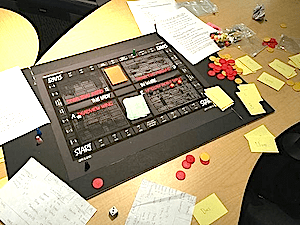 Lady In White was a horror-themed game created by a three-person team. Players would roll dice to move spaces around the game board to collect resources needed build graves and other graveyard structures used to collect souls with the goal of collecting a certain number of souls to win the game. The player could collect the more common resources, Dirt and Wood, by passing them as they moved around the board. However, the more rare resources could only be obtained by landing on a specific space or by purchasing them using the game’s currency, gold. Gold was collected by landing on marked spaces or by drawing a card with a random effect. These cards could also have negative effects on the player such as losing all of the resources they had collected so far.
The game board fit into the game’s theme well, but there was a problem with the game resources. First, the difficulty of acquiring the resources for the various graveyard structures did not correspond to the amount of souls each structure could capture. After doing some quick analysis of the cost of various structures in terms of gold, it was obvious there was only one structure worth of purchasing. Also, the game had too many resources with too little differentiation between them, so the game was basically about collecting resources as quick as you can to generate enough souls to win the game. Finally, when four players played the game, it took too long to generate enough souls to win, and we wound up quitting the game after an hour, as there was too little variety to keep us occupied. Many of these flaws should have been found in the three playtest sessions we had before Game Fair, but it appears that the players who were playtesting the game were not critical enough.
 Outfall was a board game inspired by the computer role-playing game Fall Out. Players start the game by choosing which character class to play, which determine which of four stats would be used for determining success with other characters. Throughout the game players would draw equipment cards that would be used to modify their states. When players landed on board location representing an enemy character or one occupied by another player, they would do battle by rolling dice and referring to their stats to determine which one the battle, usually with some positive benefit to the winner and a negative penalty to the loser, with the effects varying based on their character class. Equipment cards are drawn by players to reveal a potential item that they could use towards a players stats. Other elements that added uncertainty to the game were additional cards that the players could collect and play at various points in the game to add benefits to themselves or penalize others.
This game was made by a four-person student team, but the team was hampered by two of its members being frequently absent during production. As a result, the game components lacked the polish of the other two games made in the class. The gameplay was fairly simple, yet it was engaging. Overall, it was a fun premise that could have been made richer given more time (and more involvement from the rest of the team.
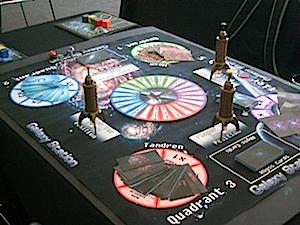 The final game presented at our Game Fair was Galaxy Station, made by another three-student team. In this game, players traveled around a game board collecting materials necessary to enhance their spacecraft, which each enhancement bestowing certain benefits. The final version of the game featured gorgeous-looking components, but what really captivated me was a game mechanics that rotated the central path on the board with each phase of the game, opening up different paths and opportunities for players to collect rate resources from the circular side paths. The game was eye-catching from a visual stand-point and its gameplay was compelling as well.
All in all, my experience in teaching a class about creating board games turned out to be an even more fun experience than I anticipated, and it made me want to start playing board games again, although perhaps checking out some more recent games that are a bit more innovative than the ones from my youth.
Remembering Wes Craven: Principled Man of Fear
 I love horror. Not real-life horror like disease and poverty, but fantasy-horror. My favorite holiday is Halloween, my favorite Disneyland attraction is The Haunted Mansion, and when I was a kid, I made my own haunted house ride, charging neighborhood kids twenty-five cents to pull them on a wagon past scary scenes I set up in my garage. But mostly, I loved watching watching Universal horror movies (my favorite was the Wolfman).
As I grew up, my tastes in horror became more sophisticated. When I went to the movies with my friends, we watched Friday the Thirteenth, Halloween, and all the other slasher films aimed at the teenage audience. But my favorite horror film of all was A Nightmare on Elmstreet, directed by Wes Craven, who passed away yesterday at the age of 76 after a losing battle with brain cancer.
A Nightmare on Elm Street contains many biographical elements, taking inspiration from director Wes Craven’s childhood. The basis of the film was inspired by several newspaper articles printed in the Los Angeles Times in the 1970s on a group of Khmer refugees, who, after fleeing to the United States from the results of American bombing in Cambodia, were suffering disturbing nightmares, after which they refused to sleep. Some of the men died in their sleep soon after. Medical authorities called the phenomenon Asian Death Syndrome.
The film’s villain, Freddy Krueger, draws heavily from Craven’s early life. One night, a young Craven saw an elderly man walking on the sidepath outside the window of his home. The man stopped to glance at a startled Craven, and then walked off. This served as the inspiration for Krueger. Initially, Fred Krueger was intended to be a child molester, but Craven eventually decided to characterize him as a child murderer to avoid being accused of exploiting a spate of highly publicized child molestation cases that occurred in California around the time of production of the film.
By Craven’s account, his own adolescent experiences led to the naming of Freddy Krueger. He had been bullied at school by a child named Fred Krueger, and named his villain accordingly. Craven strove to make Krueger different from other horror-film villains of the era. “A lot of the killers were wearing masks: Leatherface, Michael Myers, Jason,” he recalled in 2014. “I wanted my villain to have a ‘mask,’ but be able to talk and taunt and threaten. So I thought of him being burned and scarred.” He also felt the killer should use something other than a knife, which was too common. “So I thought, How about a glove with steak knives?”
What I most enjoyed about the film was that it was in some ways a thinking person’s horror film. By having the villain, Freddy Krueger, invade his victims’ dreams, the film toyed with the audience’s perception by blurring the boundary between the real and the imaginary. The film itself preys on archetypal fears and imagery: the myth of the bogeyman, the vulnerability of a sleeping victim, and the power of the unconscious conjuring up the worst horrors imaginable.
A Nightmare On Elm Street is considered by many, including me, to be one of the best films of 1984, so imagine my delight when, twelve years later, I was meeting with film’s director about making a new horror project, but in my own creative medium, video games.
I was the Creative Director of a small game publisher called Cyberdreams, which specialized in working with famous names from the fields of science fiction, fantasy and horror in adapting their works to video games. Previously, I had worked with writer Harlan Ellison in creating a game version of his classic short story I Have No Mouth, And I Must Scream as well as artist H.R. Giger on using his macabre art as the inspiration for a game called Dark Seed. And now I was meeting with a master of film horror, Wes Craven.
 Craven had approached us with a concept called Principles of Fear, which was about exploring the various causes of fear. The goal was to create an action-adventure game which encompasses all levels of human fear and conflict within a challenging game scenario. Although many games did justice in rendering ferocious combat, and others take great care in presenting a psychological challenge, few successfully combine both elements.
As Craven described his ideas across several meetings, I found him to be an extremely intelligent, erudite and charming man. He was also a master storyteller, in person as well as on-screen. I knew right away that working with him would be delight.
I contracted game developer Asylum Entertainment, whose credits included the military strategy adventure Allied General for SSI and SimFarm for Maxis, to develop the CD-ROM action-adventure. I also found working with Asylum and its president, Brett Durett, to be yet another delightful experience, as we worker together to turn Wes Craven’s insights on the essence of fear into a compelling three-dimensional game taking place in what was essentially a haunted house.
We had thought we had succeeded when we demonstrated an early prototype of the game at the 1997 Electronic Entertainment Expo when About Games awarded our game a Bronze Medal award for Best of E3 — Interactive Fiction.
Unfortunately, Wes became deeply involved in developing a new movie at this time, and we only had access to his manager, who apparently had little understanding of games or the process of making them. When I demonstrated our award-winning E3 demo to her, it did not meet whatever expectations she had about what the video game would be like. She insisted on canceling the project and we could not talk her out of it.
And so I woke up from our dream of working with Wes Craven with nothing to show for it but some good memories of our meetings with him. Now with his passing, I’ll never again have a chance to apply his Principles of Fear. Lost opportunities are one horror that I do not enjoy at all.






 David Mullich