Author Archives: David Mullich
Game Design For Cub Scouts
 A friend whose older son was in one of my sons’ Boy Scout troop asked me to attend her younger son’s final Cub Scout meeting and talk about game design. Now, I teach game design every day to college-age students, and I have a lot of experience running game design merit badge workshops for boy scouts (in fact, I’m one of creators of the Boy Scouts Game Design Merit Badge). However, this opportunity presented a different set of challenges. For one thing, I had only about an hour. And for another, we’re talking about ten-year-old boys, and that means barely-contained bundles of energy.
Okay, I needed a game plan. To keep their energy focused into a productive hour, I needed to keep my talk fast-moving and keep the boys active. So, here’s what I did.
After giving the briefest of introductions about my background (Disney, Activision, Spinmaster toy company), I asked them what their favorite game was? “Minecraft!” Of course. “Angry Birds!” “LEGO Marvel Super Heroes!” “Portal 2!” Now, those are all great video games, but what about other times of games? What’s your favorite board game? “Monopoly!” “Life!” “Risk!” What about sports? Those are games too. “Baseball!” “Football!!” What about party games? “Pin The Tail On The Donkey!” “Tag!”
Well, is every activity a game? Is homework a game? “NO!” Is taking the trash out a game? “NO!” So what does an activity need to be a game? “Fun! It has to be fun!” Right you are! Fun is an essential element of a game. But throwing rocks across a pond can be fun. Does that make it a game. “It can be, if you try to make it skip three times!” Oh, so the activity needs to both be fun and have a goal. Anything else? “Rules! It has to have rules!” (This kids are smarter than my college students!)
Maybe we can turn any activity into a game. How about painting? Is painting fun? “Yes!” Is there a way to give it a goal? “Maybe someone has to paint something!” “Maybe it’s two people!” Okay, here’s the goal: there are two painters, and we give them a word or phrase to paint. And the first person to paint it correctly wins. What other rules can we give to them? “People have to guess what they are drawing!” “They take turns!” “They have to do it in a time limit!” Congratulations! You Cub Scouts have invented the game Pictionary!
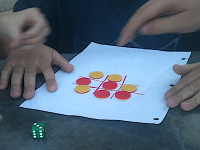 Enough talking! Let’s play some games! Let’s play one of my favorite games of all time — Tic Tac Toe! (I begin pulling papers, marking pens, dice, and colored discs — one side red, the flip side yellow — out of my supply box). Now, I’m a little fuzzy on the rules. Tell me, how do we start the game? Very quickly the cub scouts assemble the following How To Get Started Rules:
- Draw a 3×3 grid
- Choose 2 people to play
- Each person picks a color
- Roll the dice to see who goes first.
So, how do we get from the game start to game finish? “We take turns!” And what do we do each turn? “You put your color down in a square!” Any square? “An empty square!”
And how does the game end? “You win by getting three in a row!” Is that the only way the game ends? “No, you can get a cat’s game where no one wins” Well, I think that’s everything we need to know to play. So, let’s break up into groups of two and play the game.
After a couple of minutes, I tell them to stop. I re-arrange them into groups of three, with one person appointed to be game designer. I explain to them that the job of a game designer to create fun experiences for other people. It’s like being the host of a party: you decide what decorations there will be, what food to serve, what music to play, what activities to do, and when your friends arrive, you need to make sure that they are having a good time. But different people like different things, and so it’s hard to guess what will be fun for them. So, you have to watch them, and if they aren’t having a good time, you have to switch things up.
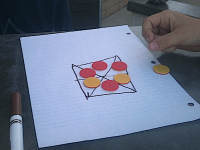 And so, I had each “game designer” propose one change to the rules that he thought would make the game more fun, as well as what his prediction would be about how the players would react to the rule change. The “designer” then watched the other two scouts play the game with that rule change, and then tell me his observations afterwards. Then I let another scout be the game designer until each scout had a chance. Most of them simply added more squares to the grid, but one scout made a very intriguing circular grid unlike anything someone has suggested before when I’ve done this exercise with students.
After everyone had their turn, I explained that even video game designers may first play their games on pen and paper before it goes to programming, because its so easy to make changes to pen-and-paper games. You can even play a first-person shooter game as a pen-and-paper game! And with that, I pulled hexagonal graph paper, sticky notes, cards, tokens, and discs out of my supply box, and described the rules for a “paintball” game (I winked at the scouts’ parents as I said this, since I knew that would be the only acceptable way I could present a first-person shooter to young kids) based on a game described in Tracy Fullerton’s book Game Designers Workshop.
Getting Started
- Use hex paper as the floor of a room
- Use sticky notes as walls
- Each player uses a colored disc as their avatar and draws an arrow on it to show shooting direction
- Each player colors one hex as their starting location and places their avatar on it.
- Each player takes 3 tokens to represent their “lives”
- Each player takes a deck of 9 cards: 3 “turn” cards, 3 “move cards”, and 3 “shoot” cards.
Gameplay
- The game is played in turns. During each turn, each player chooses 3 cards from their deck of 9 cards, indicating the actions that they want to take in each round in the turn.
- Each turn consists of 3 rounds. Players take the action for the card corresponding to that round, in the following order:
- Shoot: Any other player that the arrow on the player’s disc is currently point is hit, unless a wall blocks the short. The hit player loses a life: if he loses all three lives, he is removed from the game, otherwise, he returns to his starting point.
- Turn: The player rotates his avatar disc so that its arrow points one hex side to the left or right of its current direction.
- Move: The player moves his avatar disc one hex over from his current position, in any direction.
Game End
- The game ends when only one player remains alive.
 I was worried at first that the rules would be too complex for ten-year-olds, but my worries were unfounded, as I had underestimated the kids. They picked up the rules quickly, and the natural leader on each team wound up calling out rounds and actions. As the meeting time drew to a close, one game had been one and another was close to winning.
There was a moment or two when scout’s tempered flared because they weren’t happy with how things were going, or their excitement was almost not containable, but I kept things moving quickly enough that I was able to redirect their attention.
All in all it, the experience went as well as I could have hoped. The scouts seemed to have a fun time, the parents were pleased, and I got a blog topic out of it. I’d happily do it again some time. I’m available for future cub scout meetings, birthday parties, and bar mitzvahs.
Making Games, Making Friends At The Gamkedo Game Club
 For the past several years, I’ve been a follower and admirer of game developer and coach Chris DeLeon. Whereas I teach game production and design from the glass towers of The Los Angeles Film School, he is down in the trenches, fighting to make game development accessible to everyone through both one-on-one and worldwide engagement. After nearly two decades of game development experience, Chris now works as an independent educator helping people learn to make their own games through his ebooks, video courses, one-on-one personalized help over Skype, and more. Chris also lead a collaborative game development practice club meeting weekly in Beverly Hills called the Gamkedo Game Club, and he graciously asked me to be a guest speaker at last week’s meeting.
Ever since founding and cofounding game development clubs in college, Chris has found that these gatherings have been by far the most significant way he has been able to help people learn to make games. Between the clubs at Carnegie Mellon and Georgia Tech, he’s had club alumni go on to work Activision, Bungie, Schell Games, Microsoft Studios, Pandemic, Electronic Arts, Zynga, Maxius, Facebook, Adult Swim Games, and many other game developers, publishers, and start-ups.
Emboldened by the success of his students, Chris really wanted to create that experience in a way available to more people worldwide who weren’t attending those universities, since many of his clubs’ benefits and requirements are quite tangential to a university’s mission and logistics. Chris believed that arranged properly this could help many more people, more than any single other thing that he could be doing with hs life.
His first effort was to do this entirely online as a forum about two years ago at https://www.reddit.com/r/hobbygamedev. Chris grew that community to over 900 people, and together they completed 8-9 games, most of which can be found at http://www.hobbygamedev.com/games/. However, out of those nearly one thousand members, only had maybe a half dozen truly active people making games. The rest were largely spectators or were impossible to get engaged. That’s when Chris realized that in order to get this really going, he had to make something at least with its core roots in-person again, except now apart from university. Accountability is better, networking is stronger, and in general seeing people routinely in-person makes it way harder to simply ignore than just avoiding an online forum.
 And so Chris organized the Gamkedo Gaming Club, named after the trademark and unifying brand that he uses for his one-on-one online training services and video courses. The name is intended to sound vaguely like an eastern martial art because Chris’ training approach is a clear skill progression, roughly akin to the martial arts colored belts trope, starting from total beginner up through self-sufficient project lead, carved into discrete levels. An early fundamental skill taught in many martial arts is how to tumble without harm or safely take an expected hit, and part of the process Chris teaches is how to make game development responsibly long-term sustainable from beginner level onward.
When Chris was first starting the club, he grew a mailing list of people interested. When he mentioned this group to some local professionals, he received a few offers to meet in their game development studio spaces during off hours , but when he surveyed members about it the overwhelming majority preferred that we keep our own distinct identity. Christ then plotted all the member locations from our survey on the Los Angeles map, and Beverly Hills worked out to be a central location which was reasonably fair for all members. Chris selected the Beverly Hills Library as the club’s venue because of its free parking, ease of making reservations, and scalability for meeting space.
The club’s first meeting was Oct 1, 2015, but it really took off the last two weeks of December. The club now has twenty-four members total with about six online. Of the local members some don’t make it to every meeting due to living a bit further away, and there were about twelve members in attendance the night I spoke. However, absent members are able to keep up with meetings and collaborate the same way our long-distance members do.
 The club works sort of like an anti-Game Jam. Instead of being given a topic or concept that everyone builds a game around, members pitch their own, individual game ideas. As part of the pitch, members present a tentative, week-by-week milestone schedule that Chris has worked out with them. And instead of having a limit time, such as a weekend, to develop their game, projects tend to fall within the following two scopes:
- Warm-Up Scale: 3-5 weeks after pitch
- Full Scale: 3-5 months of weekly updates after pitch
Members can chip in 1-3 hours per week, over months. This way they can make one game after another year round. No one is assigned to a project or position. Members can make the games they want to make and fill roles they want practice in. And if you’re project misses a deadline, there’s no shame or penalty.
Despite the low-pressure atmosphere, game sensei Chris DeLeon likens the club to a “sparring” group, people who are there to practice with one another but under the low-pressure shared understanding that it’s only practice, not the high stakes “real thing.” He repeatedly emphasizes no anger or drama over people sometimes failing to meet at-times optimistic promises, and instead being grateful for all measures of contribution and progress which do happen. He encourages members to try new things, explore creative risks, and ensure everyone feels that when doing so they’re not going to risk irrecoverably ruining anything for other members.
The members I met after I gave my talk certainly seemed to embrace the notion of taking creative risks and trying new things, but from a variety of perspectives.
A young lady told me that she had worked in the industry as environment designer for Legends of the Outlands. However, she wanted to stretch her creative wings to become a game writer, but felt she would only be taken seriously in the industry if she mastered coding as well. Although I know many people who work in the game industry but don’t know a lick of coding, I can tell you that you can perform almost any game development job better — whether you be a designer, artists, sound engineer, or game writer — if you have some programming knowledge.
A young man told me his story of how he had worked in Europe as a game producer, but since heading returning to the United States decided to join the club in order to network with other people in game development. Smart man, since I tell my own students that many game jobs are not advertised and most are gotten through referrals, so it is important to network, network, network!
A middle-aged gentlemen I met told me that he decided to join the club because he was interested in game development as a hobby. Chris explained that even people who weren’t on a career path find the club to be a great way to meet new people, exercise creative skills with people who think differently, create bigger software projects they’re proud to share with friends and families, a learning context that challenged them through practice application, and gives them interesting leadership or skill application stories to tell in interviews even outside the game industry.
If you are interested in attending a meeting of the Gamkedo Computer Club, guests are welcome to attend free to follow along and network. You do not need to know any members yet or be brought by an active member, swinging by is the best way to meet them. Pitching and team involvement (and other benefits like support hours via Skype, othe club forum, etc.) are members-only, but meetings are free and open to the public. Visit this link to find out more: http://lagamedevs.com/.






 David Mullich