Author Archives: David Mullich
What Makes Pokémon Go So Popular?
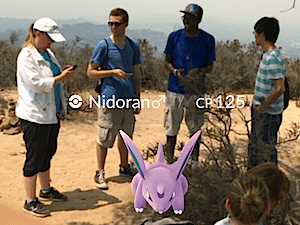 Every couple of months, the Los Angeles Film School’s Level Design instructor invites her class for a hike up to The Wisdom Tree, a landmark in the Hollywood Hills. This month she decided to call the event a Pokémon Go Hike in recognition of the unbelievably popular augmented reality game released just a few weeks ago. However, even she underestimated its popularity when 175 people indicated on the event’s Facebook page that they would be going, and 1,300 more said that they were interested. Fearing that the trail would have far more hikers than it could accommodate, she decided to cancel the public event — although I and some of her class did the hike on our own. We did find a Pokéstop at the top and added a number of Pokémons to our collections, so a good time was had by all despite the oppressive July heat and a layer of smoke from a raging wildfire in the mountains to the north of Los Angeles.
As I started the trek down back to civilization, I thought about the hundreds of people who originally wanted to go on this hike simply because it was associated with Pokémon Go. What made this game so popular, so quickly? Almost everywhere I go, I see people walking from Pokéspot to Pokéspot, trying to catch them all. Yet Pokémon as a franchise has been around for twenty years, and augmented reality games are not new (in fact Pokémon Go is built upon code the developer, Niantic, created for an earlier augmented reality game, Ingess). What makes this game so special that it is capturing everyone’s attention?
One prism that I used to analyze the game’s popularity is the 5 Domains of Play, a framework that Ubisoft Creative Director Jason Vandenberghe presented at the 2012 Game Developer Conference that draws connections between five major motivational factors and their corresponding goals in game design. This framework is based upon the Big Five personality traits, also known as the five factor model (FFM),that suggests five broad dimensions used by some psychologists to describe the human personality and psyche.
Vandernberghe’s premise was that we can describe play in terms of 5 domains, or “factor,” as a two-sided spectrum with a positive motivation on each end. The more motivational factors a game satisfies on each side of the five domains (for example, some people are open to new experiences, while others prefer the comfort of the familiar, the more popular the game will be.
The first of these domains is Novelty, the presence or lack of new, interesting, dramatic, or beautiful things in the game. For most people, an augmented reality game based on traveling to real locations is a novelty, and yet the game’s theming is based on a familiar intellectual property, Pokémon, which is one reason why this game is so much more popular than Niantic’s earlier game, Ingress.
Both games require players to travel to real-world locations –called Pokéspots in the game — which they can observe through their phone’s camera. Yet the familiar is augmented with the surprising, as these locations generate various power-ups and devices used to capture imaginary creatures that can suddenly pop-up during their travels. So, the game has equal appeal to players who are motivated by both ends of the Novelty spectrum.
The next domain, Challenge, is the part of the game that requires the player to use self-discipline: overcoming obstacles, work, avoiding danger, and collecting achievements. Much of the game provides low challenge, which appeals to casual game players: acquiring Pokémon and resources is an extremely easy grind. If you live or work close enough to a Pokéspot, you can just sit at your desk and collect stuff all day. However, for player’s who enjoy Challenge, there are Gyms, where players must battle high-level Pokémon to seize control of these training areas. While the fight controls themselves are very simple, each of the Pokémon have individual strengths and weaknesses, so fighting does require the development of Pokémon expertise.
Stimulation is the domain that excites, be that through direct thrills or through social interactions. As with the Challenge domain, those seeking Stimulation can do so in the Gym, while hunting and gathering quickly becomes a more mundane process.
Harmony is the domain involving how the player behaves in a particular way toward other people or characters. Those players who are motivated by high harmony are indulged by powering up and evolving their Pokémon, nuturing them if you will, while establishing social bonds with other players by joining one of the three colored teams in the game or simply by meeting other players who are out playing the game. Players who get off on low harmony can do so by defeating Pokémon in Gyms and then seizing control of that Gym away from other teams that own it.
The final domain, Threat, is the negative tone of the game that can evoke negative emotions in the player, such as addiction, anxiety, anger, or sadness. Generally the game is non-threatening, with its colorful graphics and cute Pokémon, and there is now way to lose the game. However, you can lose Pokémon you’ve collected by losing fights in the Gym, as well as losing control of the Gym itself.
As I look at the game mechanics and other features, I don’t have to look hard find ones that appeal to players that are motivated at each end of the five domains. No wonder the game is so popular: it literally has something for everyone!
Another way to analyze the appeal of the game is to look at how it rewards players for playing the game. The most power rewards are intrinsic ones: the rewards that are inherent in the gameplay itself. Because the game satisfy so many player motivation factors, there is no need to further analyze whether the game provides intrinsic rewards.
 However, I will point out that the game also provides extrinsic ones. The game’s developers specifically design Pokémon to encourage players to “get up an go”: go out, explore, and exercise through walking. The game explicitly requires players to exercise by indicating the number of kilometers one must walk in order to incubate eggs for hatching new Pokémon. I’ve also found that, by walking Pokéstop to Pokéstop, I’m becoming acquainted with artwork, architecture and landmarks I never notice before, thanks to the real-world snapshots that appear when I reach a Pokéstop. There is also the extrinsic reward of making social connections with people, as I greet another player who also had stopped in the park to capture the wild Pokémon lurking there.
Perhaps most important factor of all is the engagement brought about by the proper level of complexity and depth in a game. The goal of most game designers is to craft a game that is “easy to learn but difficult to master.” Even though it comes without instructions, Pokémon is extremely easy to learn because the mechanics are simple and the controls are intuitive. However, to become proficient in later levels of the game, one really needs to become familiar with the matrix of which Pokémon are effective against others, and so the game does become more complex as you play it.
As for depth, there really aren’t that many decisions to make. As I indicated, you can sit at your desk and collect Pokémon and resources all day long from a nearby Pokéstop, which recharges its rewards every few minutes. If there is a reason for visiting a variety of Pokéstops, I haven’t found it yet. There is a reason for collecting a variety of Pokémon, since some are more effective at fighting the ones guarding Gyms than others, but I’ve yet to find a reason for overtaking a variety of Gyms. If there is any depth to the game, I haven’t discovered it yet.
And this makes me wonder about the game’s long-term popularity. Yes, the game has something to offer everyone when they first start playing it, but the motivations for staying in the game once the initial novelty wears off remains as elusive as Mewtwo for me right now.
Childlike Is Not The Same As Childish
 I tend to become obsessed with pastimes for several months at a stretch before moving on to a new interest — a video game that I’m playing, a creative franchise like The Lord of the Rings or Star Trek, or even writing Wikipedia articles. My current obsession is answering people’s questions on subjects ranging from entertainment to technology on the question and answer site Quora.
The other day I saw a question that really surprised me: “Why does everyone hate Minecraft?” I immediately typed up the following reply:
Everyone does not hate Minecraft. It is one of the most popular video games of all time. In 2014, the game had 100 million registered users, with 14.3 million sales on the PC alone. Later that year Microsoft purchased the game’s publisher, Mojang, for $2.5 billion, something they would not have done if everyone hated the game.
Nor does everyone think it is a childish game. The internet has thousands of articles lauding Minecraft, like:
- 5 Surprising Benefits to Playing Minecraft
- 10 Reasons Why Minecraft Is Beneficial for Your Kids
- Could Minecraft help kids get smarter?
- Minecraft Is Shaping A Generation, And That Is A Good Thing
- Top 10 Best Benefits Of Playing Minecraft Games For Children
- Why Minecraft is more than just another video game
- 8 ways Minecraft works on your brain
- Why Playing Minecraft Could be Healthier Than Watching TV
Anyone who thinks that Minecraft is hated and looked down upon as being a childish game is seriously misinformed. It is, in fact, one of the most popular and praised video games of all time.
Sure, there are some people who don’t like it, but then, there are also people who don’t like Star Wars, Game of Thrones, Harry Potter, the Beatles, the Mona Lisa, chocolate ice cream, cats, football, and just about anything else you can name. Just become some people don’t like something, doesn’t mean that everyone does.
I thought what I wrote in my reply was pretty common knowledge, and so I began to wonder about the person who posted the question. It was probably a kid, one who enjoyed playing Minecraft, but his friends had moved on to other games and were teasing him about playing a “child’s game”.
Many people seem think that if something is appealing to children, that it had childlike qualities, then it must be unsuitable for adults. And that reminds me of my answer to another question I just answered on Quora, “Why are Disney films childish?”
I disagree with the assessment that Disney movies are childish. Disney films have a common theme of facing challenges, fearing failure, but ultimately overcoming those obstacles. Often, those obstacles involve mature themes. In Dumbo, the little elephant deals with bigotry and rejection. In Bambi, the young deer deals with the loss of his mother. In The Lion King, Simba deals with the thought that he committed patricide and exiles himself. These are not silly storylines, but ones that can resonate with adults.
However, Disney films are targeted for the entire family, and as such, they are very appealing to children. Part of that appeal is that the protagonist is often a child or young adult. Another aspect is that Disney films usually have humorous scenes and often songs. Also, the style of Disney animation is one that children can easily watch and interpret.
As to why Disney uses this formula for its films, it is because their family-friendly formula is an enormously successful one. Twelve of the 100 top box office earners of all time, adjusted for inflation, are Disney animated films.
When we are enjoying something in a childlike way, that does not mean we are being childish, because even that which is designed for children can have benefits for adults. Which brings me to Pokemon GO, as all video games articles written this month must do.
Although Pokemon is a media franchise that has always been associated with children, millions of grown-ups are suddenly playing its augmented reality incarnation. No doubt some of these players are attracted to the nostalgia of playing Pokemon as kids, but even those who are new to Pokemon are attracted by the childlike simplicity of the game, the cute animations, and the fantasy of catching little creatures hidden around their neighborhood.
Many other adults roll their eyes when they see supposed grown-ups wandering the sidewalks and parks staring at their mobile phones and playing a “kid’s game”, but it is not childish to enjoy such things. Remember that “Chewbacca Mom” video that went viral a couple of months ago. The reason it went viral was that it was delightful to see someone to so completely and unashamedly tap into their inner child, and as we watch it, we tapped into our inner child ourselves.
It is essential that we tap into our inner child regularly , whether it be by watching a film, wearing a mask, or playing a game that appeals to our childlike qualities. Without wonder, laughter, or fantasy, the pressures of real-life would dull our minds and dampen our spirits, and allowing that to happen out of fear that we would otherwise look silly — well, that is a thing that would be childish to do.






 David Mullich