Author Archives: David Mullich
Game Design Paper Prototyping Workshop 2016 Panel Discussion
 Last Wednesday I was honored to take part on a panel discussing game design paper prototyping that was moderated by International Game Developer Association Los Angeles chapter president Brandii Grace and hosted by the New York Film Academy. My fellow panelists were video game designer, former Imagineer and current NYFA instructor Scott Walker and former Schell Games narrative and content designer, Women in Gaming’s Rising Star Award winner, and IGF Narrative Excellence in 2016 Honorable Mention honoree Heidi McDonald.
Here is an edited transcript of our talk.
Brandii Grace: What are the benefits of prototyping a video game?
David Mullich: There are a number of benefits. Often we will prototype a video game before bringing on expensive programmers and artists. Doing game designs on paper first allows team members who aren’t technical to participate in the game design process by using graph paper, coins, readily available dice and stuff. And because it’s inexpensive to implement designs with these items, it allows you to make changes, to test ideas, to experiment a bit more because you aren’t worried about the expense of a programmer’s time. It allows you to really test out your design and rules before they’re implemented.
Brandii: I’ll back this up by saying that at this point, prototype changes are quick, easing and cheap, but a while later they are hard, slow and expensive.
Scott Rogers: Think about how easy it is to throw away a paper and start over again, versus communicating your idea to another human being and getting them to understand it, having them start work on it, and then coming back later and saying, “No, no, that’s not at all what I wanted.” That’s the worst way to work that I’ve found. Now, just to expand the definition of paper prototyping, from my experience, paper prototyping is done a number of different ways. The way that I think that most people understand it is as simple as making a map, getting some graph paper, and knowing the scale of your character in relation to the world you want to make, and just drawing it out — even if you don’t have any art skills — you can get a ruler and draw a straight line that way. You can make a map to communicate your ideas. Of course, the more creative, the more information you provide to your fellow teammates, the better the ideas will come across. So that’s one way of doing it.
Another way of doing it is to literally build the game in paper or some other medium. One of my favorite examples is Hideo Kojima. For Metal Gear Solid he prototyped his entire first game out of Legos. He built the entire game in Legos first, they figured out where they wanted everything to go, and then they took pictures of it and handed it off to the artists, saying, “This is what we’re going to build.” So, when you say “paper”, it doesn’t have to be paper. I’ve prototyped in Lego, I’ve prototyped in clay, I’ve prototyped in different media — Sketch Up and things like that, so there are many ways of skinning this cat.
Heidi McDonald: I’ve also noticed that when you’ve got these ideas in your head, you’re a game designer and you’re game is going to be this and this and this, and your players are going to have this great opportunity, you notice very quickly when you’re doing a paper prototype the different between what’s in your head and what happens when the player is actually moving through your experience. It’s tough to catch the glitches. You’ve got this experience going on in your head, and what you thought would be really cool, you see that for one reason or another, it doesn’t work the way you thought it would work. Maybe the player didn’t understand it, or maybe you didn’t balance things correctly. And those are really important things to catch before your game launches. It helps to know before going into the production process that your mechanics can stand up.
Scott: It’s also the connection of everything together. You have to all your maps laid out, and you realize your level isn’t fitting together. Now, back in the ancient days when I was making video games, we had to worry about that because everything was loaded in individually. But now you can make an entire structure, building, gameplay environment that lives in one file, and so if you do this on paper first, you understand the relationships. Anything from the physical space to systems.
Now, other ways to paper prototype is what I found is a really good trick was to cartoon out, to storyboard my gameplay. And I did it in almost a comic strip form. You can look in my book for some examples of this. It made it so clear, I was able to get it down to a point where I could show it to my programmer — we were maybe doing a boss fight — and I’d show up with sheets of paper with illustrations showing this is what happens when the boss does this, this is what happens when the player does this. These are the relationships. This is what the world looks like. I’d hand it to him, and I’d literally came back in a couple of weeks, and he’d hit 85% of this right on the nose. But this came after years and years of learning how to communicate this way. I think that if you do things on paper, at least from the designer’s perspective, you can knock out 75 to 80 percent of the problems that you’d normally encounter when you say, “I’m just going to jump in and do it.”
(-17:09)
A Succession Of Progression Mechanisms
 When a game is truly engaging for players, they are experiencing what Hungarian psychologist Mihayli Csikszentmihalyi, Distinguished Professor of Psychology and Management at Claremont Graduate University, described as “flow” in his seminal work, Flow: The Psychology of Optimal Experience. Flow is that mental state in which players are fully immersed in a feeling of energized focus, full involvement, and enjoyment of a game. As any player of Civilization can tell you, when players experience flow, time stops, nothing else matters, and when they finally stop, they have no concept of how long they have been playing the game.
Two critical factors identified by Professor Csikszentmihalyi that lead to that desired state of flow are clearly stated game goals and constant, immediate feedback about whether or not the players’ actions are successful as they strive to meet this goal. “Progression” is the term that game designers use to describe how players’ actions advance them toward successfully achieving a game’s goals, and providing feedback to players about their progression is essential for fully engaging them in the game they are playing.
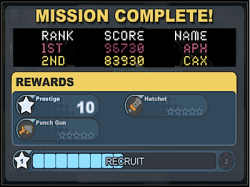
Arguably the most common form of feedback used to measure and communicate player progression is a score: numerical points awarded to a player for successfully performing actions or completing game objectives. Often, achieving a high score is the ultimate goal of the game itself.
A graphical representation of a score is a progress bar. Progress bars are used when a score mechanism has a defined maximum score. Typically, progress bars use a linear function, such that the advancement of a progress bar is directly proportional to the amount of progress that has been completed to that maximum number.
Another common implementation of progression used by game designers is the use of checkpoints, predetermined locations, intervals, or sets of challenges such as missions or quests used as intermediate goals. The playing boundary of many games are segmented into “boss battles” (especially difficult obstacles) or discrete levels to use as checkpoints for measuring and communicating player progress. Even the player’s advancement towards a checkpoint, particularly if the path or sequence required to reach it is relatively linear, is a form of progress.
Many games provide multiple forms of feedback to players about their progression. Role-playing games, for example, will augment a relatively continuous scoring mechanism (usually called “experience points”) with a leveling system, which is a type of checkpoint that recognizes a number of successfully performed actions. In such games, players may be awarded experience points for successfully killing monsters or finding treasure, and after having had a number of such experiences, they “level up”. Like other forms of checkpoints, levels are used by game designers to determine when the player is sufficiently skilled to deal with a more difficult set of challenges.
Another form of progression feedback is the use of achievements: badges, titles, or even resources awarded to the player for successfully completing game objectives. Achievements are useful for recognizing player’s who successfully complete a series of actions that are tangential to the game’s main progression path.
Whatever form of progression you use, it is essential to provide players with a constant sense of progression. If there is any point in your game where the players don’t know what the game’s goals are, or whether or not they are advancing toward those goals, you run the risk of them deciding to progress on to play another game.






 David Mullich