Author Archives: David Mullich
A Tribute To The Marvelous Stan Lee
 Today we lost one of the most prolific and influential creators of pop-culture entertainment, Stan Lee. During an incredibly fertile creative period from 1961 to 1972, he was instrumental in giving birth to Spider-Man, the X-Men, Black Panther, the Mighty Thor, Iron Man, the Fantastic Four, the Incredible Hulk, Daredevil and Ant-Man, among countless other characters. Creating comic books, like video games, is a team effort, so Stan did not do this alone, but with collaborators such as Jack Kirby, Steve Ditko, and other artists and writers. But he was the visionary and face of Marvel Comics, and through his impressive work and enthusiastic promotion of that work, by appearing at comic book conventions and in movie cameos, his vision lives on today and is as popular as ever.
Now, I have to admit that I wasn’t a Marvel fan when I grew up during the Silver Age of comic books. Although I did enjoy the Spider-Man animated series, I preferred reading DC Comics, where the superheroes were more paragons of virtue and impervious, both inside and out. It wasn’t until I grew older (and presumably wiser) that I grew to appreciate what Stan Lee brought to the world of comic books. After all, many of the great talents I admired were fans of Stan’s work, and I took notice that the great writer Harlan Ellison, with whom I had collaborated on a video game adaptation of his short story “I Have No Mouth And I Must Scream”, kept a large Spider-Man toy figure suspended from his kitchen cabinets.
Stan earned the respect of talents in other fields — even receiving the National Medal of Arts from President George W. Bush in 2008 — when he revolutionized comic books by putting the “human” into “superhuman.” As fantastic as his characters were, they were relatable because they had real-world problems like the ones you and I experience. His superhumans had very human frailties. Despite his extraordinary powers, Stan’s most popular creation, Spider-Man, had problems at work, at home and with his girlfriends,enduring many defeats and setbacks, sometimes ones of his own making. He suffered from the awkwardness, self-esteem issues, and dating difficulties that plague every real-life teenager. The other characters that Stan created together with his team of talented artists and writers all battled their inner demons while fighting off supervillains. Because we can relate to these inner struggles, we true believers can learn from them.
Stan made these larger than life characters accessible by having them relate to contemporary society. The X-Men, for example, have served as a metaphor for many groups of people who have been demonized and mistreated for their differences, but have to live in peace with those who hate and fear them. Through Stan’s stories, they became a symbol of hope for the readers who felt demonized and mistreated themselves.
By creating three-dimensional characters who had meaningful things to say about the human condition, perhaps Stan’s greatest achievement was in demonstrating that comics were not merely pacifiers for children, but could be legitimate works of literature. Stan was slow to realize this himself, telling the Chicago Tribune in 2014:
“I used to think what I did was not very important. People are building bridges and engaging in medical research, and here I was doing stories about fictional people who do extraordinary, crazy things and wear costumes. But I suppose I have come to realize that entertainment is not easily dismissed.”
That is an important message for game developers, who for many decades had their works dismissed by mainstream society as being toys for children. Both comic books and video games have millions of fans, and the influence that brings cannot be denied. Stan wrote one of the most famous lines in comics, “with great power comes great responsibility,” and in doing so, he set a very high bar of responsibility for all us other content creators to live up to by inspiring our imagination and challenging us to all use it to make the world a better place. As Stan told Tobey Maguire’s Spider-Man in his cameo in the 2003 Spider-Man film, “You know, I guess one person can make a difference … ’nuff said.”
TheatriX: A Revolutionary Step In Mixed Reality Entertainment Experiences
 One of my oldest friends in the video game industry is David Warhol, who I first met nearly thirty years ago when I hired his company, Realtime Associates, to develop a video game based on the film Dick Tracy when I worked at Disney Computer Software. For as long as I can remember, David has had a keen interest in interactive storytelling and was always seeking to use technology to combine the best of what film and video games have to offer into a unique entertainment experience. Well, today he showed me his ultimate achievement, and despite having recently experienced high-quality mixed reality attractions at The Void and Two Bit Circus, I was blown away by the 360 degree, 3D, fully interactive cinematic experience he demonstrated to me.
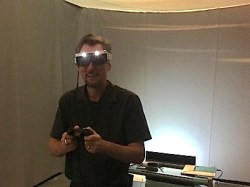 As we entered his TheatriX facilities in Long Beach, California, he told me I was about to enter the world’s largest (and only) retroreflective theater. The venue was covered in retroreflective sheeting, a flexible material primarily used to increase the nighttime conspicuity of traffic signs, high-visibility clothing, and other items so they are safely and effectively visible in the light of an approaching driver’s headlamps. Here, however, the reflected light would be from two tiny projectors built into the headset worn by TheatriX participants.
In the other mixed reality attractions I’ve experienced, I had to spend several minutes gearing up with a cumbersome headset for providing virtual audiovisuals and a heavy backpack for carrying a portable computer. Yet the TheatriX visor that David handed to me was lightweight and took me about as long to equip as a pair of sunglasses. It was tethered to the theater’s computer, but David explained that the theater would soon be using tetherless belt clip systems.
 As I looked through the visor, I found myself transported into a primeval world. A fearsome Tyrannosaurus Rex towered over my head as giant dragonflies buzzed about. Now, I have been transported to fantastic worlds and surrounded by huge monsters before in my recent mixed reality experiences, but the difference here is that my fellow participants were not represented by computer-generated avatars — I could actually see the people in my group , thanks to the environment being created not by virtual reality or even augmented reality, but what is essentially a real-time 3D green screen.
The photo I took through the visor using my iPhone camera does not do justice to the quality of the immersion, but trust me when I say that the results are impressive. My issue with VR experiences has always been my concern with inadvertently crashing into furniture or other people, which is why VR location-based attractions require an employee to always be present to prevent and respond to accidents. Also, by being able to see real people instead of avatars, it made the experience seem less isolated and more social.
 The technology behind this based on the thousands of tiny glass beads that are bonded to the retroreflective material. Instead of simply scattering light, as normal materias do, the retroreflective materials turn the light from the visor projectors around and send a large portion of it back in the same direction it came from, and into the visor wearer’s eyes. While the other participants are beaming images onto the retroreflective sheets at the same time as you, there is little visual spillover from their projections because their reflected images are too dim for you to notice. Your reflective image is much brighter to you (and will be even more so, when glasses coming off the line next month use an optic trick to return 100% of the projected light to your eyes). Currently, the reflected image does not extend to your full peripheral vision, but David tells me that enlarging the field of view that is simply a matter of grinding the visor’s lenses differently.
The next environment that David transported me into was a space station, and for this experience, he handed me a controller that allowed me to pick up objects and move through the scene. The objects looked convincingly three-dimensional when zoomed in through the stereoscopic visors, and I could see how the motion capabilities would be really cool for controlling a boat or other vehicle that was carrying everyone.
I asked David what he ultimately wanted to do with this technology. He explained that he saw TheatriX deployed as venues of two or more 26-foot dome theaters. Although the technology could support an unlimited number of participants, the more participants there are, the less interactivity each would have. So, he proscribes a maximum audience size of 15, with each participant equipped with a 3D visor and controller allowing them to participate in interactive stories, in which the entire audience moves around the theater, interacting with each other and the digital characters and world.
 Rather than basing the experience on first-person shooters like most current virtual reality attractions do, David sees Escape Rooms as being a closer cousin to what he wants to achieve. Audience members would be able collaborate with one another, solving problems, dividing up tasks, and working together, changing to profoundly affecting the story and outcome. And with the lightweight equipment and relatively low operating costs that TheatriX allows, David sees it possible to create highly repeatable, mixed reality experiences ranging from 10 to 90 minutes.
It’s a grand vision, and based on what I experienced today, a very achievable one. I can’t wait to try it when it is fully employed — where can I buy a ticket?






 David Mullich