Monthly Archives: April 2015
Can You Develop A Game With No Experience And No Money?
 Last week my wife sent me the following text message while I was at work, “My friend asked that you call her nephew. He has an idea for a game and needs your guidance. I said that you’d be more than happy to help.”
I groaned and responded, “I’d LOVE to help.” She obviously picked up on my reluctance, because she replied back, “I thought you loved helping people get started in games!”
It’s true, I like helping people get into the game industry. That’s why I spend most of my time these days teaching game production, counseling boy scouts on how to earn their game design merit badge, giving lectures, and writing blogs like this.
However, I cringe when approached by people who say they have an “idea” for a game, but don’t know what to do next next. Invariably, these people have only played games and have no idea of the difficulty involved in making one. Now, the students enrolled in my Game Production program study for thirty-six months, but that only qualifies them to be entry-level designers and developers on a game development team. So, what help can I give to people in a conversation or two that will help someone develop or publish a game when they’ve only had experience playing them?
Still, I don’t want to discourage people from pursuing the dream, and so here’s the advice I gave to my young friend.
First, be aware that having an idea for a game isn’t worth very much, because everyone can easily come up with a game design idea. I give my beginning game design students an exercise of coming up with one hundred game ideas in an hour, and no one has ever had problems completing the assignment. Coming up with an idea is the easy part.
Even so, most people who claim to have a game idea actually only have an incomplete notion of that idea. To show me that you a fully-formed game idea, I would need to know, at minimum:
- the game’s genre (e.g., first-person shooter, real-time strategy, platformer, etc.)
- the game’s theme (e.g., science fiction, fantasy, horror, World War II, etc.)
- what will make it fun to play (will it be fast-paced? leisurely-paced? full of surprises? full of interesting facts? challenging? leisurely? funny? scary?)
- what will make it different or stand out from other games of that genre and them (otherwise, why bother making it?)
What my new young friend provided me with was actually more than an idea. It was a concept document, which describes the story premise and the game’s mechanics (the player’s actions and what they do) in greater detail. Most concept documents are around five to eight pages long, but this one was about a page-and-a-half. This was because some of the mechanics were (briefly) described, but others were not. Ideally, in a concept document, I should get a feeling of the overall play experience, what the game’s goals are, what the player needs to do to achieve those goals, and how the game progresses from beginning to end. The problem with this concept document was one that common with new game designers: it described the game mechanics, but not the dynamics (how each mechanic affects the other) or aesthetics (the experience the player has in playing the game.
It certainly was not a full-blown Game Design Document, which describes how every detail of the game works and why it was designed to work that way. For example, there was a brief mention that there would be a mini-games and computer-controlled characters, but not how they worked. Nor was there any description of the camera perspective, player controls, user interface, art style, or most of the other thousand things a development team would need to know to begin working on the game.
Now, of course, my new friend was admittedly not a game designer, nor was he a developer. His plan was to hire a development team to turn his concept into a reality. However, instead of finding a studio that had experience in game development, he was talking to a company that specialized in general business apps. Okay, the perhaps had the technical skills, but did they know how to make a game. Did they have a game designer on staff who could turn a statement like “each character has the ability to be assigned tasks that produce money and experience” into all the tasks, formulas and numbers that go into the game? Did the company have any experience conducting playtest sessions with players to refine the features and balance the numbers? Who was going to create the art, music, sound effects, and dialog? These were all questions that apparently hadn’t come up in the discussions between the two inexperienced parties.
One question that had asked and answered was, “how much this was all going to cost?” Somehow, with all of these other questions being unanswered, the company had supplied a quote for the project, which was itself a red flag. What complicates the feasibility of the project any further is that my new friend wasn’t planning to fund the project himself because he didn’t have any. So where was the money going to come from, since no developer is going to work for free?
One solution was that friends and family were going to put up some of the money. Well, I hope that they like donating to charity or playing the lottery, because earning your money back when investing in a game project is about as likely as winning the lottery. Only about twenty percent of games made by even veteran game developers earn their money back, and those created by independent and/or first-time developers have even worse odds. So if family and friends want to put money into a game development project, they need to treat it as a gift rather than a loan or investment, because the risk is so large?
So, how about using crowd funding to raise money for the game? Don’t people who fund Kickstarter projects do it without expecting anything in return? Isn’t that a risk-free way to raise money? Well, actually, they do expect something in return — for the project to actually be completed. Very few people will donate to a Kickstarter project without having some assurances that the people behind the project know what they are doing. This means putting together a compelling video that shows that the project is worthy, its developers are experienced, and the plan is well thought out. It also means that sample artwork needs to be created, and ideally, a prototype showing how the completed game is going to work. And all that is going to cost some money.
Even with great presentation, you need to make sure that you have people lined up to view it. It is vital to get contributions coming in from Day 1 of your Kickstarter campaign, because many people won’t contribute until after they see that other people have contributed first. This means that you need to start a marketing campaign to raise awareness for your project though social marketing several months before your Kickstarter campaign actually begins.
Unfortunately, there is no way to avoid risk. Even when raising money through crowd funding, you need to put in both cash equity and sweat equity.
Of course, some people do succeed despite all these odds. And to do that you need four things:
- Passion: You should only be making games because they are driven to do so, because success is very hard to come buy.
- Dedication: You need to put your full energy into it, gaining as much knowledge as you can about what it takes to develop a game and learning from other people’s mistakes.
- Perseverance: You can’t give up despite all the challenges and failures. Game development is a very difficult business and not for the feint-harded.
- Luck: Even if you do everything right, success depends on so many variables outside your control.
So, can you make a game with no experience and no money? Yes, it’s possible. But changes are that you will fail… your first time. And your second time. And your third. But if you have the wherewithal to keep at it, you will eventually gain the experience you need to transform yourself from a noob and eventually become successful.
Gamifying Diversity
 I spend an entire 6-hour day teaching about diversity in my Survey of the Video Game Industry class. The reason I devote one-tenth of the course to this topic is that 79% of responders to the International Game Developers Association’s 2014 Employee Satisfaction Survey said that they believed diversity to be very important to the industry, but only 28% thought that there was equal opportunity and treatment for all in the game industry. That tells me that we have a serious problem, and one step that I can take to work on that problem is to educate my game production students about the need for diversity.
My lab assignment for this topic is to have my students pick prominent game industry veterans belonging to under-represented or potentially discriminated groups — for examples, Gordon Bellamy (openly gay), T.Q. Jefferson (African-American), Jane McGonigal (female), and John Romero (Hispanic) — and do an in-class presentation on their lives and careers.
Because my students all want a career in game development, I am now in the process of gamifying all of my lectures and assignments. Here is what I did to gamify this assignment.
First, I introduced the elements of both surprise and choice into my student’s research subject selection. I hand out a sheet containing just the photographs (no names) of each of the game industry veteran they may use as a research subject. I next have each student either roll dice or draw a numbered slip of paper to determine their selection order. Once the order is determined, I have each student select their subject (with the restriction that no two students allowed to pick the same subject.)
I next tell my students to download a free QR code reader to their smart phones. (Before class, I put up sheets of paper, each with an image of one of the subjects — again, no names — an a QR Code, around the room.) The students then must go to the paper with their subject’s image and then user their smartphone to read the QR Code, which will cause their phone’s web browser to go to a web page I wrote containing a brief biographical sketch about the subject.
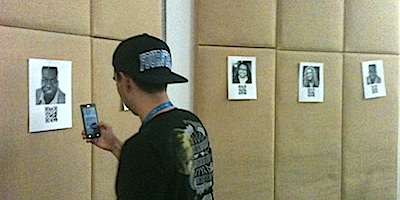
However, this biographical sketch does not contain all the information a students needs to do their presentation. However, it does contain clues for other images related to the subject. These images might be a game the subject worked on, a company he or she worked at, or some other aspect of his or her life. The student then find the images on other sheets I have put up around the room, and beneath each image is another QR Code for them to read with their smart phone. This will lead them to other pieces of information they need to complete their reports.
Once students have collected all the necessary information about their subjects, they must prepare a 5-minute biographical presentation to deliver to the rest of the class in the final hour of the presentation.
I’ve found that students have a lot more fun walking around the classroom and gathering information bit-by-bit using their smartphones and a bit of detective work then when I previously had students sit down at a computer and consult Wikipedia and other sources. And, hopefully, it will make the experience more memorable and the lesson more impactful too.






 David Mullich